
Introduction
Freight brokerages are under pressure from every direction. Carrier costs fluctuate unpredictably, the U.S. truck driver shortage hit nearly 78,000 in 2022 with projections exceeding 160,000 by 2031, and Q1 2024 spot prices ran more than $0.70 per mile below the inflation-adjusted long-run trend.
Meanwhile, moving a single load from origin to destination still requires dozens of manual touchpoints — carrier calls, check-ins, document intake, compliance checks — that consume hours of rep time without requiring a single strategic decision.
The real value of AI automation is what it removes from your operations:
- Missed check calls that create service failures
- First-quote rate acceptance that erodes margin
- After-hours load losses when no one is available to respond
- The staffing math that makes growth expensive
This article breaks down what AI automation actually does in freight and logistics operations, which advantages matter most, and what measurable outcomes brokerages should expect when they implement it correctly.
Key Takeaways
- AI automation covers carrier outreach, load tracking, document processing, and rate negotiation without proportional headcount growth
- Early AI adopters in supply chain management achieved 15% lower logistics costs, per McKinsey
- Platforms like LaneSurf compress the full source-quote-negotiate-vet-book cycle to under 10 minutes per load
- Reactive freight management erodes margin; AI automation catches problems before they compound
- The value compounds: more data processed means more accurate predictions and faster decisions
What Is AI Automation in Logistics?
AI automation in logistics means using AI-powered software to handle tasks that previously required manual effort: carrier sourcing, load tendering, rate negotiation, shipment tracking, document processing, and customer communication. Unlike scripted tools, these systems operate on data, patterns, and learned behavior rather than fixed rules.
That distinction separates AI from traditional automation. A rule-based system follows a script: "if X, do Y." An AI system learns from outcomes, adapts to variable conditions, and improves as it handles more loads. In freight, where carrier pricing, capacity, and load conditions shift daily, that adaptability is the whole point.
Where AI Applies Across the Freight Lifecycle
AI automation touches every stage of the freight workflow:
- Discovers, contacts, and qualifies carriers at scale across load boards and internal databases (carrier sourcing)
- Runs parallel negotiations across multiple carriers simultaneously, holding lane-specific pricing thresholds firm (rate negotiation)
- Checks MC numbers, COIs, authority status, and safety scores before every booking (compliance vetting)
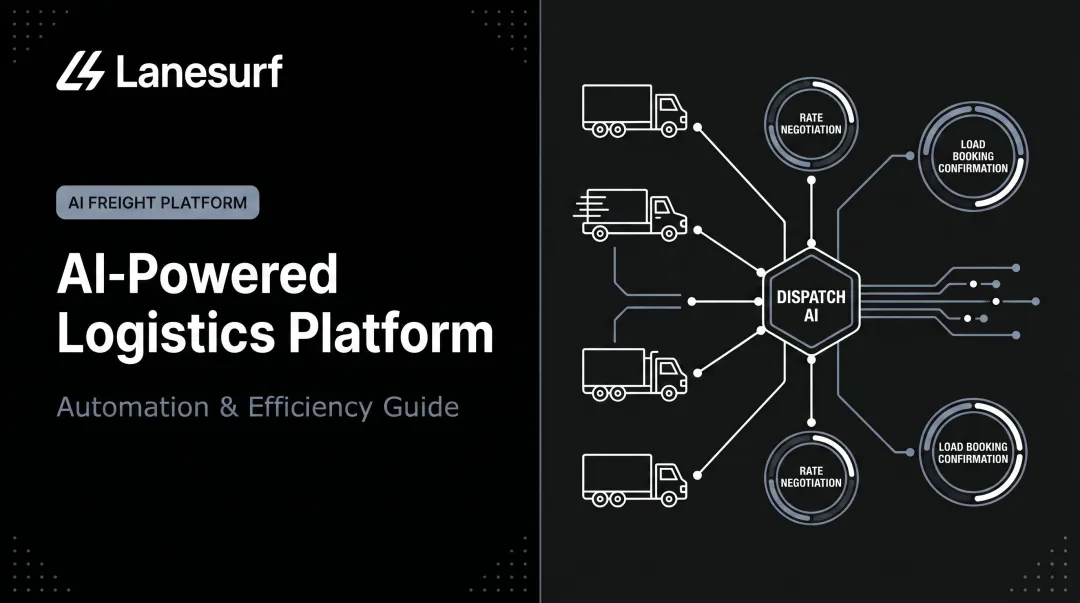
- Executes the full source-quote-negotiate-vet-book cycle without manual rep intervention (load booking)
- Contacts drivers via voice and text for check-calls, ETA updates, and delay detection (shipment tracking)
- Flags at-risk loads proactively, before the shipper calls to complain (exception management)
- Ingests and extracts data from BOLs, invoices, rate confirmations, and PODs (document processing)

The goal is operational leverage: more freight moved, more customers served, better decisions made — without scaling headcount in lockstep with volume.
Key Advantages of AI Automation in Logistics
The advantages below are measured in terms logistics operations actually track: cost per load, carrier response time, load volume per rep, and margin per lane. The largest gains appear when AI runs across multiple steps of the freight workflow simultaneously — not as a point solution dropped into a single task.
Advantage 1: Automating High-Volume, Repetitive Freight Operations
The average freight broker's day is consumed by tasks that don't require judgment: dialing carriers, waiting for callbacks, following up on load status, collecting documents. These tasks are necessary — but they're not where broker skill adds value.
AI automation eliminates this workload at scale. Voice agents dial carriers, confirm availability, negotiate rates within predefined parameters, and update load management systems automatically. C.H. Robinson's AI agents performed over 3 million shipping tasks and reduced email quote response time from hours to an average of 32 seconds. That 32-second response time was previously measured in hours — and it scales without adding headcount.
For freight brokerages, LaneSurf's AI Carrier Sales Agent contacts 10–50 carriers simultaneously per load across voice, email, and text — compressing what a rep would spend 30–90 minutes doing manually into under 10 minutes per load. Reps recapture 4+ hours per day that currently go to outbound calls and check-call follow-ups.
KPIs directly impacted:
- Carrier response time
- Cost per load
- Document processing turnaround
- Broker time on value-add tasks vs. manual tasks
- Inbound/outbound calls handled per hour
When this matters most: High-volume brokerages managing multiple lanes simultaneously, and during seasonal surges when manual call volume becomes impossible to sustain without temporary staffing.
Advantage 2: Smarter Freight Decisions Through Predictive Analytics
Reactive freight management creates cascading consequences: missed delivery windows, spot market overpayment, and customer attrition. Finding out about a delayed load after the shipper calls is already too late. AI shifts the operational mode from reactive to proactive by processing historical and real-time data faster than any manual team can.
According to McKinsey's supply chain AI research, early adopters of AI-enabled supply chain management improved logistics costs by 15% and service levels by 65%. Accenture found companies with the most mature supply chains were 23% more profitable than peers — and six times more likely to use AI widely.
In freight brokerage specifically, predictive AI enables:
- Carrier assignment recommendations based on lane history, on-time performance, and current availability
- Real-time pricing adjustments against live market signals — not last week's benchmarks
- At-risk load flagging before windows are missed, not after
- Route and cost optimization across diverse lane portfolios without dedicated rate analysts

Better carrier selection and tighter pricing discipline on every load adds up across a brokerage's book — particularly on high-volume lanes where manual rate decisions have historically relied on outdated benchmarks rather than live market data.
KPIs directly impacted:
- On-time delivery rate
- Lane profitability
- Spot rate accuracy
- Carrier acceptance rate
- Load exception frequency
When this matters most: Volatile market conditions — rate spikes, capacity crunches, seasonal shifts — and for brokerages managing diverse lane portfolios where manual rate intelligence would require dedicated analysts.
Advantage 3: Scaling Load Volume Without Growing Headcount Proportionally
Traditional freight brokerage growth is linear: more loads require more staff. Every new customer or lane adds to the manual burden. AI automation breaks that constraint.
The BLS reports logisticians earn a median of $80,880 annually, with 26,400 new openings projected per year through 2034. Hiring to absorb volume growth is expensive, slow, and carries turnover risk.
FreightWaves' analysis of mid-market non-asset brokerage economics modeled total service cost before financing at $205 per load — with $150 attributable to payroll. Automating carrier outreach, tendering, and tracking directly attacks that number.
When carrier outreach, load tendering, tracking updates, and compliance vetting are automated, a single broker or coordinator can effectively manage 2–5x the load volume they could handle manually. LaneSurf customer data documents this directly: 60–80% of loads booked with AI-sourced capacity, with the AI running the full booking cycle 24/7 — including overnight and weekends when reps are offline.

KPIs directly impacted:
- Loads handled per broker per day
- Gross margin per load
- Revenue per headcount
- Time-to-tender
- Customer onboarding speed
When this matters most: Rapid growth phases, peak shipping seasons, and when expanding into new lanes without the risk of a large staffing investment.
What Happens When AI Automation Is Missing
Brokerages that rely entirely on manual workflows fall behind. The operational costs pile up fast:
- Carrier response rates drop — manual outreach is slow and inconsistent. Carriers book with whoever calls first.
- Pricing decisions lag the market — spot rate quotes based on last week's data erode margin or lose business to faster competitors.
- Reactive firefighting replaces strategy — teams spend their time resolving exceptions that AI would have flagged hours earlier.
- Growth requires linear headcount increases — every new lane or customer adds direct labor cost, making expansion operationally risky.
- After-hours loads go uncovered — loads that arrive after 6 PM or on weekends don't get booked. That's margin left on the table every week.
Gartner's 2025 Future of Logistics Survey found 14% of supply chain operations still rely on technology-assisted manual processes, while 86% have adopted at least one mainstream logistics technology. That 14% is increasingly hard to sustain — AI-automated competitors keep pulling further ahead on response times and booking throughput.
How to Get the Most Value from AI Automation in Logistics
AI automation delivers compounding returns when embedded across the freight workflow — not when deployed as a point solution for a single task. A few principles that determine whether implementation succeeds:
Start with highest-volume, most repetitive touchpoints first. Carrier calls, driver check-ins, and document intake produce the fastest ROI and free rep capacity immediately. That freed capacity shifts toward relationship-building and deal-closing — work that requires human judgment, not task management.
Track outcomes before and after implementation. Cost per load, loads per rep, and carrier response time should all be measured. If a section of the workflow isn't improving, it needs either better automation coverage or a clearer human-AI handoff point.
Choose platforms built specifically for freight workflows. Generic automation tools require significant customization and often break on the edge cases that freight operations encounter daily — variable carrier pricing, compliance flags, load exceptions. Platforms built for freight — like LaneSurf — integrate carrier call automation, parallel rate negotiation, compliance vetting, and tracking into a single system. That consolidation cuts the integration complexity that typically slows adoption.
LaneSurf's onboarding structure reflects this directly: new customers are live in under 48 hours via an Excel-of-loads fast-start, with full TMS integration completing in under 10 days. The AI works real loads from day one, so results start accumulating before the integration is even complete.
Conclusion
The value of AI automation in logistics shows up in the numbers: lower cost per load, faster carrier cycles, more loads handled per broker, and better pricing decisions made without manual analysis. These aren't theoretical — they're the metrics that determine whether a brokerage is profitable at scale.
The advantages also compound. The more data the AI processes, the more accurately it predicts and recommends. Brokerages that implement AI automation now build a compounding advantage with every load processed. Those that delay will face rising labor costs, slower response cycles, and growing difficulty competing on the speed and responsiveness that win and retain freight customers.
Treat AI automation as an ongoing operational practice, not a one-time technology deployment. The brokerages that scale sustainably are the ones that continuously expand its role across more daily operations — revisiting, refining, and building on what's already working.
Frequently Asked Questions
Which AI is best for supply chain?
The right AI depends on the function being automated. For freight brokerage, purpose-built tools that handle carrier communication and load management outperform general-purpose AI. For broader supply chain needs, platforms with demand forecasting and route optimization are more appropriate.
How does AI automation reduce costs in logistics?
The primary levers are fewer manual labor hours per load, better carrier rate selection through parallel negotiation, lower error rates in document processing, and elimination of overtime costs driven by repetitive communication tasks. Each load becomes cheaper to execute as automation handles the high-touch, low-decision work.
What are the biggest challenges of adopting AI in freight and logistics?
A McKinsey study identified the top barriers as change management (82%), poor process design (70%), and missing capabilities (57%). Integration with existing systems and data quality are additional friction points — cloud-based, freight-specific platforms reduce many of these compared to building custom solutions.
How is AI used in freight brokerage specifically?
The primary applications include:
- Automated carrier outreach and rate negotiation
- Load tracking and driver check-call automation
- Document extraction from BOLs and invoices
- Predictive carrier matching based on lane history and performance data
Platforms like LaneSurf automate the full source-quote-negotiate-vet-book cycle as one integrated workflow.
Can small freight brokerages benefit from AI automation?
Yes. AI automation allows a small team to handle load volumes that would otherwise require additional hires. Subscription-based platforms have lowered the entry cost, and the productivity gains — 4+ hours saved per rep per day, 60–80% AI-sourced loads — are equally meaningful at smaller scale.
What is the difference between traditional automation and AI automation in logistics?
Traditional automation follows fixed rules — "if X, do Y." AI automation learns from data and adapts, enabling it to handle variable situations like dynamic carrier pricing, load exceptions, and shifting capacity conditions that rule-based systems cannot manage. That adaptability is what makes AI useful in freight, where conditions change constantly.