
Carrier management software exists to solve exactly this problem. At its core, it's a digital platform that centralizes everything involved in managing freight carrier relationships — from finding and vetting carriers to comparing rates, tracking shipments, and measuring performance over time.
This guide covers what carrier management software is, how it works, its key features, who uses it, and how to choose the right solution for your operation.
Key Takeaways
- Carrier management software centralizes carrier selection, tracking, rate management, compliance, and performance monitoring into one platform
- Core features include real-time tracking, rate comparison, carrier scorecards, contract management, and workflow automation
- Freight brokerages, 3PLs, shippers, and manufacturers use it — but feature priorities differ by user type
- The software reduces costs, cuts manual work, and improves carrier accountability
- AI-powered platforms like LaneSurf go further by automating carrier calls, rate negotiations, and load bookings without manual intervention
What Is Carrier Management Software?
Carrier management software (CMS) is a digital platform that helps businesses manage every aspect of their carrier relationships — from initial selection and contracting through shipment tracking and performance measurement.
The easiest way to understand the difference: a Transportation Management System (TMS) covers the full freight lifecycle — order management, route planning, financial settlement, and reporting.
Carrier management software is either a standalone tool or a focused module within a TMS. It handles specifically the carrier-side functions: selection, rates, compliance, performance, and relationship workflows.
Gartner defines TMS as software supporting multimodal sourcing, planning, and execution of physical goods transport across the supply chain — including carrier procurement, shipment tracking, freight cost control, and performance management. Carrier management sits within that scope as the dedicated carrier relationship layer.
That definitional overlap matters when you're evaluating software. Some vendors use the terms interchangeably, or bundle CMS capabilities into a broader TMS. Others sell standalone carrier management tools that plug into an existing TMS. Knowing which you're looking at prevents mismatched expectations before you get deep into a vendor demo.
Who Uses It and Why
The organizations that benefit most are those managing multiple carriers simultaneously:
- Freight brokerages — carrier relationships are their entire business model
- Third-party logistics providers (3PLs) — managing multi-carrier networks across multiple shipper clients
- Manufacturers and retailers — controlling outbound freight costs and carrier contract compliance
- E-commerce shippers — tracking deliveries to end customers at scale
Before CMS, all of this ran on spreadsheets, manual rate sheets, and institutional knowledge held by individual reps. According to FreightWaves, 16% of freight companies still rely on Excel and manual phone calls, while 61% use partially automated but disconnected systems. That fragmentation has a direct price: missed loads, margin erosion, and carriers falling through compliance cracks.
How Does Carrier Management Software Work?
The core workflow follows a consistent sequence: a load is created → the system identifies carrier options → the best-fit carrier is selected → the shipment is booked and tracked → performance data is captured post-delivery.

Each stage in that sequence can run with minimal human intervention — here's how the key pieces work.
Carrier Selection and Rate Comparison
When a new load is created, the software pulls carrier options from two sources simultaneously: your contracted carrier database and live spot market rates. It compares options across cost, transit time, service reliability, and capacity — surfacing the best match in seconds rather than hours.
Transport Topics reports that advanced carrier management systems process pricing calculations in 25 to 30 milliseconds. For context, a manual rep working through DAT or Truckstop one carrier at a time might take 30–90 minutes to run the same comparison.
LaneSurf's AI Carrier Sales Agent extends this further — running parallel negotiations with 10–50+ carriers simultaneously across voice, email, and text, rather than working sequentially through a list. The result, per LaneSurf customer data, is 8–10% better buy rates per load compared to one-and-done manual rate acceptances.
Performance Monitoring and Carrier Scorecards
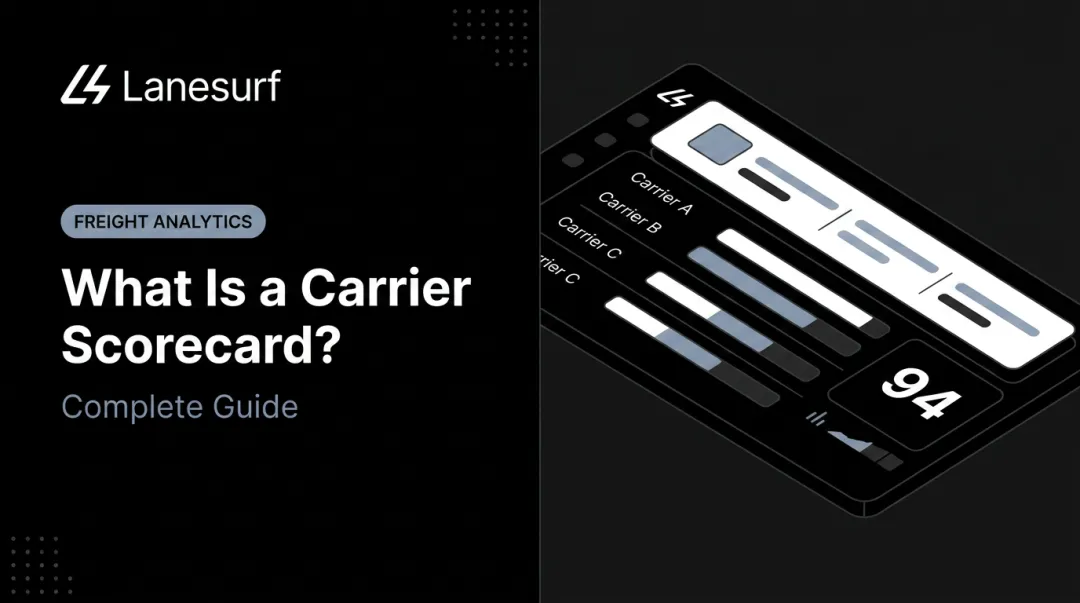
Every completed shipment generates data. Carrier management software aggregates that data into carrier scorecards — structured performance reports that benchmark each carrier against their contractual commitments.
SupplyChainBrain recommends focusing scorecards on 4 to 6 metrics that directly affect operations and customer experience. Key metrics to track:
- On-time pickup and delivery rate
- Transit time accuracy
- Tender acceptance rate
- Claims ratio and resolution time
- Billing accuracy
- Communication responsiveness
Scorecards shift carrier negotiations from subjective conversations to data-driven discussions. When you can show a carrier their 72% on-time rate against a 90% SLA commitment, you're negotiating from a position of fact.
Contract and Rate Management
That same data-driven discipline applies to how contracts are managed. The software stores all carrier contracts, rate agreements, and service-level terms — tracking renewal dates, flagging compliance issues, and automating rate updates. Your team isn't manually maintaining carrier rate sheets in spreadsheets while contracts quietly expire in the background.
Automation Layer
Modern CMS platforms automate repetitive carrier tasks: outreach, booking confirmations, invoice matching, exception alerts. AI-powered platforms take this further.
LaneSurf, for example, automates the entire source-quote-negotiate-vet-book cycle to under 10 minutes per load and handles 200–800 inbound carrier calls per day with an AI Voice Agent. Because the system runs 24/7, loads that would otherwise go missed after hours or on weekends get covered without adding headcount.
Key Features to Look for in Carrier Management Software
Carrier Selection and Rate Comparison
The ability to pull rates from multiple carriers in one view, compare them against defined criteria, and auto-assign the best option. The depth of the carrier network matters — more connections means more competitive options on any given lane.
Real-Time Shipment Tracking and Visibility
Gartner defines real-time transportation visibility platforms as providing near-real-time location and status insights into orders and shipments, with predictive ETAs across transportation networks. True real-time tracking is fundamentally different from milestone-based updates — it enables proactive exception management rather than reactive firefighting.
Performance Monitoring and Carrier Scorecards
Look for platforms that capture shipment-level data automatically and aggregate it into carrier scorecards without manual export work. The four to six core metrics — on-time delivery, transit time, claims ratio, and billing accuracy — should map directly to your SLA commitments.
Contract and Claims Management
The platform should store carrier contracts, flag renewal windows, and track SLA compliance. On claims, the software should cover the full workflow: submission, investigation, and settlement. Unresolved freight claims left in someone's inbox are a direct source of revenue leakage — the right platform closes that gap automatically.
Automation and Workflow Tools
Practical automation in CMS includes:
- Auto-carrier assignment based on predefined rules
- Automated booking confirmations and load tendering
- Invoice reconciliation
- Exception alerts with root-cause context
- Driver check-call automation

The best platforms eliminate manual data entry at every stage of the carrier management workflow — from first outreach through final invoice.
System Integrations
Carrier management software needs to connect with your existing ERP, WMS, OMS, and TMS systems. Native integrations are preferable to manual workarounds — they ensure data flows in real time without creating siloed records. LaneSurf, for example, integrates natively with McLeod, MercuryGate, Tai, Turvo, Revenova, Aljex, and Tailwind TMS, with full TMS integration completing in under 10 days.
Benefits of Carrier Management Software
Cost Reduction
CSCMP's 2024 State of Logistics Report puts U.S. business logistics costs at $2.3 trillion — 8.7% of national GDP. For any business moving significant freight volume, logistics costs are a material line item. CMS drives savings through:
- Rate comparison that surfaces cheaper carrier options on every load
- Automated carrier selection that avoids suboptimal choices made under time pressure
- Data-driven contract negotiations backed by performance scorecard evidence
- Parallel negotiation that eliminates first-rate acceptance patterns
McKinsey research on freight pricing found that carriers and brokers leveraging data for spot-contract allocation decisions could improve EBIT by 15% to 30% — evidence that data-driven procurement decisions create real margin impact.

Operational Efficiency and Time Savings
Tasks that previously consumed hours (carrier outreach, quote collection, booking confirmations, check-calls) compress to minutes with automation. LaneSurf customer data shows 4+ hours saved per rep per day from automating outbound carrier calls alone. For a brokerage running hundreds of loads weekly, that reclaimed time translates directly into capacity for more loads — without adding headcount.
Improved Carrier Relationships and Accountability
Beyond cost and time, how you manage carrier relationships affects service quality over the long run. When performance is tracked objectively and shared transparently, carriers step up to that standard. Carriers who know their on-time rates and claims ratios are being measured tend to perform to that standard. Scorecard data also makes contract renewals more productive — both sides enter with facts rather than competing impressions.
Who Uses Carrier Management Software?
Freight Brokerages
Brokerages are among the heaviest users. Their entire operation — finding capacity, matching loads, negotiating rates — runs on carrier relationships. FMCSA data shows 28,773 registered property brokers in the U.S., with 93.1% classified as small entities. For small to mid-sized brokerages, CMS is how they compete with larger operations without adding headcount.
Brokerages use CMS to manage high carrier volumes, compare spot and contract rates at scale, and track carrier performance across many concurrent loads. AI-powered platforms like LaneSurf enable brokerages to book 60–80% of loads with AI-sourced capacity, freeing reps for higher-value work.
Third-Party Logistics Providers (3PLs)
3PLs manage multi-carrier networks on behalf of multiple shipper clients — often across FTL, LTL, intermodal, and drayage simultaneously. The U.S. 3PL market reached $323.4 billion in 2025, per Armstrong & Associates. For 3PLs, consolidated carrier scorecards and per-shipper configuration (different rate thresholds, tracking rules, and compliance requirements per client) are especially valuable.

Shippers (Manufacturers, Retailers, E-commerce)
Shippers use CMS to control outbound freight costs and manage carrier contracts at scale. The priorities differ from brokerages — instead of optimizing buy-rate margin spread, shippers focus on:
- Reducing total landed cost across all carriers
- Maintaining consistent service reliability for end customers
- Enforcing contract compliance and preferred-carrier routing
Most traditional TMS vendors are built around this use case, which is why brokerage-focused platforms like LaneSurf serve a distinct need.
How to Choose the Right Carrier Management Software
Define Your Use Case First
The right software depends on who you are. A freight brokerage needs strong carrier call automation, parallel rate shopping, and spot booking throughput. A manufacturer prioritizes contract management, compliance, and outbound freight cost control. Before evaluating vendors, build a prioritized requirements list — must-haves versus nice-to-haves.
Evaluate Integration Compatibility and Scalability
The platform needs to fit your existing workflow and connect with current systems. Confirm it integrates natively with your TMS, ERP, and compliance portals — not through manual workarounds.
Then pressure-test scalability: can it handle your peak season load volume? Can it absorb additional carrier relationships or new geographic lanes without requiring a platform change?
Freight brokerages should look for platforms built specifically for brokerage workflows, not generic TMS tools retrofitted for broker use. LaneSurf, for example, functions as a carrier operations layer that sits on top of your existing TMS — adding AI-driven carrier sourcing, call automation, and booking without requiring a platform replacement.

Assess Vendor Reputation and Pricing Transparency
Check reviews on G2 or Capterra, which has verified over 2.5 million software reviews. Request demos from at least two vendors before committing.
On pricing, push for full transparency upfront. Ask about:
- Setup and onboarding fees
- Contract length and renewal terms
- Post-promotional pricing changes
- Usage-based components on top of subscription fees
The promotional rate rarely reflects what you'll pay in year two. Evaluate long-term cost, not just the entry price.
Frequently Asked Questions
What is the difference between carrier management software and a TMS?
A TMS covers the full transportation lifecycle — order management, route planning, execution, and financial settlement. Carrier management software focuses specifically on the carrier relationship layer: selection, contracts, performance tracking, and compliance. It deploys either as a standalone tool or as a dedicated module within a broader TMS.
Who uses carrier management software?
Freight brokerages, 3PLs, shippers, manufacturers, and retailers all use it — but for different purposes. Brokerages focus on carrier sourcing and rate negotiation at volume, while 3PLs manage multi-shipper networks and shippers control outbound freight costs and contract compliance.
What are the most important features of carrier management software?
The core feature set includes:
- Real-time shipment tracking
- Carrier rate comparison
- Performance scorecards
- Contract management
- Workflow automation
Integration capability — connecting to existing TMS, ERP, and compliance systems — is equally critical and often overlooked during evaluation.
Can carrier management software reduce shipping costs?
Yes. Rate comparison tools surface cheaper options on every load, while parallel negotiation prevents first-rate acceptance. Data-driven scorecards then support better contract terms at renewal. Together, these mechanisms create measurable cost reduction across total freight spend.
Is carrier management software suitable for small freight brokerages?
Many modern platforms — including AI-powered tools built specifically for brokerages — are designed to be accessible and scalable. LaneSurf onboards in under 48 hours and scales without requiring proportional headcount growth, making it viable for smaller operations competing against larger players.
How does carrier management software handle carrier performance tracking?
The software captures shipment-level data — on-time delivery, transit time accuracy, claims ratio, and billing accuracy — and aggregates it into carrier scorecards. These scorecards benchmark performance against contractual commitments and support renegotiations and future carrier selection decisions.