
Introduction
Freight rate negotiation is one of the highest-leverage skills in brokerage. Margins are thin—often just 12–18% gross on a load—and every dollar saved on the buy side or earned on the sell side flows directly to the bottom line.
The problem most brokers face isn't a lack of effort. It's a lack of structure. Many approach carrier and shipper negotiations reactively: calling the first carrier on a load board, accepting the first reasonable quote, then moving on to the next load without a second thought. Margin bleeds out one missed negotiation at a time.
This guide covers the full negotiation picture: what drives rates, how to prepare before any conversation starts, and the tactics that consistently improve outcomes. It also covers the mistakes that quietly erode margins—and how AI is changing what's possible for brokers negotiating at scale.
Key Takeaways
- Always benchmark lane rates before negotiating—use paid invoice data, not posted asking rates
- Volume commitments and competing quotes are your two most reliable leverage tools
- Negotiate accessorial fees as a separate line item, not as part of the base rate conversation
- Loads-to-trucks ratio gives you a real-time read on market leverage before you dial
- AI-powered parallel negotiation delivers 8–10% better buy rates compared to one-at-a-time carrier outreach
What Drives Freight Rates: Key Factors to Know Before You Negotiate
Before you can negotiate effectively, you need to understand what's actually moving the number you're trying to change.
The Primary Pricing Variables
Carriers price loads based on a predictable set of inputs. Each one creates room—or closes it—for negotiation:
- Shipment weight and freight class – Critical for LTL pricing. Misclassifying density can inflate your quote before the conversation even starts
- Lane distance and direction – Outbound lanes from major freight hubs are easier to fill; return lanes into secondary markets carry a premium
- Mode of transport – Dry van, reefer, flatbed, LTL, and FTL each draw from different capacity pools with different rate dynamics
- Seasonality – Produce harvests drive reefer demand up; holiday retail surges tighten dry van capacity. A stable 90-day average can hide a seasonal spike coming in the next two weeks

Supply and Demand: The Loads-to-Trucks Ratio
The single most useful real-time indicator of your negotiating leverage is the loads-to-trucks ratio. DAT defines it as posted loads divided by posted trucks—a sensitive, live read on market tightness. When trucks outnumber loads, carriers need volume and your leverage improves. When the ratio climbs, carriers have options and your leverage shrinks.
As of the week ending March 31, 2026, DAT reported a dry-van load-to-truck ratio of 10.6 loads per truck—a market signal that carriers hold meaningful leverage right now on most lanes. Check it before you open a rate conversation.
Accessorial Fees: The Hidden Cost Layer
Base linehaul rates are only part of what you'll actually pay. Detention, fuel surcharges, liftgate fees, and residential delivery charges are separate cost components that often go unnegotiated. DAT identifies these as distinct charge categories that can inflate your total cost well beyond the initial quote. Treat them as a separate negotiation item with their own floor and ceiling.
Pre-Negotiation Preparation: Building Your Leverage
Preparation is where negotiations are won or lost. The broker who walks in with data wins more than the broker who walks in with intuition.
Know Your Shipping Profile and Volume Data
Pull 6–12 months of historical shipment data before any negotiation. The metrics that give you the most leverage:
- Total load volume by lane
- Shipment consistency (how regularly do you move on this lane?)
- Tender-to-book ratio (do you reliably execute what you offer?)
Identify your top 10–15 highest-volume lanes and focus negotiation energy there first. Saving 5% on a lane you run 3x per week is worth 10x more than saving 15% on a lane you touch once a month.
Before any carrier conversation, calculate your cost-per-mile floor for the lane. For example, a 400-mile dry van move with $280 in fixed and variable carrier costs (per Truckstop's cost-per-mile framework) puts the carrier's break-even at roughly $0.70/mile. Any quote well above that floor, relative to market rate, is negotiable ground.
Benchmark Market Rates Before You Open a Conversation
Two benchmarking tools every broker should use before negotiating:
| Tool | What It Shows | Best Use |
|---|---|---|
| DAT RateView | Paid broker/carrier invoice data from $150B in annual transactions | Historical lane-level rates; the gold standard for comparing quotes |
| Truckstop Rate Insights | Daily lane estimates with 4-week and 36-month trends | Spot-checking directional movement on specific O-D pairs |
Understanding the difference between spot and contract rates shapes when and how you negotiate:
- Spot rates reflect real-time supply/demand and can move within weeks — useful for reading market direction before a contract conversation
- Contract rates adjust slowly and typically cover 6–12 month terms — locking in during soft markets protects margin when capacity tightens
- The Coyote Curve model shows spot rates accelerate ahead of contract rates as capacity tightens — if spot is rising, contract renewals 60 days out will face pressure

Timing matters: enter contract negotiations during market softness, when carriers are competing for committed volume. Waiting until renewal falls in a capacity crunch eliminates your leverage before the conversation starts.
Proven Freight Rate Negotiation Tactics That Actually Work
Use Competing Quotes to Create Carrier Leverage
Never enter a negotiation with a single quote in hand. Get at least three before any conversation starts. The existence of competing quotes—even without naming the source—creates natural price tension.
The framing is simple: "I have capacity options at [X], and I'm trying to see if we can make this work with you at [Y] given our lane volume." You're not being adversarial; you're being transparent about the market.
Pair competing quotes with a lane commitment offer. Carriers value predictability — guaranteed minimum shipments per month means they can plan capacity without scrambling for backhauls.
A sample framing: "We typically move 8–12 loads per month on this lane. If we can get to $[X] per load, I'm comfortable making that a standing arrangement for the next quarter." That offer converts a spot negotiation into a planning asset for the carrier, which is worth a rate concession.
Negotiate the Full Rate Picture, Not Just the Base
Experienced negotiators treat accessorials as a separate negotiation item after the base rate is set. Once a carrier has committed to a linehaul rate, fuel surcharge structure, free time, and detention policy become the next conversation — not assumed terms.
Offering expanded pickup windows (6 AM to 2 PM instead of 8 AM exactly) or relaxed transit time requirements costs the broker little but gives the carrier real planning value. Many carriers will move a rate $0.05–0.10/mile for flexibility that makes their routing easier. Ask what that flexibility is worth before you give it away for free.
A useful discipline: aim to ask questions and listen roughly 70% of the time, speak 30%. The point isn't rigid adherence to a ratio — most brokers talk too much and learn too little.
Let the carrier tell you their constraints: empty repositioning, return freight availability, equipment pressure on the lane. That information is your counteroffer.
Protect the Agreement and Set Expectations
Good tactics get you to a number. Written confirmation protects it. Get everything documented before executing the load — a rate confirmation should cover:
- Base linehaul rate
- Fuel surcharge structure (percentage or table)
- Accessorial fees agreed upon (liftgate, detention free time, residential)
- Payment terms
- Any volume commitment clauses

This isn't bureaucratic box-checking. It's the only document that resolves disputes when a carrier bills $150 more than what was discussed.
Common Mistakes to Avoid When Negotiating Freight Rates
Evaluating Rate Per Mile Without Deadhead Context
Rate per mile is not the same as load profitability. A carrier quoting $2.50/mile on a 300-mile lane looks expensive—until you learn there's no return freight in that market and they're running 200 empty miles back.
ATRI reported that empty mileage rose to 16.7% in 2024, with average operating costs at $2.26/mile. That repositioning cost is real, and carriers price it in. Ask about the return situation before treating a high quote as pure negotiating margin.
Overcommitting on Volume You Can't Deliver
Promising 15 loads per month to secure a contracted rate—when your shipper base reliably generates 8—is a trap. Carriers who consistently don't receive the volume they were awarded will price that risk into future bids. One favorable contract rate isn't worth burning a carrier relationship and the leverage that comes with it.
Accepting Terms Without Asking Clarifying Questions
Before finalizing any rate, ask:
- How many stops does this load require?
- What is your detention policy and when does the clock start?
- Does this rate include fuel, or is there a surcharge table?
- What are your payment terms?
- What equipment is available and when?
Each answer can shift the actual margin on a load. Get them before you commit.
How Technology and AI Give You a Negotiating Edge
Use Data Analytics to Enter Every Negotiation Informed
The power dynamic in a negotiation shifts toward the party with better information. Brokers who walk in with lane-level rate trends, carrier performance data, and historical quote records are negotiating from a position of knowledge—not intuition.
Logistics analytics platforms give brokers visibility into shipping patterns, carrier performance benchmarks, and historical rate trends at the lane level. Data-driven transportation procurement has been shown to deliver meaningfully better cost outcomes than reactive, benchmark-free approaches. Brokers who show up with data close at better margins—those who don't are negotiating blind.
LaneSurf's KPI dashboard surfaces lane pricing analytics, carrier performance metrics, and booking throughput data in real time—giving operations teams the pre-negotiation data layer they need without manually exporting CSVs from a TMS.
Let AI Handle Carrier Communication at Scale
The most time-consuming part of freight rate negotiation isn't the negotiation itself—it's the outreach. A rep calling carriers one at a time, waiting for callbacks, and manually tracking quotes can realistically manage a handful of loads per day before hitting a throughput ceiling.
AI-powered tools that automate carrier outreach change the math. FreightWaves reported that LaneSurf's AI contacted 96 carriers simultaneously and booked a compliant carrier in 10 minutes in a documented demonstration—a capability that human reps can't replicate sequentially.
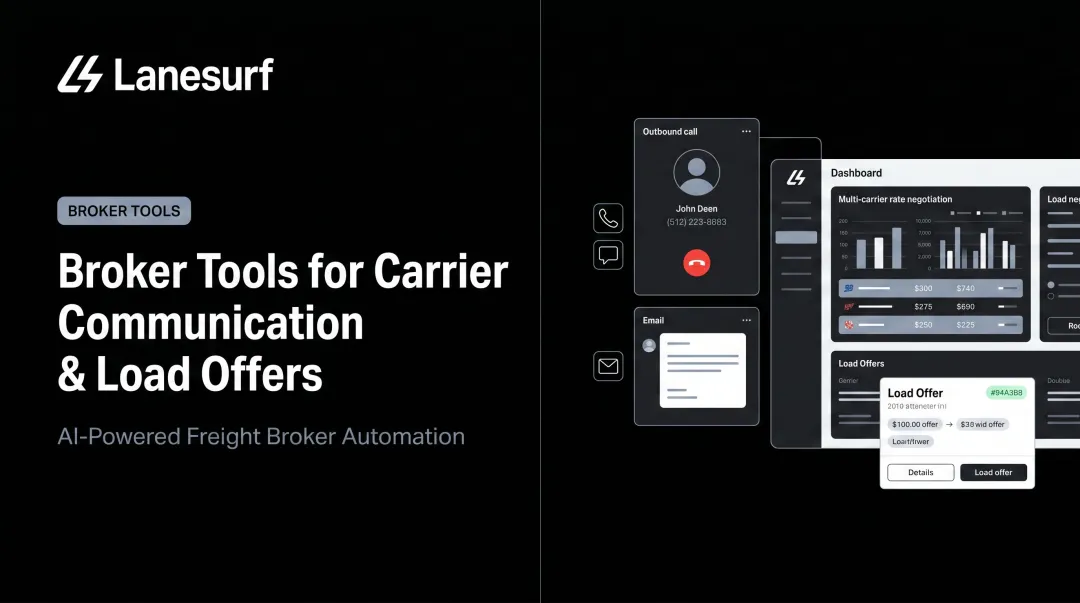
LaneSurf's AI Carrier Sales Agent runs parallel negotiations across voice, email, and text simultaneously. Key capabilities include:
- Enforces lane-specific pricing thresholds—never accepts rates above your defined ceiling
- Operates 24/7, including after-hours and peak periods
- Sources 60–80% of loads without rep involvement
Brokers using the platform report 8–10% better buy rates per load and 4+ hours saved per rep per day.

The structural advantage this creates isn't just speed. It's genuine competitive pressure. When a carrier knows their quote is being compared to 20+ others in real time, they price more competitively. A single rep working the phone sequentially never generates that pressure—and carriers know it.
Keeping Rates Competitive After the Deal Is Done
Negotiated rates have a shorter shelf life than most brokers expect. DAT's analysis suggests the useful life of an annual truckload rate averages around two months before market conditions diverge enough to make it stale—supporting lane-level reviews or mini-bids on high-volume lanes even within an annual contract.
Review cadence: Benchmark contracted lane rates every 6–12 months against current paid invoice data. When market rates drop materially, approach carriers proactively with your shipment volume history and reliability track record—not just a request for a lower number. You're offering proof of value, not asking for a concession.
That benchmark discipline pairs directly with how you manage carrier relationships day-to-day.
Relationship investment pays off in peaks: Carriers who receive consistent volume, accurate paperwork, and payment within 30 days behave differently when the market tightens. Coyote's shipper-of-choice research identifies prompt, accurate payment as especially important for smaller carriers. Those carriers often hold the capacity you need most during surge periods, when primary options are rejecting loads.
Brokers who benchmark aggressively and pay reliably end up with better rates and better access when capacity tightens. The two habits reinforce each other.
Frequently Asked Questions
How do you negotiate freight rates?
Start with market benchmarks and 6–12 months of shipment data, then use competing quotes, volume commitments, and accessorial fee negotiations to build your case. The goal is negotiating the full rate picture—not just the base linehaul—with specific data backing every ask.
What is the 70/30 rule in negotiation?
The 70/30 rule is a listening discipline: spend roughly 70% of a negotiation asking questions and listening, 30% presenting your position. The value isn't the exact ratio—it's that carriers who talk reveal their constraints, empty lane positioning, and flexibility, which gives you better leverage for a targeted counteroffer.
Are trucking freight rates going up?
The Cass Truckload Linehaul Index declined 3.4% in 2024, then rose 1.8% for full-year 2025, with September and October showing consecutive monthly gains. Spot rates softened mid-2025, but rising tender rejections signal tightening effective capacity—not a broad rate surge, but a floor forming.
What factors affect freight rates the most?
Shipment weight and freight class (especially for LTL), lane distance and direction, mode and equipment type, fuel surcharges, and the loads-to-trucks ratio as a real-time supply/demand signal. Accessorial fees compound on top of these variables and are often the least-negotiated cost layer.
How do volume commitments help in freight rate negotiations?
Volume commitments give carriers revenue predictability, which reduces their uncertainty and incentivizes lower per-shipment rates. The key is committing only to volume you can reliably deliver—carriers who don't receive promised volume raise rates on future bids, eliminating the advantage.
When is the best time to negotiate freight rates?
During soft market conditions when spot rates are low and carriers are actively seeking committed volume—or ahead of contract renewals when both parties have an incentive to lock in terms. Avoid negotiating new contracts when the loads-to-trucks ratio is climbing and carriers have more options than they need.