
Introduction
A load is running three hours behind. The carrier hasn't checked in. The receiving dock is already calling your dispatcher — who is simultaneously managing a dozen other active loads, none of which are updating themselves.
That single scenario, repeated across dozens of loads every day, is where freight brokerage margins quietly disappear. The dispatcher spends the next two hours chasing the carrier, confirming the delay, then working back through the notification chain to the shipper and receiver. By that point, the dock appointment may already be gone.
The core problem is structural. Freight brokerages are under pressure to move more loads without adding headcount, yet delay notifications are still handled through manual phone calls that don't scale. ATRI's 2024 research found that 39.3% of all truck stops involved detention over two hours in 2023, generating $11.5 billion in lost productivity industry-wide.
This article covers how AI call bots built for freight operations are automating shipment delay notifications in 2026 — what they do, when they trigger, why voice outperforms passive channels, and what brokerages measurably gain.
Key Takeaways:
- Manual delay notification chains take 10–20 minutes per load — and break down fast at volume
- AI call bots automate carrier check-ins and downstream shipper/receiver notifications without dispatcher involvement
- Event-driven triggers fire the moment a load status changes — not on a schedule
- Voice outperforms email for time-sensitive decisions; both channels serve different notification types
- Operations teams save 1–2 hours per rep per day on check-call and delay workflows with purpose-built AI automation
Why Manual Delay Notifications Are Breaking Freight Brokerages
The Dual-Communication Burden
Freight brokerage creates a notification problem that most industries don't face: dispatchers must contact the carrier first to confirm a delay, then separately notify the shipper or receiver — often while three other loads are competing for their attention simultaneously.
Each manual call chain runs 10–20 minutes when you account for hold times, voicemail, callbacks, and the follow-up to confirm the receiver got the message. At 30 loads per day with a 15% delay rate, that's a full hour of a dispatcher's day spent purely on notification calls — before handling a single load.
The Reactive Spiral
The timing problem compounds the volume problem. By the time a dispatcher:
- Notices the load hasn't checked in
- Calls the carrier to confirm the delay
- Gets through to someone with an actual ETA
- Calls the shipper or receiver with updated information
...the dock appointment window may already be closing. Missed appointments trigger detention charges, rebooking fees, and customer disputes that erode brokerage margins on loads that were already thin.
The Scale Ceiling
Manual delay notification works at 20 loads per day — but it breaks down well before 80, and at 200 it's completely untenable.
The bottleneck isn't dispatcher capability — it's the linear relationship between load volume and the time required to manage exception communications. Each new load added to a dispatcher's plate is another potential delay notification call waiting to happen. Hiring more dispatchers only pushes the ceiling slightly higher before the same problem returns.
The Consistency Gap
Manual notifications depend entirely on who's on shift, how busy they are, and how organized their carrier relationships are. The result is uneven coverage across your customer base:
- High-priority shippers get proactive updates the moment a delay is confirmed
- Lower-tier accounts find out when the dock window has already passed
- After-hours delays often go unnotified until the next business day
That inconsistency is a reputation problem. A shipper burned once by poor delay communication will think twice before renewing — even if your actual on-time performance was average.
Why Portals and Email Don't Fill the Gap
Passive channels — tracking portal status updates, email alerts — don't solve the notification problem. A dock scheduler at a manufacturing plant is on the floor, not watching a portal. Research from Tive and FreightWaves found that only 20% of shippers are satisfied with shipment visibility from logistics providers, and just 4% are "very satisfied" with shipment communications. A delay email that sits unread for two hours means a missed dock appointment, a detention charge, and a shipper who had no chance to reroute — the same outcome as no notification at all.

What an AI Call Bot for Shipment Delay Notifications Does
Automating Carrier Check-Ins for Delay Detection
An AI call bot doesn't wait for a dispatcher to notice something is wrong. When a load hasn't updated its status by an expected checkpoint, the bot initiates an outbound call to the carrier driver or dispatch line directly.
The call collects what a human dispatcher would collect: current location, reason for the delay, and revised ETA. That information is logged back into the load management system automatically — no dispatcher involvement, no callback required.
The bot handles common carrier responses naturally:
- Driver running two hours behind due to traffic
- Load still at shipper awaiting dock release
- Mechanical issue with revised ETA pending
- Weather delay with no confirmed ETA yet
Each response is classified by delay type, which determines what downstream notification gets triggered and to whom.
Automating Shipper and Receiver Delay Notifications
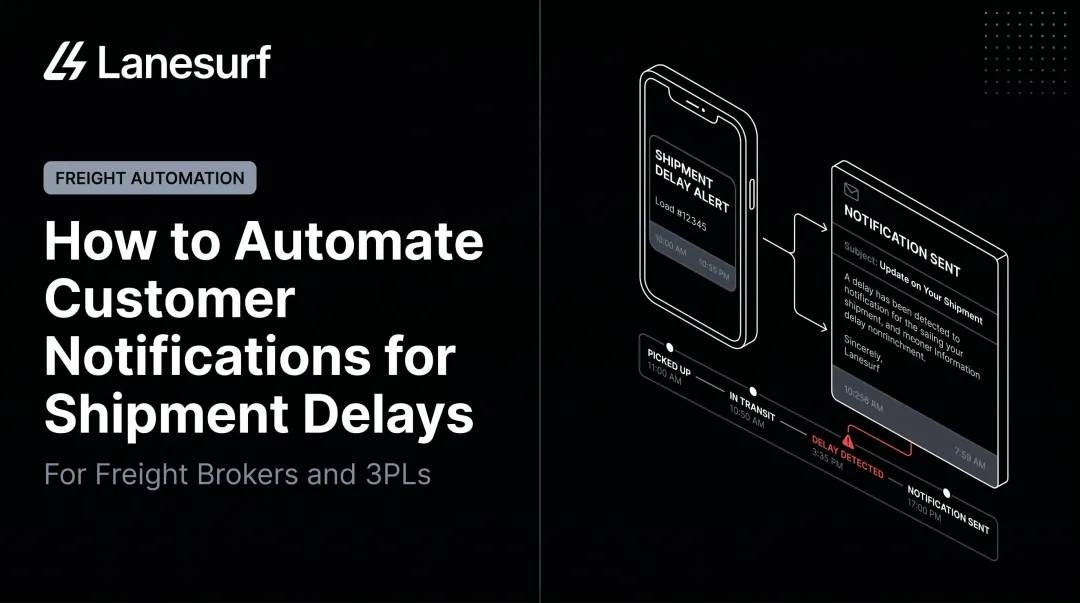
Once a delay is confirmed — either through carrier contact or an automatic TMS status change — the bot immediately places outbound calls to the shipper and/or receiver. The call includes specific load details: reference number, revised ETA, reason for delay if available, and any action options such as rescheduling the dock appointment.
LaneSurf's carrier call automation handles this entire sequence without dispatcher involvement. Operations teams typically spend 1–2 hours per rep per day on driver check-calls and delay-related communications alone; the platform is built to reclaim that time across every load.
When the receiver doesn't answer, the bot doesn't drop the task:
- The bot retries on a configured schedule
- Falls back to SMS for informational follow-up
- Transfers to a live broker when the situation requires human judgment — a shipper threatening to pull the load, a multi-day weather delay, or a rerouting decision
Key Trigger Points: When the AI Call Bot Springs Into Action
Effective AI call bots in freight are event-driven, not scheduled — a check-in call at 2pm is useless if the load missed its window at noon.
Primary trigger events include:
- Carrier hasn't responded by the configured checkpoint time (missed check-in window)
- Tracking platform flags the load behind based on GPS position versus planned route
- Driver submits a delay status via portal or text, which fires the notification workflow
- Recalculated ETA puts the load within a configurable window of missing the receiver's dock appointment

The Approaching-Appointment Trigger
This one matters most for dock-scheduling efficiency. When a load's recalculated ETA threatens a dock appointment, the bot calls the receiver before the truck misses the window — giving them time to hold, reschedule, or make alternative arrangements. A receiver with 90 minutes of warning can reassign the dock door. One with no warning gets a detention invoice.
Multi-Stop Load Handling
For loads with multiple pickup or delivery points, the bot tracks each leg independently. A delay at stop 2 generates calls only to the parties affected at stop 2 and beyond — not a blanket alert to every stop on the load. That specificity keeps downstream contacts from receiving noise they can't act on, which means fewer ignored notifications overall.
Why Voice Beats Email and SMS for Freight Delay Alerts
The Response Rate Gap
Hiya's 2024 State of the Call report, analyzing over 221 billion calls, found that 46% of unidentified calls go unanswered and 77% of people are more likely to answer if they recognize the caller identity. For comparison, Twilio SendGrid's email benchmark across 5 trillion emails found an average unique open rate of just 19.09% — and that's for emails that actually land in the inbox.
For freight delay alerts specifically, the stakes of a missed notification are high. A dock scheduler on the warehouse floor won't see an email for two hours. A missed call shows up on their phone immediately.
Voice Forces Immediate Decision-Making
When a receiver gets an automated call saying their inbound load is four hours late, they have to decide right then: hold the dock appointment, reschedule, or arrange alternatives. An email waits. A call gets answered.
That forced decision-making prevents downstream chaos. The receiver who reschedules at 10am avoids a blocked dock appointment sitting idle at 2pm — and the ripple of delayed departures that follows.
Three situations where real-time voice decisions matter most:
- Dock holds that need same-day confirmation before a window closes
- Carrier swaps where the broker needs a quick go/no-go from the shipper
- Multi-stop loads where one delay reshuffles the entire sequence
Matching Channel to Urgency
Not every freight notification carries the same weight. Voice and text serve different purposes within the same workflow:
| Notification Type | Best Channel | Reason |
|---|---|---|
| Delay requiring dock reschedule | Voice call | Immediate decision required |
| ETA update, no action needed | SMS | Informational, low urgency |
| Pickup confirmation | SMS or email | Reference documentation |
| Multi-day disruption requiring rerouting | Voice → broker escalation | Judgment required |

AI call bots route notifications by urgency and type automatically — voice for decisions, text for updates — within a single workflow.
How AI Call Bots Integrate With Freight Management Systems
The Integration Architecture
AI call bots connect to freight management systems via webhooks and APIs that fire the moment a load status changes. When a load is flagged as delayed, late, or at risk in the TMS, the event automatically triggers the call bot workflow — no manual step, no dispatcher required to notice and act.
The call goes out when the status changes — not when someone gets around to it. That timing gap is exactly where shippers lose confidence in their brokers.
LaneSurf integrates natively with major TMS platforms, with full integration completed in under 10 days:
- McLeod
- MercuryGate
- Tai
- Turvo
- Revenova
- Aljex
- Tailwind
The Data Flow
During a delay notification call, the bot pulls load-specific information from the TMS — reference numbers, shipper and receiver names, scheduled appointment time, current ETA, and carrier contact details. A receiver who hears their actual load reference number and revised appointment time treats the notification as authoritative — not a generic status update.
The receiver's response — confirm the appointment, request a reschedule, escalate to a broker — is logged back to the load record, maintaining a complete audit trail without any manual entry.
Setup Without Heavy IT Involvement
Modern AI call bot platforms for freight don't require months of custom engineering. LaneSurf's platform onboards in under 48 hours, with a pre-integration fast-start option that allows operations teams to submit a load file and begin running AI workflows immediately while TMS integration completes. Trigger conditions, escalation paths, and SOP-tuned communication behavior are configured to match how the brokerage already operates.
What Freight Brokers Gain: Operational Impact
Dispatcher Time Recapture
When AI call bots handle carrier check-in calls and downstream delay notifications, dispatchers shift from reactive call-chasing to managing genuine exceptions. LaneSurf's platform data shows 1–2 hours per rep per day recaptured specifically from check-call and delay communication workflows, as part of a broader 4+ hours saved per rep per day across the full automation suite.
C.H. Robinson's 2025 reporting on their own AI implementation illustrates the scale possible: their AI agents completed over 3 million shipping tasks, with loads accepted in under 90 seconds versus manual email queues that previously took up to four hours — a 30% productivity increase across 2023 and 2024.
McKinsey's analysis of generative AI in supply chain found it can reduce logistics coordinator workload by 10–20%, with documentation lead times cut by up to 60%.
The Scalability Unlock
A brokerage running 50 loads per day and one running 500 loads per day face the same AI call bot workflow. The system scales with load volume automatically during peak periods — no additional staffing required, no coverage gaps on nights or weekends.
LaneSurf positions this directly: mid-market and enterprise brokers managing high freight volumes can achieve 2–5× scaling without proportional headcount growth. Every dispatcher hire that growth would otherwise trigger comes with onboarding time, management overhead, and eventual turnover — costs the AI sidesteps entirely:
- Scales instantly with load volume, no ramp time
- Covers nights, weekends, and peak surges without overtime
- Eliminates recurring hiring and training cycles as the brokerage grows

The Customer Trust Benefit
Shippers and receivers who receive proactive delay calls — even with bad news — respond better than those who discover a load is late when the truck doesn't show.
The Tive/FreightWaves survey of 500+ logistics professionals found that over 80% of shippers want real-time shipment insights and proactive alerts, yet only 20% are satisfied with what they currently receive from their logistics providers. That 60-point gap is where brokerages running automated proactive outreach pull ahead of competitors who still rely on dispatchers to make the call — when they get around to it.
Frequently Asked Questions
What is an AI call bot for shipment delay notifications?
An AI call bot is an automated voice agent that detects delay events in freight shipments and immediately places outbound calls to carriers, shippers, or receivers with specific load details. It handles the full notification workflow — from carrier check-in to shipper and receiver alerts — without requiring dispatcher involvement.
How does an AI call bot know when a shipment is delayed?
The bot connects to the TMS or freight management system via webhooks and APIs. When a load status changes: missed check-in, ETA recalculation, or carrier-reported delay — the event triggers the call workflow in real time, with no manual monitoring required.
Can AI call bots replace human dispatchers for delay notifications?
AI call bots handle the routine, high-volume notification calls: carrier check-ins, shipper and receiver delay alerts. Human dispatchers focus on complex exceptions that require negotiation, judgment, or relationship management — such as multi-day disruptions, shipper disputes, or rerouting decisions.
What types of delay notifications can an AI call bot automate in freight brokerage?
Common trigger scenarios include:
- Carrier missed check-in
- Load running behind ETA
- Dock appointment at risk
- Failed delivery attempt
Each trigger can be configured to notify the right parties — carrier, shipper, receiver, or broker — automatically based on situation type.
How do AI call bots integrate with existing TMS or freight management platforms?
Most platforms connect via webhooks and REST APIs. Setup typically involves mapping load status events to notification triggers within the TMS, then configuring which parties receive calls for each scenario. Responses are logged back to the load record automatically, with no manual steps required.
Is voice better than email or SMS for freight delay notifications?
Voice is more effective when a decision or immediate action is required — such as rescheduling a dock appointment. Email and SMS suit informational updates that don't require an immediate response. AI call bots can be configured to use the right channel based on urgency and notification type within the same workflow.