
Broker-carrier matching platforms address this directly. They replace the "post and pray" load board cycle with automated, active carrier sourcing — connecting brokers to qualified, vetted carriers faster and at better rates.
This guide covers how these platforms work, what benefits they deliver, which features matter most, and how AI is reshaping the category.
Key Takeaways
- Matching platforms actively tender to pre-vetted carriers; load boards passively wait for responses
- Automated parallel outreach compresses the source-to-book cycle from 30–90 minutes to under 10 minutes per load
- MC checks, COI validation, and safety scores run automatically — cutting double-brokering and fraud exposure
- TMS and EDI compatibility determines whether a platform fits your existing workflow — verify both before committing
- AI-powered platforms like LaneSurf can source 60–80% of loads autonomously, saving reps 4+ hours daily
What Are Broker-Carrier Matching Platforms?
Broker-carrier matching platforms are digital systems that automatically connect freight brokers with available, qualified carriers based on load requirements. Unlike traditional load boards — which post a load and wait — matching platforms identify best-fit carriers, reach out, and manage the response cycle without a rep working down a call list.
How the Two Sides Work
The platform connects two operational feeds simultaneously:
- Brokers submit load parameters — lane, equipment type, weight, pickup and delivery windows — via TMS integration or manual upload
- Carriers advertise available capacity, which the platform cross-references against incoming load requirements in real time
Types of Platforms
Matching platforms vary significantly in scope. Understanding the spectrum helps brokers evaluate the right fit:
| Platform Type | What It Does | Best For |
|---|---|---|
| Standalone matching tools | Carrier discovery and tendering only | Brokers with existing TMS workflows |
| Integrated TMS modules | Matching built into the TMS | Teams that want fewer vendor relationships |
| Full automation suites | End-to-end sourcing, booking, tracking, compliance | Brokerages scaling volume without adding headcount |
LaneSurf is a full automation suite, covering carrier sourcing, booking, vetting, tracking, and exception management in a single integrated platform.
How Broker-Carrier Matching Technology Works
The Matching Engine
Platforms ingest load data from a broker's TMS or manual input (such as an Excel upload), then cross-reference it against a carrier database using filters and algorithmic scoring. Factors that typically drive carrier ranking include:
- Lane history and frequency
- Equipment availability and type match
- Proximity to pickup location
- Past performance scores and on-time delivery data
- Compliance status — active operating authority, insurance, safety scores
Uber Freight's matching system, for example, uses a candidate generation stage followed by an XGBoost ranking model that orders carriers by booking probability — ranking carriers by predicted likelihood to book rather than applying binary pass/fail filters.

Automated Tendering
Once the platform scores its carrier list, it initiates outreach automatically. Traditional platforms use waterfall tendering: offer the load to the top carrier, wait for a response within a defined window, then cascade to the next if there's no reply.
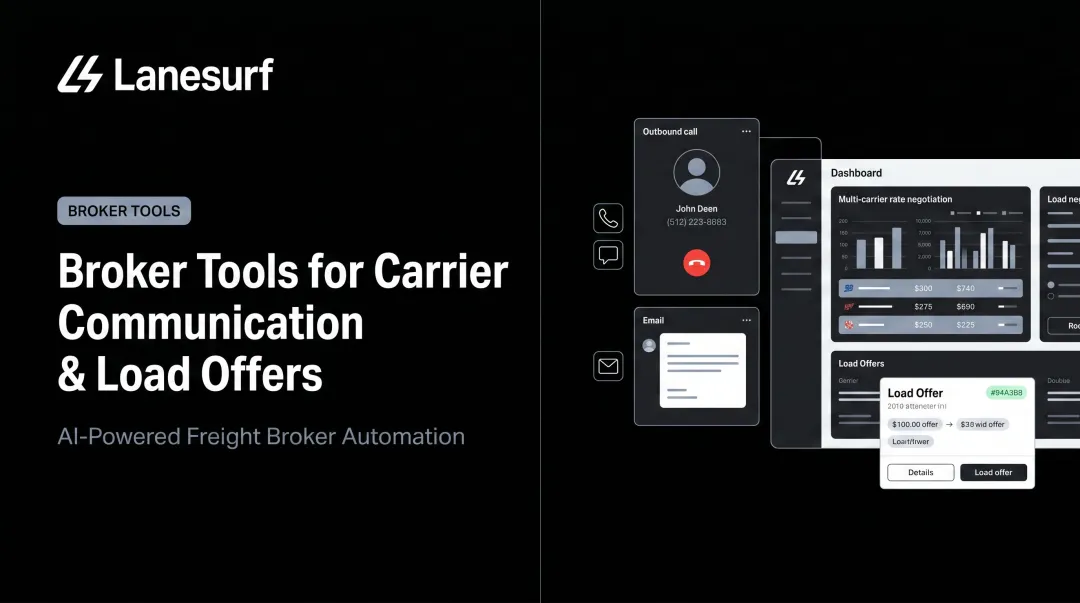
More advanced platforms — including LaneSurf — replace waterfall sequencing with parallel outreach, simultaneously contacting 10–50+ carriers via voice, email, and text at once. This eliminates the waiting time built into sequential tendering and creates genuine rate competition.
Real-Time Capacity Data
Matching accuracy depends on current carrier availability. Most platforms pull capacity signals through:
- Load board integrations (DAT One, Truckstop) for live carrier availability
- ELD data feeds and GPS telematics for truck location and hours-of-service context
- Inbound carrier calls and carrier app check-ins for active availability confirmation
LaneSurf uses load board integrations (DAT One and Truckstop) alongside 24/7 inbound carrier call handling to capture real-time availability. The AI answers inbound carrier calls instantly while ingesting responses from outbound outreach at the same time.
Key Benefits of Broker-Carrier Matching Platforms
Time Savings
Manual carrier sourcing runs on a sequential clock. Reps dial one carrier, wait for a callback, dial the next. The typical source-to-book cycle runs 30–90 minutes per load through manual outreach.
Automated matching compresses that cycle dramatically. LaneSurf's platform collapses the full source-quote-negotiate-vet-book process to under 10 minutes per load by running parallel outreach across multiple carriers simultaneously. Across a rep's daily load volume, that compounds to 4+ hours saved per rep per day in recovered time.
Cost Efficiency
The economics of freight brokerage are tight. With payroll costs at $150 per load and break-even margins requiring $210–$215 per load, every inefficiency in the sourcing cycle directly compresses margin.
Two cost levers where matching platforms deliver measurable impact:
- Parallel rate negotiation prevents one-and-done rate acceptance — the most common source of buy-side margin leakage. LaneSurf reports 8–10% better buy rates per load from running simultaneous negotiations across 10–50+ carriers rather than settling for the first acceptable quote
- Load volume per rep scales without proportional headcount growth — brokerages managing $50M+ in freight can handle more loads per agent as automation absorbs the repetitive outreach work
Risk Mitigation and Fraud Protection
The financial exposure from carrier fraud is substantial. The TIA's April 2025 State of Fraud report found average broker fraud losses of $402,344 per company, with more than 80% of respondents saying insurance companies rarely or never reimburse those losses.
Matching platforms reduce exposure by only surfacing pre-vetted, credentialed carriers. LaneSurf's automated vetting runs before every booking:
- Real-time MC number verification against active FMCSA operating authority
- Automated COI verification with cargo insurance limit validation
- CSA/SMS safety score evaluation
- Auto-flagging when a carrier fails any check, with human handoff and a full audit log per booking

Integration with compliance portals — RMIS, MyCarrierPortal, Highway, Carrier Assure, and Saferwatch — means the platform enforces your existing compliance rules automatically, not a generic standard.
Scalability Without Proportional Headcount Growth
The hardest constraint for growing brokerages isn't load volume — it's rep capacity. A human carrier rep running 50–150 calls per day hits a ceiling. Adding loads means adding reps, which erodes the operating leverage that makes growth profitable.
Matching platforms break that constraint. LaneSurf customers consistently report:
- 60–80% of loads booked with AI-sourced capacity, with the majority of volume running without direct rep involvement
- 24/7 platform coverage, handling after-hours loads that previously went to voicemail
- Overnight booking with full audit context delivered to the team each morning
Must-Have Features to Evaluate in a Matching Platform
Carrier Network Depth and Lane Coverage
Network size matters — but network quality matters more. FMCSA registration data shows over 2 million registered motor carriers in the U.S., but raw count doesn't equal usable capacity. A large, unvetted network creates fraud exposure; a smaller, verified one creates operational confidence.
Questions to ask any platform vendor:
- Are carriers pre-vetted before they appear as match results, or does vetting happen post-selection?
- Does the platform access your existing carrier relationships, or only its proprietary network?
- What happens when no in-network carrier is available — is there overflow access to open market capacity?
LaneSurf sources from both your existing carrier database and connected load boards (DAT One, Truckstop), then vets every carrier through your compliance portal integrations before booking at every stage of the process.
TMS and API Integration
A matching platform that doesn't connect cleanly into your TMS creates more work, not less. Reps end up re-entering data manually, and the supposed automation gains evaporate.
Core integration requirements to verify:
- Native connectors for your specific TMS — McLeod, MercuryGate, Tai, Turvo, Revenova, Aljex, and Tailwind are the platforms most brokers run on
- Full EDI coverage across 204 (load tender), 990 (acceptance/decline), 214 (status update), 210 (invoice), and 997 (acknowledgment)
- Compliance portal connectivity to RMIS, MyCarrierPortal, Highway, and Carrier Assure
LaneSurf completes full TMS integration in under 10 days and offers a pre-integration fast-start using an Excel upload of current loads, so brokers can begin sourcing capacity while the formal integration finishes.
Carrier Compliance and Onboarding Automation
Carrier onboarding is where compliance gaps typically form. Platforms should automate the full onboarding workflow:
- Document collection (W-9, authority docs, broker-carrier agreements)
- COI verification against your specific insurance requirements
- TMS profile setup without manual data entry
- Pre-booking compliance re-verification — not just at initial onboarding
Real-Time Load Tracking and Visibility
Onboarding and compliance set the foundation — but post-booking visibility is where many platforms fall short. Managing tracking in a separate tool fragments the load lifecycle and creates communication gaps. Look for:
- AI-driven driver check-call automation (replaces the 1–2 hours/day reps spend on manual follow-up)
- ETA monitoring with proactive delay detection
- Exception escalation with root-cause context before the shipper calls to complain
Broker-Carrier Matching Platforms vs. Traditional Load Boards
The core difference comes down to who does the work. With a load board, you post and wait — carriers browse, respond on their own timeline, and you negotiate from whatever shows up. A matching platform inverts that: it actively reaches out to pre-vetted carriers on your behalf, runs parallel negotiations, and closes the booking without your team manually driving each step.
When Each Tool Makes Sense
Most brokerages use both, which makes sense operationally:
- Matching platforms as the primary sourcing channel for managed lanes, repeat carrier relationships, and high-volume spot freight where speed and rate discipline matter
- Load boards for spot overflow when in-network capacity is exhausted and open-market access is needed
LaneSurf integrates directly with DAT One and Truckstop — treating them as carrier discovery inputs rather than competitors — so the AI can search and post on existing load board accounts while handling all outreach and negotiation.
Key Operational Trade-Offs
| Dimension | Load Board | Matching Platform |
|---|---|---|
| Speed to book | Dependent on carrier response time | Compressed via parallel automated outreach |
| Carrier control | Open market — any carrier can respond | Pre-vetted, credentialed carriers only |
| Compliance assurance | Manual verification required | Automated checks built into the workflow |
| Rate discipline | Rep-dependent negotiation | Enforced lane-specific thresholds |
| After-hours coverage | None — rep must be available | 24/7 with AI-driven outreach |

Each dimension in that table represents time — time your reps either spend manually or don't. Load boards remain a useful overflow valve. But for brokerages focused on scaling volume without proportionally scaling headcount, a matching platform handles the execution layer that currently sits on your team's plate.
How AI Is Transforming Broker-Carrier Matching
Traditional matching filters carriers against static criteria. AI-powered systems go further: they predict which carrier will accept a load before the tender goes out, then act on that prediction without waiting for a human to initiate contact.
Uber Freight's system illustrates how the underlying technology works: candidate generation followed by XGBoost ranking that orders carriers by booking probability based on signals like prior bookings, home location proxies, and load preferences. The result was a 99% tender acceptance rate, up from 91% in 2018.
AI Carrier Call Automation
The most operationally significant shift isn't smarter matching — it's autonomous outreach. Instead of agents manually calling down a carrier list, AI handles the full communication cycle: outbound calls, rate negotiation, availability confirmation, compliance vetting, and booking execution.
LaneSurf is built around this model. Its AI Carrier Sales Agent works across voice, email, and text simultaneously. Core capabilities include:
- Negotiates rates within lane-specific pricing thresholds
- Executes bookings end-to-end under the brokerage's own SOPs
- Handles volume automatically while human reps manage exceptions and relationships
The AI operates within customer-defined rules: SOPs, lane pricing thresholds, MC vetting criteria, and escalation logic. When the AI encounters an edge case — missing COI, team-driver requirements, unclear rates — it escalates to a human with full context already captured.

The Broader Trajectory
AI adoption in supply chain operations is still early. A 2025 Gartner survey found only 23% of supply chain organizations had a formal AI strategy — meaning most freight brokerages are operating without one. For brokerages that move now, that gap is an operational advantage before the rest of the market catches up.
Frequently Asked Questions
Can I be both a carrier and a broker at the same time?
Yes. With both carrier operating authority and broker authority from the FMCSA, a company can legally operate in both roles. Compliance requirements, liability considerations, and operational complexity all increase significantly when both functions run under the same entity.
What is the difference between a load board and a broker-carrier matching platform?
Load boards are passive posting marketplaces where brokers post loads and wait for carrier responses. Matching platforms actively identify, reach out to, and tender loads to pre-vetted carriers based on scoring criteria, delivering faster coverage and greater control over which carriers are booked.
How do broker-carrier matching platforms vet carriers?
Platforms automate carrier onboarding by verifying insurance certificates (COI), checking FMCSA operating authority status, reviewing CSA/SMS safety scores, and running recurring compliance checks before each booking. LaneSurf integrates with RMIS, MyCarrierPortal, Highway, Carrier Assure, and Saferwatch to enforce your existing compliance rules automatically.
What integrations should I look for in a broker-carrier matching platform?
Prioritize TMS connectivity (via API, native connector, or EDI), load board integrations (DAT One, Truckstop) for carrier discovery, and compliance portal connections for automated vetting. EDI support for message types 204/990/214/210/997 covers the full cycle from tendering through invoicing.
How long does it take to implement a broker-carrier matching platform?
LaneSurf completes platform onboarding in under 48 hours and full TMS integration in under 10 days. A fast-start option (submitting an Excel file of current loads) lets brokers generate value immediately while integration finishes.
How does AI improve broker-carrier matching compared to rule-based systems?
Rule-based systems filter carriers against static criteria but can't contact them, negotiate, or adapt. AI-powered systems autonomously reach out across multiple channels simultaneously, negotiate within defined thresholds, detect edge cases, and learn from historical outcomes, improving match quality and reducing manual intervention with every load.