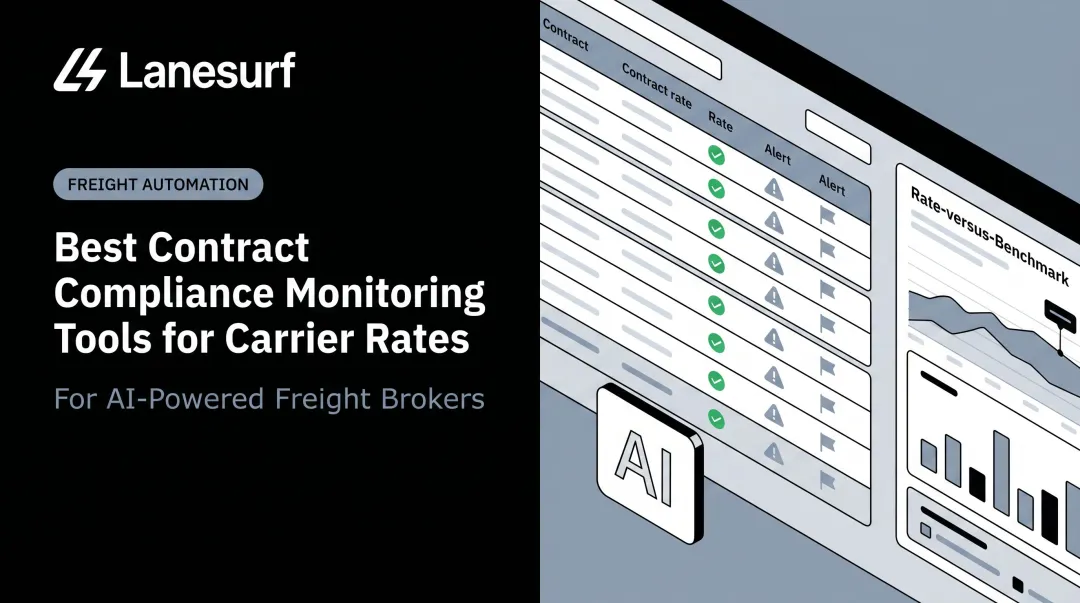

That's why freight contract management isn't an administrative function. It's a revenue protection discipline. According to WorldCC, the average business loses nearly 9% of contract value annually through poor contract management practices — a figure that stings even more in freight, where margins are already thin.
This guide covers what freight brokers need to know: the main contract types, the management challenges that create the most costly blind spots, proven best practices, and what to look for in software.
Key Takeaways
- Freight contracts cover multiple distinct types — broker-carrier agreements, rate confirmations, accessorial schedules, and compliance documents — each with separate renewal and monitoring needs
- Manual management creates compounding blind spots: missed renewals, billing discrepancies, and compliance gaps that erode margin
- Contract centralization, regular audits, and version control turn agreements into operational assets rather than static files
- AI-powered tools automate the most error-prone tasks — document extraction, renewal alerts, compliance verification — before problems reach the billing stage
- Brokerages that align contract terms with live carrier operations close more loads and generate fewer billing disputes
What Is Freight Contract Management?
Freight contract management is the end-to-end discipline of negotiating, executing, tracking, and renewing agreements between brokers, carriers, shippers, and logistics partners. The emphasis on "end-to-end" matters — this isn't document storage. It includes rate monitoring, SLA enforcement, compliance tracking, and renewal management across every agreement type in your carrier network.
Why Freight Contracts Are More Complex Than Standard Business Contracts
A typical freight invoice doesn't just reflect a base rate. It layers on accessorial charges that can push actual costs well above the headline rate:
- Fuel surcharges
- Detention fees
- Liftgate charges
- Reclassification adjustments
Each of those add-ons may or may not be pre-authorized in the original agreement. Without active monitoring, overbilling goes undetected.
Contract leakage — paying more than negotiated rates, missing service credits, or triggering compliance penalties — is the direct result of passive agreement management. The cost adds up. Worst performers in WorldCC's research lose 15% or more of contract value annually through this kind of passive management.
TMS vs. CLM: Why You Need Both
Many brokerages assume their Transportation Management System handles contract management. It doesn't cover the full picture.
| System | Function |
|---|---|
| TMS | Manages active shipments: tendering, tracking, freight audit, performance |
| CLM | Manages the agreements those shipments run on: terms, rates, renewals, compliance |
Gartner's TMS definition covers sourcing, planning, and execution of physical transport. Forrester's CLM framework covers digitization, negotiation, execution, governance, and post-signature lifecycle management. These are complementary systems, not interchangeable ones. When contract data doesn't connect to operational workflows, dispatchers book loads using outdated rates, and nobody catches it until the invoice arrives.

Types of Freight Contracts Every Broker Should Know
Knowing which contract governs which relationship helps brokers negotiate better terms, catch billing errors before they're paid, and prioritize which documents need active monitoring.
Broker-Carrier Agreements
The foundational contract. A broker-carrier agreement establishes base rates, payment terms, liability allocation, cargo insurance requirements, and double-brokering prohibitions. These agreements define what happens when things go wrong. Ambiguous liability clauses rarely surface until a claim is filed.
Under 49 CFR Part 371, brokers must maintain records of every brokered transaction for three years, with each party retaining the right to review. This is a federal requirement, not just a best practice.
Rate Confirmations and Spot Rate Agreements
Rate confirmations are load-specific documents that lock in the agreed rate for a single shipment. They're distinct from long-term contract rates, which negotiate volume commitments in exchange for pricing stability.
- Contract rates: Negotiated for a defined period (typically 12 months), lower per-unit cost, requires volume commitment
- Spot rates: Per-shipment pricing, higher per-unit cost, full flexibility for demand spikes or out-of-network lanes
Brokers typically lean on spot rates when contract carriers decline tenders during tight capacity. The rate confirmation for that spot load is the only document binding the transaction — keep it.
Load Tenders and Bills of Lading
A load tender is the shipment plan: what's moving, where, pickup/delivery windows, and equipment type. A bill of lading is the legal receipt for goods in transit, required under 49 CFR Part 373 for all interstate motor carrier shipments.
Both connect back to the master broker-carrier agreement. Version errors — wrong rate confirmation attached, missing BOL at delivery — create liability exposure that's difficult to resolve without complete documentation.
Accessorial and Surcharge Schedules
Accessorial contracts pre-define extra fees: detention, fuel surcharges, liftgate, inside delivery, reclassification. They exist to eliminate surprise charges, yet accessorial billing is the most common source of freight disputes.
The most common mistake: storing accessorial schedules separately from the parent rate agreement. When a detention invoice arrives, someone has to locate the right schedule for the right carrier at the right rate period.
If those documents are in different folders, the lookup fails. The charge gets paid without verification.
Carrier Compliance Documents
Every carrier relationship requires a compliance packet:
- FMCSA operating authority (active status verification)
- DOT certification and safety records
- Certificate of Insurance with cargo limits and expiration dates
- W-9 for tax reporting
- Signed broker-carrier agreement
These are not one-time onboarding documents. Insurance certificates expire. Authority can be revoked. A carrier operating under lapsed authority mid-shipment creates serious liability exposure, and the broker who dispatched without verifying shares that exposure.

Common Challenges in Freight Contract Management
Version Control and Amendment Tracking
Contracts get updated via email threads, verbal confirmations, and informal addenda. The result: teams frequently operate from outdated terms without realizing it. When a billing dispute surfaces three months later, nobody can confirm which rate version was active on that shipment date.
Amendment logs and timestamped change records aren't just organizational hygiene. They're the evidence that resolves disputes quickly — and in your favor.
Rate Volatility and Reactive Renewals
DAT notes that shippers traditionally conduct RFPs annually, but during volatile markets the average contract life has shortened significantly — in one 2022 period, down to 190 days. Without automated renewal alerts, agreements auto-renew at yesterday's rates while the market has moved in either direction.
The 90-to-120-day renewal window is widely recommended for freight contracts. Miss it, and you're negotiating under pressure rather than strategy.
Data Silos Between Contracts and Operations
A contract stored in an email folder or a static PDF is invisible to the dispatcher booking a load. Negotiated rates and approved accessorial schedules don't get applied if the team executing shipments can't access them. The result is margin leakage on every load where an off-contract carrier gets used or an unauthorized charge passes through billing unchallenged.
Compliance Complexity
Modern broker-carrier agreements increasingly include clauses around driver hours-of-service, cargo securement standards, and environmental compliance (EPA SmartWay participation, for example). Non-compliance penalties apply even when the carrier is technically responsible — because the broker selected and dispatched that carrier.
HOS rules are a case in point: FMCSA caps property-carrying drivers at 11 hours of driving after 10 consecutive hours off duty, within a 14-hour on-duty window. If a carrier pushes those limits and an incident occurs, whether the broker monitored compliance becomes a liability question too.
Common compliance gaps that create broker exposure include:
- Carrier HOS violations on brokered loads
- Missing or expired COI documentation at booking
- Cargo securement standard mismatches for specialized freight
- EPA SmartWay non-participation on environmentally scoped contracts
Best Practices for Freight Contract Management
Centralize Everything in a Single Searchable Repository
This is the prerequisite before any automation is layered on. Every broker-carrier agreement, rate confirmation, compliance document, and accessorial schedule — in one place, with version history and access controls.
The practical test: can a dispatcher, biller, and compliance manager all access the right current document for any carrier within 60 seconds? If not, you have a silo problem.
Establish a Regular Contract Audit Rhythm
Quarterly reviews work well. Each review should:
- Check carrier performance against SLA commitments from the agreement
- Verify accessorial charges on recent invoices match the contracted schedule
- Flag contracts expiring within the next 90-120 days for proactive renegotiation
- Assess whether current rates still reflect market conditions

The output of each review should be a short action list , not a report that gets filed and forgotten.
Automate Renewal Alerts and Amendment Tracking
Every contract needs an assigned owner and an expiration alert set well before the renewal window. Manual calendar tracking fails at scale. Automated alerts that escalate to the contract owner 90-120 days before expiration turn renewal management from reactive scrambling into planned negotiation.
Amendment logs serve double duty: they protect brokers in billing disputes and give negotiators a clear record of what's changed over time.
Connect Contract Terms to Operational Workflows
Negotiated rates only create value if the team executing shipments can access them. When contract data is integrated into booking and billing workflows, dispatchers can see which carriers are compliant, what rates are agreed, and which accessorials are pre-authorized at the point of booking, not after the invoice arrives.
LaneSurf connects directly to this workflow gap. Its carrier operations platform automates carrier calls, compliance vetting, and load tracking, with lane-specific pricing thresholds embedded in the negotiation engine. The AI holds your rate parameters firm across parallel negotiations, which is how LaneSurf customers consistently capture 8–10% better buy rates per load compared to manual booking.
What to Look for in Freight Contract Management Software
Core Document Capabilities
Any freight contract software worth evaluating should handle:
- OCR and document extraction — scanning paper contracts, compliance certificates, and rate confirmations into structured, searchable data
- AI-powered data extraction that pulls key terms — rates, expiration dates, accessorial schedules — without manual entry
- Automated expiration alerts that surface insurance certificates and compliance documents approaching renewal before they lapse
Operational Integration
Contract software that doesn't connect to your TMS means negotiated rates still get looked up manually at booking time. The best freight contract platforms push rate and compliance data directly into booking workflows so those terms are applied automatically — every time.
LaneSurf integrates with major TMS platforms including McLeod, MercuryGate, Tai, Turvo, and others, with full integration completed in under 10 days. A pre-integration fast-start option lets brokerages submit an Excel file of active loads so the AI agent begins working immediately while connectivity is built out.
On the carrier compliance side, LaneSurf connects to RMIS, MyCarrierPortal, Highway, Carrier Assure, and Saferwatch. Before every booking, it runs automated MC verification, COI checks, authority status, and safety score evaluation. Failed checks auto-flag the load and route it to a human before dispatch.

What Separates Contract Software from Document Storage
The features that actually reduce cost and disputes:
- Catches billing errors against negotiated rates before payment — not during a dispute after the fact
- Carrier performance dashboards tracking on-time rates, exception frequency, and compliance history to support data-driven renegotiations
- Version control with timestamped audit trails that resolve disputes quickly and protect the broker when terms are ambiguous
According to a Gartner Market Guide for Freight Audit and Payment Providers, reducing incorrect or duplicate freight bills can save 2%-5% of total freight costs — a meaningful number when applied across high-volume brokerage operations.
Frequently Asked Questions
What is freight contract management?
Freight contract management is the process of negotiating, executing, monitoring, and renewing agreements between freight brokers, carriers, and shippers — covering rates, compliance documents, SLAs, and accessorial schedules. The goal is reducing costs, preventing billing errors, and avoiding disputes through active contract oversight rather than passive document storage.
What are the main types of freight contracts?
The primary contract types brokers work with are broker-carrier agreements, rate confirmations, spot rate agreements, load tenders, bills of lading, accessorial schedules, and carrier compliance documents. Each governs a different piece of the shipment relationship and carries its own monitoring and renewal requirements.
What is the difference between a spot rate and a contract rate in freight?
Contract rates lock in negotiated pricing for a defined period — typically 12 months — in exchange for volume commitments. Spot rates are per-shipment prices negotiated in real time, typically at a higher per-unit cost but with no volume commitment. Brokers use spot rates when contract carriers decline tenders or for lanes outside the contract network.
How do freight billing errors happen, and how can they be prevented?
Billing errors most often occur when accessorial charges, fuel surcharges, or reclassification fees on an invoice don't match the contracted schedule. Prevention requires storing rate agreements and accessorial schedules together, then validating invoices against them before payment — before any dispute is filed.
How often should freight contracts be renegotiated?
Annual renegotiation aligned with renewal dates is standard. That said, significant market shifts — fuel cost swings, major capacity changes — can justify mid-contract discussions on fuel surcharge structures. Renewal alerts are what prompt the conversation before the auto-renewal window closes.
What should freight brokers look for in contract management software?
Priority features include:
- OCR and AI extraction for scanned documents
- Automated expiration alerts for insurance and compliance credentials
- Rate validation against invoices before payment
- Carrier performance tracking
- Integration with your existing TMS and carrier compliance portals
Software that operates as a standalone silo, without connecting to booking workflows, solves the storage problem but not the operational one.