
Introduction
Freight brokerage has undergone a genuine operational overhaul. Tasks that once required hours of phone calls, spreadsheet management, and manual carrier outreach now run through automated platforms that match loads, track shipments, and process settlements with minimal human intervention.
The numbers reflect how quickly this shift is happening. According to Grand View Research, the US digital freight brokerage market stood at $2.03 billion in 2024 and is projected to reach $8.42 billion by 2030 — a 27.3% CAGR. That pace signals a fundamental shift in how freight operations are built and run — not just a technology upgrade layered onto existing workflows.
For many logistics professionals, though, the mechanics behind these platforms remain murky. Knowing the market is growing doesn't explain how the technology actually works, where it delivers real value, or where it still falls short. This guide covers all three — in practical terms.
Key Takeaways
- Digital freight brokers use algorithms and automation to connect shippers with carriers, replacing manual phone-and-spreadsheet workflows
- The process follows four stages: load submission, carrier matching, in-transit tracking, and settlement
- Automation delivers measurable gains: faster matching, lower overhead costs, real-time shipment visibility, and around-the-clock coverage
- Standard truckload freight benefits most; complex or specialized loads still require experienced broker oversight
- Top brokerages pair automation with experienced agents who manage exceptions and carrier relationships
What Is a Digital Freight Broker?
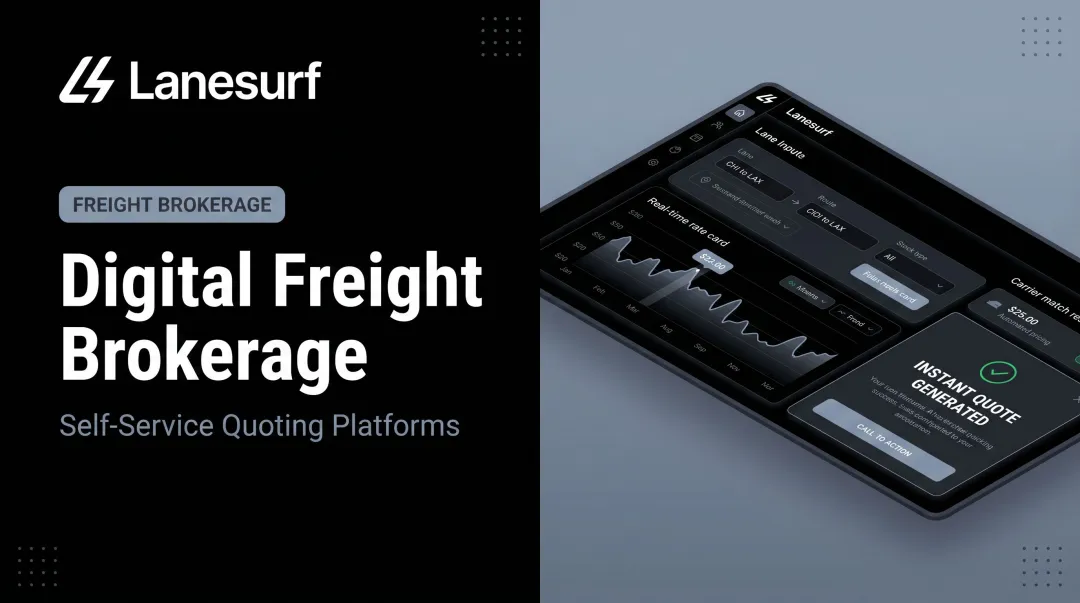
A digital freight broker is an online platform — accessed via web or mobile — that uses algorithms to match shippers with carriers based on load requirements, location, equipment availability, and historical performance. The platform handles matching, pricing, documentation, and communication in a single workflow — replacing the manual outreach that traditional broker agents perform one call at a time.
How It Differs from a Load Board or TMS
These three tools are often confused, but they serve very different functions:
- Load board: A passive listing tool. Shippers post loads; carriers search and reach out. No active matching occurs. FreightWaves describes load boards as digital bulletin boards, contrasting them with platforms that actually perform the match
- Digital freight broker: Actively facilitates matching, pricing, communication, documentation, and sometimes tracking within a single workflow
- Transportation Management System (TMS): Manages a company's internal logistics operations — it doesn't connect external shippers and carriers the way a broker platform does
Why Digital Brokerage Emerged
Traditional brokerage required agents to source carriers by phone — one call at a time, during business hours, with no parallel processing. That model created predictable bottlenecks:
- Slow coverage during freight surges
- Missed loads after business hours
- Rates set by the first available carrier, not the best one
Digital platforms were built specifically to remove those constraints.
How Does a Digital Freight Broker Work?
Digital freight brokerage follows a defined four-stage sequence — load submission, carrier matching, in-transit tracking, and settlement. Each stage has a distinct automation profile, with some nearly fully automated today and others still requiring human judgment.

Load Submission
The process starts when a shipper enters load details into the platform: pickup and delivery locations, freight type, weight, dimensions, timeline, and any special handling requirements.
For brokerages using a TMS, this step is often automated. Platforms like LaneSurf integrate natively with McLeod, MercuryGate, Tai, Turvo, and other major TMS systems — syncing load data directly rather than requiring manual re-entry. After a load is booked, confirmed details flow back to the TMS, closing the loop without manual intervention.
Data quality at this stage is critical. Incomplete or inaccurate submissions degrade matching accuracy downstream and create coverage delays that ripple through the rest of the workflow.
Carrier Matching and Communication
With load data in hand, the platform's algorithm filters its carrier network against the submitted parameters — evaluating proximity, available capacity, equipment type, safety ratings, and historical performance to surface qualified candidates.
This is where the gap between traditional and digital brokerage is most visible. A human rep dials carriers sequentially, waits for callbacks, and often accepts the first reasonable rate due to time pressure. Automated platforms contact multiple carriers simultaneously across voice, email, and text.
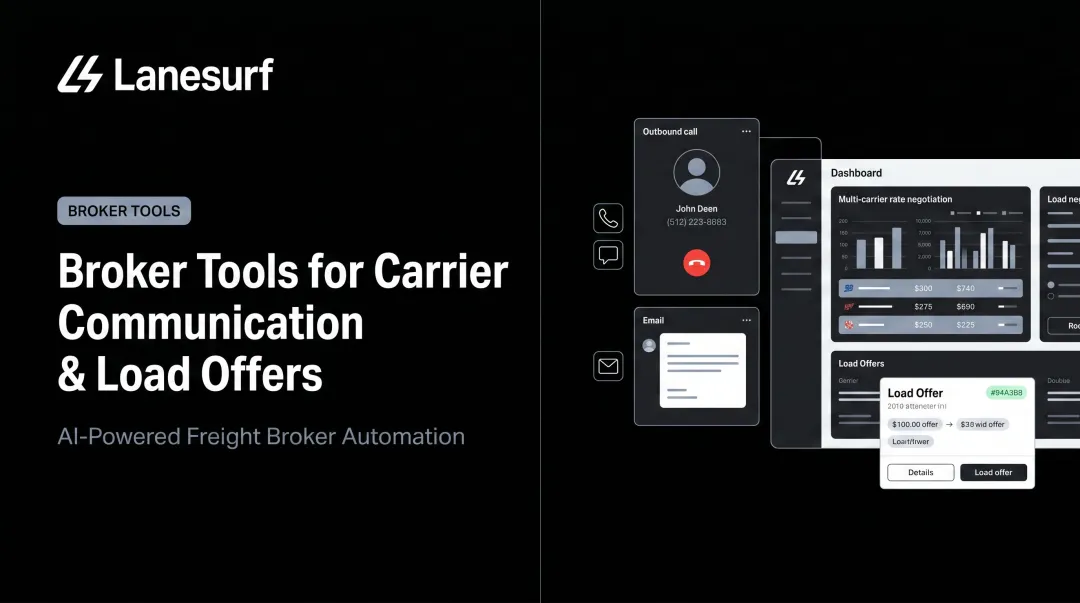
LaneSurf's AI Carrier Sales Agent takes this further, running parallel outreach and concurrent negotiations against lane-specific pricing thresholds. Per LaneSurf customer data:
- Contacts 10–50× more carriers per hour than a single rep
- Sources 60–80% of loads via AI without manual intervention
- Delivers 8–10% better buy rates per load vs. sequential negotiation
- Completes the full source-quote-negotiate-vet-book cycle in under 10 minutes

In-Transit Tracking and Oversight
After a load is accepted, the platform maintains shipment visibility through GPS integrations, EDI/API connections, and driver communication. A 2023 FreightWaves/Tive survey of over 500 logistics professionals found that only 20% of shippers were satisfied with visibility from their logistics providers, and over 80% wanted real-time shipment insights.
Real tracking infrastructure addresses this gap directly. FourKites reports users see a 65% decrease in internal "where is my truck?" calls after deploying visibility tools.
Exception management is where purely automated platforms have historically struggled. LaneSurf handles this through AI-driven driver contact: when a deviation is detected, the system contacts the driver via voice or text to gather root-cause context, then escalates to the appropriate team member with full situational detail. The goal is to surface problems before the shipper calls to complain.
Delivery Completion and Settlement
Upon delivery, the platform captures proof of delivery, manages related documentation (BOLs, rate confirmations, PODs), and prepares a settlement-ready handoff to the TMS and downstream ERP systems.
LaneSurf's EDI integration covers the full standard freight document flow:
| EDI Message | Function |
|---|---|
| EDI 204 | Load tender |
| EDI 990 | Carrier acceptance or decline |
| EDI 214 | In-transit shipment status |
| EDI 210 | Freight invoice |
| EDI 997 | Functional acknowledgment |
Faster settlement improves carrier satisfaction and retention. Digitized delivery records reduce disputes and support freight audit processes downstream.
Key Advantages of Digital Freight Brokerage Platforms
Efficiency and Speed
Automated matching and carrier communication cut load-to-coverage time dramatically. project44's Autopilot AI agents reported up to 75% faster sourcing cycles and a 70% reduction in manual coordination — concrete evidence of what parallel automation delivers over sequential human workflows.
Lower Overhead Per Load
Digital platforms carry fewer operations staff per load moved. Automation handles the high-frequency, repetitive work at a cost structure that scales with volume rather than headcount. That includes carrier calls, quote collection, and compliance checks. For brokerages adopting AI automation internally, this translates to competitive spot rates for shippers and improved margins without proportional hiring.
Real-Time Visibility
Embedded tracking and API integrations give shippers, carriers, and brokers a single accurate view of shipment status. The practical benefits:
- Reduced check-call volume for operations teams
- Proactive customer communication rather than reactive problem management
- A full data trail for claims, disputes, and freight audit processes
Carrier Network Scalability
Manual teams can only manage so many active carrier relationships. Automated outreach platforms remove that ceiling — simultaneously contacting far more carriers per load than any human team can sustain. That capacity matters most when markets tighten or when a lane has fewer available carriers to begin with.
Data-Driven Decision-Making
Every transaction on a digital platform generates structured data. That data — covering lane pricing trends, carrier performance scores, and delivery timing — feeds directly into better future decisions.
Patterns that are invisible in manual operations become measurable and actionable at scale:
- Identify underperforming carriers before they affect service levels
- Spot lanes where market rates have shifted and adjust pricing accordingly
- Track rep-level booking metrics to surface operational bottlenecks

Uber Freight's AI load recommendation system, which uses XGBoost-based matching, reported a 12% increase in bookings for active users — a tangible example of data improving match quality over time.
Where Digital Brokerage Falls Short
Complex and Specialized Freight
Most digital matching platforms are optimized for standard dry van truckload moves. Temperature-controlled, oversized, hazmat, and time-critical freight typically require:
- Specialized carrier relationships built over years
- Contextual judgment about carrier suitability beyond what algorithm inputs capture
- Hands-on problem-solving when things go wrong mid-transit
Truckstop data puts this in context: there are roughly 1.7 million dry van trailers in the US compared to approximately 400,000 refrigerated units. Reefer, flatbed, and hazmat represent smaller, more specialized carrier pools where automated matching has less data density and human relationships carry more weight.

Exception Blind Spots
Automation performs well in predictable conditions. Disruptions — missed pickups, damaged freight, route changes, weather events — require real-time human intervention. Platforms that lack accessible human support infrastructure leave carriers and shippers without clear recourse when exceptions escalate.
Convoy's restructuring in early 2023 illustrated this tension directly. As the platform transitioned toward an automated customer service model, it cut staff and closed offices — leaving some users without clear resolution paths during disruptions.
Convoy closed entirely in October 2023, with CEO Dan Lewis citing "a massive freight recession" and capital market contraction. Flexport subsequently acquired Convoy's technology assets.
Removing human oversight entirely creates brittleness that disruptions expose. Automation works best when human escalation paths remain intact.
Pricing Sustainability and Platform Risk
The Convoy story also illustrates a second risk: unsustainable pricing models. Several early digital brokerages used below-market rates to acquire volume — Convoy's 2020 Guaranteed Primary program promised 100% tender acceptance and claimed shipper cost reductions of up to 50% versus industry averages. That model required absorbing losses whenever machine learning cost predictions missed. It proved unsustainable.
Brokerages building their capacity strategy around a single digital platform carry real counterparty risk — meaning if that platform pivots, scales back, or exits, coverage gaps appear immediately. Strategies that reduce this exposure include:
- Maintaining internal carrier relationships alongside platform access
- Distributing volume across multiple sourcing channels
- Avoiding exclusive dependency on any single platform for critical lanes
Conclusion
Digital freight brokerage works best as an operational layer — one that automates the high-volume, repetitive tasks in carrier matching and communication so broker teams can focus on relationships, exceptions, and the complex freight scenarios where human judgment matters most.
Brokerages that treat automation as an operational layer within their existing workflow, rather than a wholesale substitute for their team, are best positioned to scale without sacrificing service quality. Tools like LaneSurf are built for exactly this model. The platform handles carrier calls, parallel negotiations, compliance vetting, and exception escalation under customer-defined SOPs — so the AI runs the execution layer while human agents handle what algorithms can't.
The most effective digital freight operations aren't simply the most automated. They're the ones that draw a clear line between execution tasks the AI owns and judgment calls the person makes — and build their workflow around that distinction.
Frequently Asked Questions
What is the difference between a digital freight broker and a traditional freight broker?
Traditional brokers rely on human agents using phone, email, and TMS tools to source and manage loads manually. Digital freight brokers use algorithms and automated platforms to handle matching, communication, and tracking. Leading brokerages today blend both — using automation for volume and human agents for complex or exception-driven freight.
How do digital freight brokers make money?
Digital freight brokers earn a margin between what shippers pay for a load and what they pay carriers — the same model as traditional brokers. Automation reduces per-transaction costs, allowing them to operate competitively at higher volumes without proportionally scaling headcount.
What technology powers digital freight brokerage platforms?
Core technologies include load-matching algorithms, GPS tracking integrations, EDI/API connections for TMS integration, mobile apps for carrier communication, and increasingly AI for pricing, carrier outreach, and exception management. Standard EDI message types (204, 990, 214, 210, 997) handle structured document exchange between brokers, carriers, and shippers.
Are digital freight brokers suitable for all types of freight?
Digital platforms work best for standard truckload freight — dry van in particular. Specialized modes such as refrigerated, oversized, hazmat, or complex LTL typically require brokers with dedicated carrier relationships and hands-on operational expertise that automated systems cannot replicate.
What are the biggest challenges facing digital freight brokers today?
Key challenges include maintaining service quality at scale, managing exceptions without sufficient human support infrastructure, sustaining profitability beyond initial growth phases, and platform concentration risk for brokerages dependent on a single digital tool.
How does AI improve digital freight brokerage operations?
AI automates high-frequency tasks — carrier outreach calls, parallel rate negotiation, compliance vetting, and exception detection — reducing manual workload per load and improving response times. Brokerages can handle higher volumes with the same team size. Parade's CoDriver platform reportedly generated 27% more quotes from the same call volume after deploying AI carrier communication tools.