
Introduction
Delayed shipments, carrier no-shows, missed pickups, failed handoffs — these aren't occasional disruptions in freight brokerage. They're Tuesday.
The operational cost is real. According to ATRI's 2024 research, drivers were detained in 39.3% of all stops in 2023, costing the trucking industry $3.6 billion in direct expenses and $11.5 billion in lost productivity. Detention is just one exception category — and it alone is catastrophic at scale.
Most brokerages have visibility tools. That's not the problem.
The problem is that detecting an exception and actually resolving it are two entirely different things. Resolution still means a dispatcher picking up the phone, chasing a carrier, updating a spreadsheet, and hoping the shipper doesn't call first. That model holds under normal volume. It breaks the moment volume grows.
This guide covers exactly how AI agents change that equation — from detection through triage, carrier communication, and resolution — and where brokerages see the fastest, most concrete operational gains.
Key Takeaways
- Logistics exceptions are routine, not edge cases — manual resolution workflows can't scale with load volume
- AI agents detect exceptions continuously — before shippers notice, not after a rep checks a dashboard
- Automated carrier outreach eliminates the phone chain — the most time-consuming step in exception resolution
- Triage automation ensures ops teams focus on high-risk loads, not every alert equally
- LaneSurf handles exception detection, carrier outreach, and load management from one connected workflow
What Is Logistics Exception Handling — and Why Does It Fail?
A logistics exception is any shipment event that deviates from the plan — missed pickup window, carrier running three hours behind, driver going dark mid-route, freight refused at delivery. Exception handling is the process of detecting that deviation, classifying what went wrong, and resolving it before it becomes a service failure.
It exists as a distinct function because freight touches too many parties, carriers, and conditions for the plan to survive contact with reality. Exceptions aren't failures of planning. They're a routine feature of freight operations.
Exception handling is distinct from shipment tracking or TMS alerts. An alert tells you something changed. Exception handling requires you to decide what to do about it — who to call, what to rebook, how to update the shipper, whether to escalate. That's active decision-making, not passive visibility.
Why Manual Exception Handling Breaks Down
The failure modes of manual exception handling tend to cluster around three problems:
- Late detection — ops teams often find out about a delayed load when the shipper calls to complain, not when the delay starts
- Inconsistent response — different brokers handle the same exception type differently, creating uneven service quality and no institutional learning
- Labor misallocation — dispatchers spend significant time on low-value coordination work (check calls, status chases, update emails) rather than judgment-intensive decisions
A 2025 FreightWaves report found that 68% of brokerages experienced financial stress over the prior year, with only 2% achieving full back-office automation — a clear signal that manual processes remain the norm, with real economic consequences.
How AI Agents Handle Logistics Exceptions
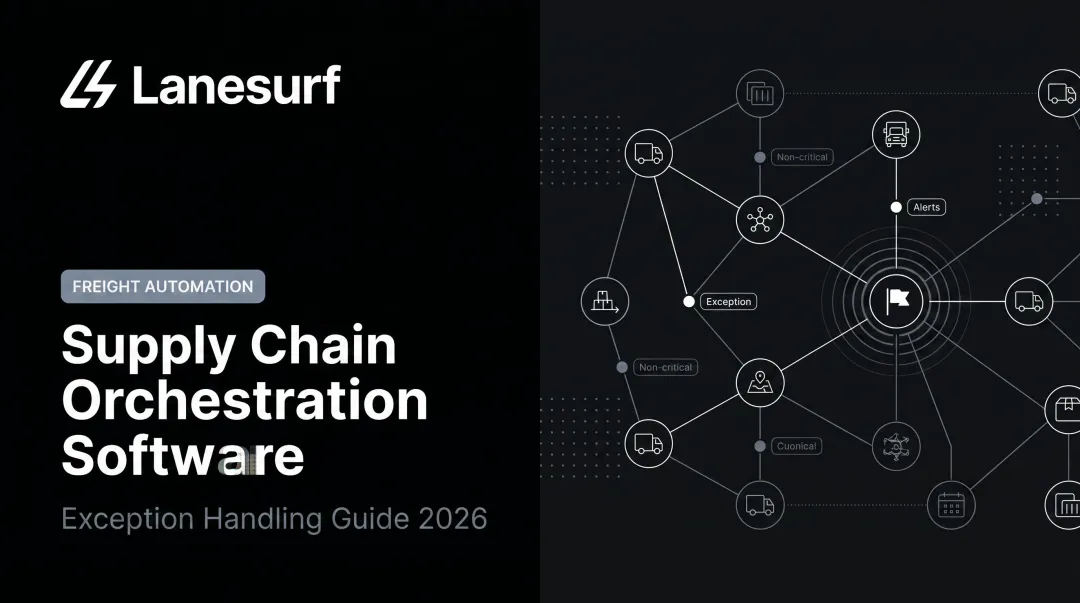
AI agents handle exceptions through a defined sequence: continuous monitoring, detection, classification, automated response, and human escalation. Each stage reduces the time and labor required at the next.

Exception Detection
AI agents monitor live data — TMS milestone feeds, ETA thresholds, driver check-in cadence, and carrier communication patterns — to identify deviations before they become confirmed failures. The key distinction is that detection is continuous and condition-based, not dependent on a human opening a dashboard and noticing something is off.
LaneSurf's exception detection, for example, contacts drivers directly via voice and text to capture real-time status rather than waiting passively for a tracking signal to disappear. When a carrier goes dark or an ETA starts slipping against configured thresholds, the system flags it — before the shipper is aware anything is wrong.
Early detection keeps resolution options open. By the time a customer calls to ask where their shipment is, the only thing left to do is manage the fallout.
Triage and Prioritization
Not every exception carries the same risk. A minor delay on a low-priority lane is not the same as a missed pickup on a time-critical shipment with a tight SLA. Without automated triage, every alert lands in the same inbox with the same urgency — which means dispatchers spend time on low-stakes exceptions while high-stakes loads wait.
AI agents classify exceptions by severity, load value, customer SLA exposure, and time sensitivity. Routine exceptions move through automated resolution workflows in the background, while genuinely complex situations surface to the right person with the right context already attached.
LaneSurf's triage logic is governed by configurable SOPs and per-lane tracking rules — brokerages define the thresholds, and the AI executes within them consistently.
Automated Resolution and Carrier Communication
Once an exception is classified, the AI agent initiates resolution. For the most common exception types — carrier delays, tracking gaps, ETA deviations — that means automated carrier outreach deployed as fast as possible:
- Voice calls, SMS, and email deployed in parallel to reach drivers or carriers immediately
- 10–50× more carriers contacted per hour than a manual rep workflow
- 24/7 coverage with no gaps on nights or weekends
Carrier communication during exceptions — the check calls, the status chases, the rebook conversations — is the most time-consuming part of exception handling in freight brokerage. LaneSurf automates this entire cycle.
Every interaction is logged automatically: call records, status confirmations, ETA updates, and root-cause context. Each shipment ends up with a complete audit trail, without anyone manually writing up notes.
Escalation and Human Oversight
The escalation layer is what keeps automation and human judgment working in the right proportion — volume handled by AI, judgment calls handled by people.
AI agents escalate when they hit the edge of their configured resolution scope: complex reroutes, compliance failures, situations requiring contractual negotiation, or any case where the available options exceed what the SOP covers. When LaneSurf escalates, the handoff includes full context — tracking log, prior outreach attempts, delay root cause, shipment history — so the rep can act immediately without re-gathering information.
Humans retain authority over judgment-intensive decisions. The AI handles the volume that would otherwise consume their entire day.
Types of Logistics Exceptions AI Agents Can Manage
AI agents are built to handle the most common exception categories in freight operations, with resolution logic that varies by type:
- Carrier delays — the most documented category; automated driver outreach captures root cause and confirms revised ETA
- Tracking gaps (carrier goes dark) — AI initiates immediate voice and text contact to re-establish communication and verify location
- Capacity shortfalls — when an assigned carrier can't fulfill, the platform re-runs the sourcing workflow to find replacement capacity across load boards and carrier networks
- Missed pickups — flagged via ETA monitoring and trigger automated carrier contact and escalation
- Damaged or refused freight — classified on intake and routed to the appropriate resolution path, typically involving human oversight given claims implications

Classification determines more than routing — it determines how much of the resolution the AI can own independently versus when a human needs to step in.
Research from FreightWaves documented one LTL carrier, Roadrunner, that reduced missed pickups from approximately 30% to virtually zero through operational and tracking improvements — illustrating the scale of impact when exception workflows move from reactive to proactive.
That same shift extends to the administrative layer. LaneSurf handles documentation within the load lifecycle — including POD handling and EDI 210 invoice messaging — clearing the administrative exception queue that would otherwise accumulate in email.
Where AI Agents Make the Greatest Impact for Freight Brokerages
Exception Volume Management
For freight brokerages, the core problem isn't any single exception. It's the volume. A brokerage managing hundreds of active loads deals with exceptions as a constant background condition, not an occasional disruption.
Manual exception handling doesn't scale with load count — it scales with headcount. When every exception requires a dispatcher to make calls, log outcomes, and update status, adding loads means adding people.
AI agents break that relationship. LaneSurf's platform saves 4+ hours of manual effort per rep per day across carrier sourcing, tracking, and exception workflows, meaning the same team can manage significantly more loads without slower response times.
Check-call and driver follow-up automation alone typically reclaims 1–2 hours per rep per day — time that currently disappears into status chases with no value to the customer relationship.
Customer Experience
A FreightWaves survey of 500+ logistics professionals found that only 20% of shippers were satisfied with the visibility provided by their logistics service providers, and only 4% were very satisfied with shipment communications. More than 80% wanted proactive, real-time alerts.
That gap between shipper expectations and manual delivery is where AI agents do measurable work. Proactive exception communication means:
- Customers receive structured delay updates before they think to call
- Inbound inquiry volume drops as shippers gain real-time visibility
- Consistent, reliable communication builds the account trust that drives retention
Decoupling Growth from Headcount
As load volumes scale, exceptions scale proportionally. Without automation, brokerages must hire to maintain service levels — and at some point, additional payroll outpaces additional revenue.
Given that FreightWaves estimates average gross margin per load at approximately $189 against $150 in payroll cost per load, the math on manual exception handling at scale is tight. AI-driven exception handling lets the same team absorb more volume, making growth economically viable rather than margin-compressive.

LaneSurf ties exception handling into the full load management workflow — carrier sourcing, booking, tracking, and resolution in a single system — so the efficiency gains compound across the entire operation, not just one touchpoint. Full TMS integration (McLeod, MercuryGate, Tai, Turvo, and others) completes in under 10 days.
Conclusion
AI agents improve logistics exception handling not by replacing human judgment, but by handling the detection, classification, and routine resolution work that currently consumes most of a dispatcher's day. The exceptions that genuinely need a human decision reach one — faster, with full context, and without the friction of manual information gathering.
The operational compounding is real: more loads managed per person, faster recovery from disruptions, and customers who receive proactive status updates without a dispatcher having to intervene. As load volumes recover and exception pressure climbs with them, brokerages running this layer will simply handle more — without adding headcount to keep up.
Frequently Asked Questions
How can I use an AI agent to solve logistics problems?
Deploy AI agents to monitor shipment data, detect exceptions automatically, trigger carrier outreach via voice, SMS, and email, and escalate complex issues to your ops team with full context already attached. The core problem they solve is slow, manual exception response — replacing phone chains with automated workflows that run at scale and around the clock.
What is an AI agent for customer service calls?
In freight logistics, an AI voice agent automates outreach to carriers or drivers during exception events. It retrieves status updates, confirms ETAs, captures root-cause context, and logs outcomes without a rep initiating each call. LaneSurf's AI voice agent handles inbound and outbound carrier calls 24/7.
What is the protocol for AI agents to communicate?
AI agents communicate through API integrations with TMS platforms, carrier portals, and tracking systems, exchanging structured event data and logging outcomes to maintain a complete audit trail. EDI message types (214 status updates, for example) are the standard structured format for carrier-to-broker status communication.
What types of logistics exceptions can AI agents handle automatically?
AI agents handle carrier delays, tracking gaps (carrier goes dark), capacity shortfalls, missed pickups, and failed delivery attempts through automated workflows. High-complexity exceptions (damaged freight claims, contractual disputes, compliance failures) are escalated to human operators with full shipment context and prior outreach history attached.
How do AI agents detect freight exceptions before they escalate?
AI agents monitor TMS milestone feeds, ETA thresholds, and driver check-in cadence, flagging deviations based on configured rules rather than waiting for hard failure events. LaneSurf adds proactive driver contact via voice and text, catching delays before the shipper is aware anything has changed.