
Introduction
Sales reps spend roughly 60% of their time on non-selling work, according to Salesforce's survey of 4,000+ sales professionals. For freight brokerages specifically, that non-selling work has a name: outbound calls. Carrier availability checks, load status updates, rate follow-ups, appointment confirmations — these repeat dozens of times per load, per day, with no end in sight.
The pattern is consistent across brokerages: repetitive scripts, missed follow-ups, inconsistent outreach quality, and a hard ceiling on how many carriers a rep can contact before the day runs out. Hiring more reps adds headcount, but the underlying inefficiency stays the same.
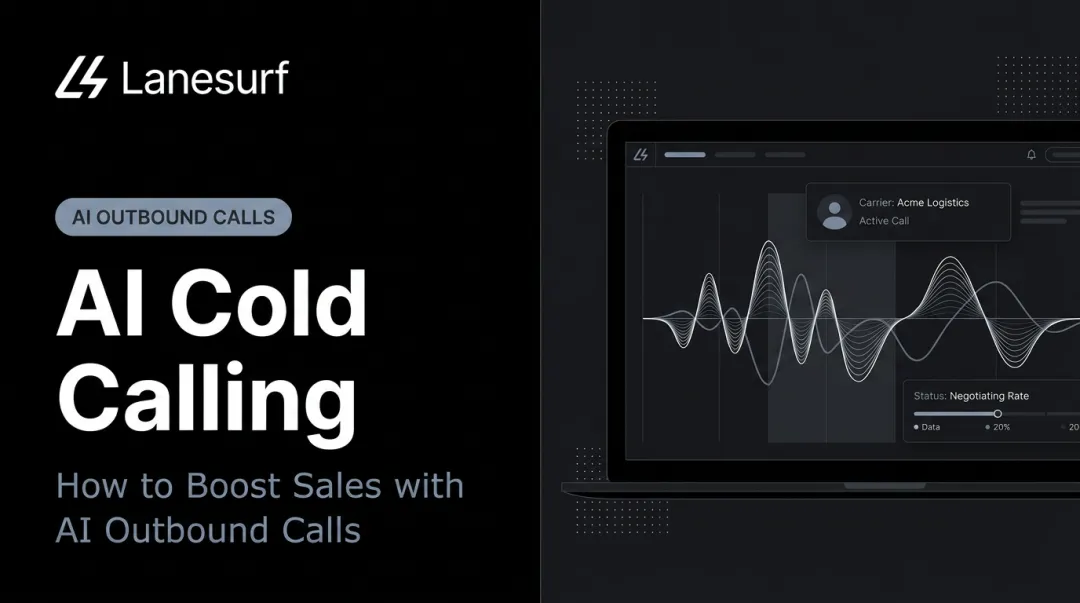
AI outbound calling addresses this by automating the mechanical, high-volume tasks that consume rep time — freeing human judgment for the work that actually requires it. This guide covers how AI outbound calling works, when to use it, how to set it up correctly, and what separates implementations that deliver results from those that stall at go-live.
Key Takeaways
- AI outbound calling conducts real two-way conversations — not pre-recorded messages
- Best suited for structured, repeatable call types: qualification, confirmations, reminders, and availability checks
- Success requires a defined call objective, clean contact list, consent compliance, and TMS/CRM integration before launch
- The highest ROI comes from automating high-volume, low-complexity calls so humans focus on qualified conversations
- Freight brokerages see disproportionate ROI due to extreme call volume across the load lifecycle
When Should You Use AI Outbound Calling?
Not every outbound call is a good candidate for automation. The deciding factor is whether the call depends on information delivery or on judgment and relationship.
AI outbound calling works when the conversation follows a predictable path with a defined outcome. It breaks down when calls require real-time commercial decisions, emotional sensitivity, or context that doesn't exist in your system.
Scenarios Where AI Calling Fits
- Carrier availability checks — yes/no responses on load coverage, pickup windows, or delivery times
- Rate collection at scale — reaching multiple carriers simultaneously to source competitive quotes
- Cold outreach — initial contact to screen for fit before a rep engages
- Payment reminders — structured, single-purpose calls with a clear next step
- Lead qualification — collecting predefined information to route contacts appropriately
- Post-service feedback — satisfaction checks or brief surveys after load completion

Where It's Commonly Misapplied
- Complex rate negotiations where price depends on real-time load context or carrier relationship
- Complaint resolution calls requiring empathy and discretion
- High-value account management where the contact expects a named rep
- Calls where the contact's history or preferences haven't been captured in your system
The Volume Test
If your team is making dozens of the same call type daily and still can't keep up, that's the clearest signal AI outbound calling is worth deploying. If the call type is infrequent or varies too much to script reliably, the configuration effort outweighs what you get back.
What You Need Before Getting Started
Launching without these four elements in place is a reliable path to poor results. Get them right before a campaign goes live:
| Prerequisite | Why It Matters |
|---|---|
| Defined call objective | Determines how the conversation is scripted and what counts as a successful outcome |
| Clean, segmented contact list | Drives personalization and ensures compliance — bad data produces bad calls |
| Consent and compliance baseline | The FCC confirmed in 2024 that AI-generated voices fall under TCPA's restrictions — prior consent requirements apply |
| CRM or TMS integration | Ensures call outcomes are logged automatically and triggers fire from real business events |
In the US, the Telephone Consumer Protection Act governs automated outbound calls. The FCC's 2024 ruling treats AI-generated voices as "artificial voices" under TCPA, with no exemption for interactive or two-way calls. Consult legal counsel before launching outbound AI campaigns, particularly to consumer or business mobile numbers.
How to Set Up and Run AI Outbound Calling
Effective AI outbound calling follows a defined sequence. Skipping steps (especially testing and trigger configuration) leads to poor call quality and wasted contacts.
Setup and Configuration
Start by defining the call goal precisely. "Qualify leads" is not a goal — "determine if the contact hauls flatbed loads on the Chicago-Dallas lane and is open to new broker relationships" is a goal. That specificity shapes every decision that follows.
Once the goal is defined:
- Write conversation logic for real conditions, not ideal ones. Every script needs paths for "not interested," "call me back later," "already working with someone," and "wrong number"
- Load your knowledge base — relevant information the agent needs to answer questions it will actually receive (rates, lanes, service scope, FAQs)
- Select a voice profile that matches your brand tone — formal or conversational, but always consistent
- Connect your CRM or TMS so outcomes are logged per contact without manual entry

The most common setup errors: scripts that don't adapt to caller responses, no fallback path when the contact goes off-script, and missing CRM integration that causes all call data to disappear after the call ends.
Once setup is solid, the next step is configuring how and when calls actually go out.
Initiating Your First Campaign
Configure call triggers before you contact anyone. Triggers can be:
- Event-based — a form submission, a load posted, a pipeline stage change, or an appointment booked
- List-based — a batch upload with defined call windows and frequency limits
Set daily call caps, time-zone-based scheduling, and retry rules for no-answers. Then test the agent internally before going live. Call your own number and try:
- Staying silent after the agent speaks
- Giving an unexpected answer ("I have no idea what you're talking about")
- Asking a question outside the script's scope
If the agent breaks down on any of these, fix the prompt or escalation path before the campaign touches real contacts.
Monitoring and Optimizing Calls
During an active campaign, track four signals:
- Connection rate — how many calls reach a live person (low rate signals a list quality or timing issue)
- Conversation completion rate — how many calls reach the intended outcome without dropping (low rate signals a script problem)
- Escalation-to-human rate — how often the agent transfers to a live rep (high rate signals the AI is hitting edge cases it wasn't prepared for)
- Sentiment signals — whether contacts are engaging or disengaging early in the call
After the campaign, review call recordings and transcripts weekly. Identify where conversations are dropping off, which objections are going unhandled, and whether the handoff trigger to a live rep is activating at the right point in the conversation.
Treat the agent like a new hire — it needs coaching based on real call data, not just a one-time setup.
Where AI Outbound Calling Is Used in Freight and Logistics
Freight brokerages are among the most call-intensive environments in any industry. Carrier outreach, load confirmations, rate follow-ups, and check calls happen across every load — and as FreightWaves has documented, repetitive carrier communication is a defining feature of entry-level and mid-level brokerage work. AI outbound calling fits this environment precisely because the calls are structured, high-volume, and follow predictable scripts.
High-Value Call Types for Freight Automation
- Carrier availability checks: A yes/no call that happens dozens of times per load at high-volume brokerages. Automating it frees reps to focus on carriers that are already interested.
- Load status and ETA check calls: AI contacts drivers on a defined schedule, logs ETA data, and escalates delays before they impact the shipper's operations — no manual tracking team required.
- Rate confirmation follow-ups: Carriers who receive a digital rate offer but don't respond get an automatic call to confirm or decline, eliminating the manual task of chasing individual replies.
- Appointment and dispatch confirmations: Confirming pickup windows the night before or morning of a load reduces no-shows and the miscommunication behind costly delays.
- Carrier network outreach and qualification: New carrier prospects are contacted, screened for lane preferences and capacity fit, and only the qualified ones are routed to a human broker to close.

Each of these call types shares the same profile: structured, repeatable, and time-consuming at scale — which is exactly where AI delivers the most value.
LaneSurf is built around these specific freight brokerage workflows, covering everything from carrier availability calls to full load lifecycle management within a single platform. Customers source 60–80% of loads via AI and save 4+ hours of manual effort per rep per day. Before automation, carrier rep teams at these brokerages were typically running 50–150 manual outbound calls daily.
Best Practices for AI Outbound Calling
Match Call Type to AI Capability
Use AI for structured, goal-defined conversations — availability checks, confirmations, reminders, qualification screening. Route anything involving negotiation above a defined threshold, pricing disputes, complaint resolution, or high-value relationship management to a human agent immediately.
The cleaner this boundary is documented upfront, the better both AI and human agents perform. Define it in your initial SOP — that document becomes the line of accountability when edge cases arise.
Write Conversation Logic for Real Conditions
Most failed implementations ignore edge cases. The script should have defined paths for every realistic response:
- "Not interested"
- "Call me back next week"
- "Already working with someone else"
- "This is a wrong number"
- Silence beyond a threshold
- A question the agent wasn't configured to answer
When the agent hits an unexpected response with no fallback path, the conversation breaks down. That carrier or prospect is now lost — and in freight, those are often lanes you needed covered today.
Establish a Clean Human Handoff Protocol
Define exactly which signals should transfer the call to a live agent:
- A specific intent phrase ("I want to talk to someone about pricing")
- An escalation request
- A question requiring real-time commercial judgment
- Silence beyond an acceptable threshold
At handoff, the agent must pass full call context — what was said, what the contact's situation is, what the call was trying to accomplish. A rep who has to re-introduce the conversation from scratch after a transfer defeats the purpose of the automated leg entirely.
Monitor Call Quality as a Discipline
Reviewing call recordings and transcripts weekly is how the agent actually improves. Identify:
- Where conversations are dropping off in the flow
- Which objections are going unhandled
- Whether new questions are emerging that the knowledge base doesn't cover
- Whether the escalation trigger is firing at the right moment or too early/late
Update the knowledge base when new objections surface. The agents that perform best six months in are the ones that got reviewed and adjusted every week from day one.
Frequently Asked Questions
What is the difference between AI outbound calling and robocalling?
Robocalling plays a pre-recorded one-way message to every recipient — the contact cannot respond. AI outbound calling holds a live two-way conversation that adapts in real time based on what the contact says, using speech recognition and natural language processing. The FCC's 2024 ruling clarified that AI-generated voices still fall under TCPA's restrictions, so the regulatory treatment overlaps even when the product experience differs significantly.
Which outbound calls should a freight brokerage automate first?
Carrier availability checks, load status check calls, and appointment confirmations are the best starting point. They follow a predictable script, have a clear yes/no outcome, and happen at high volume every day — making them the highest-ROI use case for AI calling in freight. Rate confirmation follow-ups on unanswered digital offers are a close second.
When should a human agent take over from an AI outbound call?
Handoff should happen when the conversation requires negotiation above defined thresholds, pricing decisions outside pre-set parameters, complaint resolution, or an explicit request for a human. The handoff must include full call context so the rep can continue without the contact repeating themselves.
What compliance requirements apply to AI outbound calling?
In the US, the TCPA governs automated outbound calls and requires prior express consent for certain call types. The FCC confirmed in 2024 that AI-generated voices are treated as artificial voices under TCPA — two-way interactivity does not create an exemption. Consent revocation rules also took effect in April 2025. Consult legal counsel before launching outbound AI campaigns, especially to consumer or business mobile numbers.
How long does it take to launch an AI outbound calling system?
A basic deployment can go live within days once the call objective, contact list, and conversation instructions are defined. LaneSurf's freight-specific platform onboards in under 48 hours with a fast-start option using an Excel load file, while full TMS integration completes in under 10 days.
Can AI outbound calling handle objections or unexpected questions?
AI agents can be configured with fallback paths and objection-handling scripts for common responses. Response quality depends on how well the knowledge base and conversation logic were built — an agent tested only against ideal responses will fail the moment a real contact deviates. Run tests against adversarial inputs before going live.