
Introduction
The average freight broker's day is a constant triage between urgent and important — and urgent almost always wins. Covering loads means calling down carrier lists, leaving voicemails, following up on callbacks, manually entering rate confirmations, and answering check-call requests, all while a new load tender sits waiting in the inbox.
There are only so many loads a rep can cover, so many carriers they can contact, and so many hours in a day. Adding headcount keeps pace for a quarter — it doesn't fix the underlying throughput constraint.
According to McKinsey, one transportation company boosted productivity by over 40% since 2022 by automating pricing, capacity sourcing, tracking, and document handling. That kind of scale shift doesn't come from hiring — it comes from AI.
This article breaks down exactly how AI is reshaping broker operations: the core capabilities, where the biggest efficiency gains are, and how to start bringing it into your brokerage without disrupting existing operations.
Key Takeaways
- AI automates the most time-consuming tasks in brokerage — carrier calls, load building, document processing, and rate quoting
- Brokers who adopt AI can manage significantly more loads without proportionally increasing headcount
- Carrier communication is one of the highest-ROI areas for AI automation — and still largely manual at most brokerages
- The human broker's role shifts toward strategy, relationships, and exception management — not away from the business
- Adoption doesn't require a full technology overhaul — start with one workflow and expand
Why Freight Brokerage Is Ripe for AI Disruption
Freight brokerage runs on volume. With over 25,000 active US brokerages competing for the same lanes, margins are under constant compression — and FreightWaves has documented a clear downward trend in brokerage gross margins as technology and new entrants flood the market.
The structural problem is what makes this hard to fix.
Every additional load a brokerage takes on requires more carrier outreach, more manual rate lookups, more status check-ins, and more document handling. Historically, the only answer was to hire more people. But hiring introduces its own costs — training time, turnover, salary overhead — and still doesn't solve the volume ceiling itself.
What Makes AI Different from Earlier Tech
Previous tools — basic TMS platforms, load boards, email templates — helped brokers organize work but didn't reduce it. AI changes the equation qualitatively:
- Learns from data rather than executing fixed rules
- Adapts to spot rate shifts and capacity swings in real time
- Handles multi-step tasks autonomously without human handoffs at each stage
- Operates continuously including after hours, weekends, and peak season
The scaling constraint is an automation gap. Brokerages that close it can take on more loads without adding proportional headcount — and that's where the margin math finally starts working in their favor.

Core AI Capabilities Transforming Broker Operations
AI in freight brokerage covers several distinct capabilities, each targeting a specific operational bottleneck. Here's where it's being deployed:
Smart Load Matching
Traditional load matching means scrolling a load board, identifying available carriers, and calling down a list sequentially. AI flips this.
AI algorithms analyze shipper load specs alongside carrier lane history, on-time performance, safety ratings, equipment type, and current availability — surfacing the best-fit carriers in seconds rather than minutes. DAT's digital freight matching platform, which handles more than 400 million loads and trucks annually, describes this as replacing slower manual methods like phone calls and faxes with predictive, data-driven matching.
C.H. Robinson demonstrated what this looks like at scale: in February 2025, its AI agents parsed carrier emails to extract truck availability and uploaded 10x more trucks to its capacity center than manual processes could support.
Predictive Pricing and Dynamic Rate Intelligence
Quoting from memory or last week's lane history is a margin problem. Rates move — spot truckload linehaul rates rose 16.5% year over year in Q1 2026, according to RXO — and a quote based on stale data either loses the load or loses margin.
AI pricing tools continuously ingest spot market data, capacity signals, and lane-specific trends to generate rate recommendations that reflect current conditions. C.H. Robinson's AI delivers customer-specific price quotes in 32 seconds and reduced load acceptance time for 5,200+ customers from 4 hours to under 90 seconds.
For most brokerages, that translates directly to faster quotes, better win rates, and protected margins.
Automated Document Processing
Manual document handling — entering BOL data, matching POD fields, processing invoices — is slow and error-prone. One freight-logistics company McKinsey profiled deployed AI agents that automated 80% of paper invoice payments, cutting both labor hours and processing errors at scale.
AI uses OCR and NLP to extract data from unstructured documents, validate fields, flag mismatches, and populate the TMS automatically. It's a task that eats hours of back-office time for zero revenue return.
Shipment Tracking and Proactive Visibility
Every "where is my freight?" call from a shipper represents a communication failure upstream. AI-driven track-and-trace eliminates the manual check-call cycle: the system contacts drivers directly, collects ETA and status updates, detects exceptions, and routes proactive alerts to the right people before the shipper notices a problem.
Fewer inbound service calls, faster exception resolution, and a measurably better shipper experience follow as a direct consequence.
Carrier Vetting and Fraud Detection
Cargo theft losses reached an estimated $725 million in the US and Canada in 2025, with average theft value rising 36% year over year, according to CargoNet's 2025 analysis. Organized groups have used document fraud, identity theft, and MC number manipulation to bypass manual compliance checks.
AI vetting cross-references FMCSA records, COI validity, safety scores, and insurance status automatically, running checks at both carrier onboarding and before every individual booking. When something looks wrong — a bank account change, an MC reactivation, a credential mismatch — the system flags it before a costly booking gets confirmed.
Automating Carrier Communication: The Biggest Time Sink Gets Solved
Ask any broker where their day actually goes, and the answer is almost always the same: carrier calls.
The load-covering cycle — searching for carriers, dialing, leaving voicemails, waiting for callbacks, negotiating rates, confirming details — is sequential when done manually. A rep can only be on one call at a time.
That constraint determines how many loads they can work, how fast they can cover them, and whether the rates they accept are the best available or just the first acceptable.
How AI Carrier Communication Works
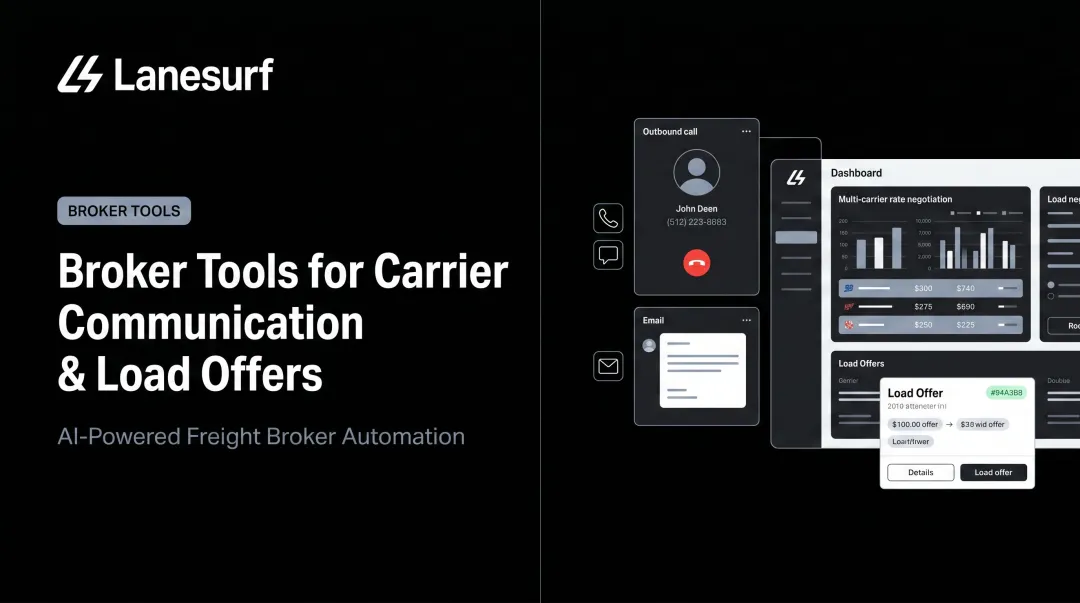
AI voice and messaging platforms handle the first-pass outreach autonomously — contacting carriers across voice, email, and text simultaneously, communicating load details, gathering rate responses, and logging outcomes without a human dialing each number.
Platforms like LaneSurf are built specifically around this capability. LaneSurf's AI Carrier Sales Agent contacts 10–50+ carriers simultaneously per load across all three channels, holds lane-specific pricing thresholds firm during negotiation, and runs the complete source-quote-negotiate-vet-book cycle in under 10 minutes per load — down from the 30–90 minutes a rep typically spends manually.
The outcomes from LaneSurf customer data are concrete:
- 60–80% of loads booked with AI-sourced capacity
- 8–10% better buy rates per load through disciplined parallel negotiation
- 4+ hours of manual effort saved per rep per day
- 24/7 coverage — loads that previously went uncovered after 6 PM book overnight

What AI Carrier Communication Doesn't Replace
AI handles volume outreach. It does not handle everything.
Human brokers still own:
- Relationship negotiations with preferred carriers built on years of earned trust
- Complex, multi-stop, or specialized freight that requires contextual judgment
- Carrier retention conversations where relationship equity matters more than speed
- Edge cases outside configured parameters — which the AI flags and escalates with full context
The AI works the volume. The broker works the exceptions and the relationships. That's how reps go from covering 15 loads a day to 50 — without burning out on hold music.
AI-Driven Load Management and Pricing Intelligence
Managing a large active load board manually means holding a lot in your head simultaneously — which loads are at risk, which carriers need callbacks, which rates are about to expire. AI load management removes that cognitive overhead by automating the status progression and surfacing exceptions proactively.
What Load Lifecycle Automation Covers
LaneSurf's load lifecycle automation runs from ingestion to settlement handoff:
| Stage | Automation Level |
|---|---|
| Load ingestion from TMS or Excel | Fully automated |
| Carrier sourcing and parallel outreach | Fully automated |
| Quote collection, normalization, and comparison | Fully automated |
| Rate negotiation within lane thresholds | Fully automated |
| Compliance vetting (MC, COI, authority, safety) | Automated; broker-supervised on failures |
| In-transit driver check-calls and ETA monitoring | Fully automated |
| Exception detection and escalation | Automated detection; broker resolves |
| Document handling and settlement handoff | Automated |
The cumulative effect: a broker can manage a significantly larger active load board with far less time spent on status management and routine coordination.
Pricing Intelligence in Practice
Rather than quoting from memory or pulling last week's lane data, AI pricing tools surface rate recommendations based on current market conditions. LaneSurf's margin protection logic runs parallel negotiations with 10–50+ carriers per load, holding lane-specific pricing thresholds firm and eliminating the common rep behavior of accepting the first acceptable rate due to time pressure.
That discipline, applied consistently across every load, delivers documented 8–10% better buy rates per load compared to one-at-a-time manual negotiations.

For shippers, the downstream benefits are tangible:
- Faster quotes with rates grounded in live market data
- More reliable carrier matching based on lane history and compliance records
- Proactive communication throughout the load lifecycle
Brokers who can demonstrate these outcomes consistently have a measurable edge — service quality that's visible to shippers, not just promised.
The New Broker: Human Expertise Meets AI Power
The "will AI replace freight brokers" question deserves a direct answer: no — but it will replace a significant portion of what brokers currently spend their time doing.
The 2025 Third-Party Logistics Study found that only about 1 in 10 respondents believe AI will replace human intuition. The same study found that 46% of both shippers and 3PLs see AI primarily as a tool for automating data analysis, and 36% of 3PLs see it as automation for repetitive, mundane tasks.
That framing is accurate. The tasks with high automation potential are:
- Outbound carrier calls and rate collection
- Load posting and status updates
- Document extraction and TMS entry
- Track-and-trace check calls
- Initial carrier compliance verification
The tasks that remain human are fundamentally different in nature:
- Strategic account management with shippers
- Relationship-building with carrier partners
- Crisis management when a shipment goes sideways
- Complex load negotiations that require judgment and context
- Business development and competitive positioning
The broker who uses AI to handle 70–80% of administrative and transactional work evolves into something closer to a logistics consultant and account manager.
Brokers who don't adopt AI face a structural cost and speed disadvantage. Competitors using automation can cover more loads, respond faster, price more accurately, and do it all without adding headcount.

McKinsey notes that asset-light logistics incumbents retain real advantages in scale, personal connections, and proprietary data — and AI is unlikely to erase those advantages. The risk isn't replacement. The risk is being outpaced by peers who build operational efficiency over time while you remain capped by manual throughput.
How to Start Bringing AI Into Your Brokerage
The most common mistake in AI adoption is trying to automate everything at once. It creates integration complexity, organizational friction, and makes it hard to measure what's actually working.
Start With Your Highest-Friction Workflow
Track where your reps lose the most time each week. For most brokerages, the answer is carrier outreach. If your team is making 50–150 outbound calls per rep per day and still missing loads, that's the starting point.
Document processing is the second most common high-value starting point — particularly if your back-office team is manually entering BOL and invoice data that could be extracted and populated automatically.
What to Look for in an AI Freight Platform
Not all AI tools are built for freight. Generic automation platforms require extensive customization to handle lane-specific pricing logic, compliance vetting workflows, and multi-channel carrier communication. Key evaluation criteria:
- Freight-native functionality — not a generic tool adapted for logistics
- Carrier call automation — outbound and inbound, 24/7
- TMS integration with your existing system (McLeod, MercuryGate, Tai, Turvo, Revenova, Aljex, Tailwind)
- Compliance portal connectivity (RMIS, MyCarrierPortal, Highway, Carrier Assure)
- Scalability — can it grow with load volume without requiring proportional reconfiguration?
LaneSurf handles carrier calls, parallel load management, and TMS integration natively, with no customization required to get started. Onboarding takes under 48 hours using an Excel-of-loads fast-start, with full TMS integration complete in under 10 days.
Roll It Out in Phases
Start with one workflow. Measure the time saved per rep per day and the change in loads worked per week. Then expand to the next bottleneck. The goal is compounding efficiency gains over time — not ripping out existing operations overnight.

That said, the barriers are real. The 2025 Third-Party Logistics Study cites TMS integration complexity (28% of respondents) and lack of skilled personnel (25%) as the top challenges. A phased rollout addresses both: you're not replacing your TMS on day one, and your team learns on a single workflow before taking on more.
Frequently Asked Questions
Can freight brokers make 7 figures?
Yes, and AI changes the scaling economics significantly. Brokers who automate carrier outreach, load management, and document processing can handle substantially more loads per rep , so revenue scales without proportional cost increases. Seven-figure brokerage revenue becomes more achievable when technology drives operational capacity, not just efficiency.
Will AI replace freight brokers entirely?
No. AI replaces repetitive, data-heavy tasks like carrier call volume, document processing, and status updates. It cannot replicate the relationship capital, contextual judgment, and crisis management that define successful brokers. The role shifts toward higher-value work.
What freight brokerage tasks can AI automate right now?
The primary automatable tasks today include:
- Outbound and inbound carrier calls
- Load matching and rate quoting
- Rate negotiation within configured thresholds
- Document extraction (BOLs, PODs, invoices)
- Track-and-trace check calls
- Initial carrier compliance verification
How does AI handle carrier communication for freight brokers?
AI voice and messaging agents autonomously contact carriers across voice, email, and text simultaneously to communicate load details, gather rate responses, negotiate within configured pricing thresholds, and log all outcomes. This replaces the sequential, one-carrier-at-a-time outreach that consumes most of a broker's day.
How long does it take to implement AI tools in a freight brokerage?
Faster than most brokers expect. LaneSurf's Excel fast-start gets AI running on live loads in under 48 hours, with full TMS integration completing in under 10 days.
What should I look for in an AI freight brokerage platform?
Prioritize: freight-specific functionality (not generic automation), carrier call automation across voice/email/text, native TMS integration, compliance portal connectivity, and a scalable architecture that grows with your load volume without requiring constant reconfiguration.