
Introduction
The US 3PL and domestic transportation management market hit $128.3 billion in gross revenue in 2025, according to Armstrong & Associates — and with over 28,000 registered brokers competing for loads across nearly 800,000 motor carriers, the pressure to cut per-load labor costs without adding headcount has never been more acute.
Manual carrier coordination remains one of the biggest drags on brokerage profitability. Calls made one at a time, rate comparisons done by hand, load assignments that sit idle until a rep is free — each delay compounds into eroded margins and lost capacity opportunities.
Multi-carrier shipping automation tools replace that manual work with rule-based and AI-driven workflows: automated carrier selection, real-time rate shopping, and load tendering without the phone tag. This post covers the 5 best tools available today — what they cost, who they're built for, and how to choose the right one for your operation.
Key Takeaways
- Multi-carrier automation replaces manual carrier calls, rate shopping, and load assignments with rules-based workflows
- Pricing ranges from free tiers to enterprise contracts — total cost of ownership matters more than the base subscription rate
- Tool selection depends on freight mode: parcel-focused platforms differ significantly from full freight lifecycle solutions
- Carrier network breadth, TMS integration depth, and rules engine flexibility are the most important evaluation criteria
- Freight brokerages should prioritize tools purpose-built for brokerage workflows, not repurposed ecommerce label platforms
What Is Multi-Carrier Shipping Automation?
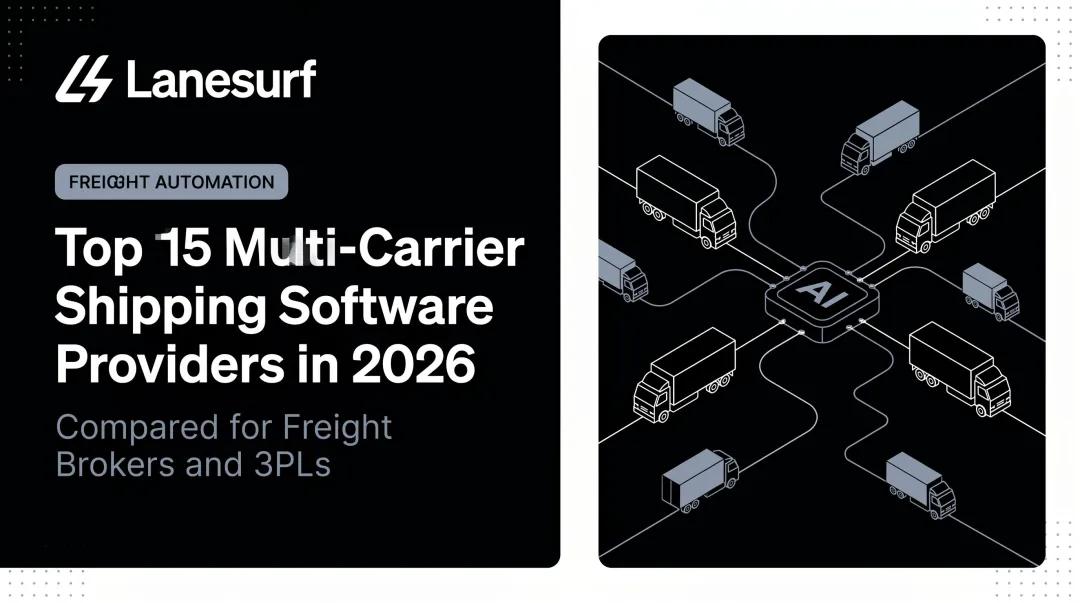
Multi-carrier shipping automation software connects freight brokerages or shippers to multiple carriers through a single platform. Instead of manually comparing rates across carrier websites or calling dispatchers one by one, the platform automates carrier selection, rate comparison, load tendering, and shipment tracking based on configured business rules.
For US freight brokerages, this matters because the scale of manual coordination is unsustainable. With hundreds of active carrier options per lane and shipper expectations shifting toward faster, more transparent delivery, brokerages that rely on rep-driven outreach face mounting inefficiencies as volume grows.
TMS users typically save 5–15% annually on freight costs, and automation has allowed major brokerages like C.H. Robinson to achieve a 40% productivity increase since 2022 while reducing headcount — not growing it.

The tools covered below are evaluated across four dimensions relevant to brokerage operations: automation depth, carrier network reach, pricing transparency, and fit for freight brokerage workflows.
5 Best Multi-Carrier Shipping Automation Tools
These tools were selected based on automation capabilities, carrier integration breadth, pricing structure, and suitability for US-based freight brokerages and logistics operations.
Shippo
Shippo is a cloud-based multi-carrier shipping platform used by small-to-mid-size shippers, 3PLs, and logistics operations. Its focus is on automating label generation, rate shopping, and carrier selection across national and regional carriers through a single API.
What makes it accessible is the combination of a developer-friendly API and a no-code dashboard — ops teams can configure carrier selection rules without engineering support, which suits growing brokerages that need quick deployment.
| Category | Details |
|---|---|
| Key Features | Multi-carrier rate shopping, automated label printing, bulk label editing, tracking consolidation, branded tracking pages, return labels, address validation, API-based workflow integration |
| Pricing | Starter: free (up to 30 labels/month, $0.05/label with personal carrier account); Pro: from $17/month (up to 10,000 labels, $0.08/label overage); Premier: custom pricing for unlimited shipments |
| Best Fit | Small-to-mid-size brokerages and shippers with moderate parcel volumes needing quick setup and API access |
Note: Shippo is built around parcel shipping and ecommerce integrations. It supports 40+ global carriers but is not designed for full freight brokerage TMS workflows, FTL/LTL load management, or carrier relationship management at scale.
ShipStation
ShipStation is one of the most widely adopted multi-carrier shipping automation platforms in the US, serving ecommerce brands, 3PLs, and logistics operations across 100–200+ carrier and marketplace integrations.
Its automation rules engine auto-assigns carriers, services, and packaging based on shipment attributes — weight, destination, order value — cutting manual decision-making across high order volumes.
| Category | Details |
|---|---|
| Key Features | Multi-carrier rate comparison, bulk label printing, automated rules engine, branded tracking pages and notifications, return automation portal, WMS/OMS integrations, unlimited automations on Standard/Premium |
| Pricing | Starter: $14.99/month (3 users, up to 5,000 shipments); Standard: $29.99/month (10 users, up to 100,000 shipments); Premium: $349.99/month (15 users, up to 100,000 shipments) |
| Best Fit | Mid-volume shippers and 3PLs needing omnichannel order automation and broad carrier connectivity |
Note: ShipStation's strength is ecommerce order fulfillment automation. It lacks the load lifecycle management, carrier negotiation, and freight-specific compliance features that traditional freight brokerages require.
EasyPost
EasyPost is an API-first multi-carrier shipping platform designed for businesses that want to embed carrier automation directly into their own systems or TMS. It's used by enterprise shippers and tech-forward brokerages that need programmable shipping logic rather than an out-of-the-box UI.
A unified shipping API connects to 100+ carriers with real-time rate shopping, address verification, and tracking. Everything is programmable through a single integration, giving operations teams full control over automation logic.
| Category | Details |
|---|---|
| Key Features | Carrier API aggregation (100+ carriers), real-time rate shopping, tracking webhooks, address validation, customs documentation, batch label creation, return labels, insurance |
| Pricing | Tracking API: $0.01–$0.03/shipment; Advanced Tracking: $0.03/shipment; Insurance: 1% of shipment value ($1.00 minimum). No published free tier or startup pricing found in official sources |
| Best Fit | Tech-forward brokerages and logistics platforms needing a programmable shipping API rather than a pre-built UI |
Note: EasyPost requires developer resources to implement. Client libraries are available for Python, PHP, Ruby, Node.js, and Java. It's parcel-focused and not designed for FTL/LTL freight brokerage operations without significant custom development.
Enveyo Cloudroute
Enveyo Cloudroute is a multi-carrier TMS built specifically for shippers and 3PLs that need automated carrier selection, parcel spend management, and analytics in one platform. It focuses on making data-driven routing decisions at scale rather than just comparing rates.
It pairs automated carrier selection with parcel auditing, delivery experience management, and logistics scenario modeling. For operations managing high parcel volumes across multiple carrier contracts, that integrated scope is a meaningful operational advantage.
| Category | Details |
|---|---|
| Key Features | Rules-based carrier selection, customizable business rules, shipping label and documentation workflows, parcel audit and refund recovery, shipment analytics and alerting, logistics scenario modeling |
| Pricing | Not publicly stated — contact sales for pricing. No public tiers, entry-level benchmarks, or per-label fees found in official sources |
| Best Fit | Mid-to-large 3PLs and enterprise shippers with complex carrier contracts needing integrated spend visibility and audit automation |
Note: Cloudroute is strong for parcel and carrier optimization analytics but is not positioned as a traditional freight brokerage TMS for FTL load lifecycle management. Its APC Postal Logistics partnership specifically targets enterprise parcel customers.
project44
project44 is an advanced multi-carrier visibility and automation platform serving large freight brokerages, shippers, and 3PLs across road, ocean, air, rail, drayage, and parcel. Its strength is real-time shipment tracking, predictive ETAs, and carrier network connectivity across every transport mode.
The decision intelligence layer is where it stands apart: project44 surfaces shipment exceptions and delays before they escalate. Brokerage ops teams can proactively reroute loads and protect service commitments across large, complex carrier networks.
| Category | Details |
|---|---|
| Key Features | Real-time multi-modal tracking, predictive ETA generation, AI-powered geofencing, exception alerting and disruption intelligence, carrier performance analytics, data-quality benchmarking, TMS integration (SAP, Oracle, BlueYonder) |
| Pricing | Not publicly stated — enterprise sales-led. No public subscription tiers, per-shipment fees, or entry-level pricing found in official sources. Coverage includes 600+ rail lines and 140+ port terminals |
| Best Fit | Mid-to-large freight brokerages and enterprise shippers needing deep carrier visibility and exception management across complex, multi-modal networks |
How We Chose the Best Multi-Carrier Shipping Automation Tools
Tools were assessed on five dimensions:
- Carrier network breadth — number and type of carriers supported, including regional and mode-specific coverage
- Automation depth — rules engine flexibility, AI-driven routing, and how much manual work the platform actually eliminates
- Integration compatibility — TMS, WMS, ERP, and API connectivity with existing systems
- Pricing transparency — availability of public pricing tiers vs. sales-only quotes
- Scalability — ability to handle growing freight volumes without proportional headcount growth

Two mistakes brokerages commonly make when evaluating these tools:
- Rate shopping gets the focus; total cost of ownership doesn't. Integration fees, implementation timelines, and per-shipment surcharges can reverse the apparent savings entirely.
- Platform fit gets overlooked. Tools built for ecommerce parcel shipping lack the load management, carrier relationship features, and compliance workflows freight brokerages require.
Shippo, ShipStation, and EasyPost are excellent platforms for their intended use case — parcel label automation and ecommerce order fulfillment. But they weren't designed for the spot market negotiations, MC vetting, and FTL load lifecycle management that define freight brokerage operations. Applying freight brokerage criteria to parcel tools produces a short list of wrong answers.
Conclusion
Multi-carrier shipping automation is no longer optional for freight brokerages that want to stay competitive. The right tool reduces per-load labor, protects margin through better carrier selection, and creates the operational capacity to scale without adding headcount proportionally.
When evaluating options, go beyond the feature list. Ask:
- Does it integrate with your existing TMS stack?
- Does it handle your freight mode — parcel, LTL, or FTL?
- Does the vendor have a track record with brokerage operations specifically, not just ecommerce fulfillment?
For freight brokerages, those criteria point toward tools built for carrier operations — not just parcel rate shopping. LaneSurf is an AI-powered freight brokerage automation platform that automates carrier calls, parallel rate negotiation, compliance vetting, and load booking. Brokerages using LaneSurf book 60–80% of loads with AI-sourced capacity and save 4+ hours per rep per day. If you're scaling freight operations without scaling headcount, start at lanesurf.com.
Frequently Asked Questions
How much does freight brokerage software cost?
Pricing ranges from entry-level SaaS plans (Shippo starts at $17/month; ShipStation at $14.99/month) to enterprise contracts with no published pricing, like project44 and Enveyo. Costs vary based on shipment volume, users, carrier integrations, and module depth — so evaluate total cost of ownership, including implementation time and integration fees, not just the base subscription.
What is the best software for logistics?
The right choice depends on your freight mode, operation size, and automation priorities. Multi-carrier TMS platforms suit high-volume parcel shippers; AI-powered tools like LaneSurf are purpose-built for freight brokerages that need carrier call automation, parallel rate negotiation, and load management across FTL and LTL freight.
What is multi-carrier shipping automation software?
It's a platform that connects shippers or brokerages to multiple carriers through a single interface, automating carrier selection, rate comparison, label generation, and shipment tracking based on configurable business rules. This replaces manual rate shopping and carrier outreach with rule-driven workflows.
What is the difference between a TMS and multi-carrier shipping software?
A TMS manages the full shipment lifecycle — routing, load planning, and carrier procurement. Multi-carrier shipping software focuses specifically on automating carrier selection, rate shopping, and label execution at the shipment level. Many modern platforms blend both, so it's worth confirming which capabilities a vendor actually covers before you buy.
What features should I look for in a multi-carrier shipping automation tool?
Core features to prioritize:
- Rules-based carrier selection and real-time rate comparison
- Integration with your existing WMS or TMS
- Shipment tracking, visibility, and performance analytics
Freight brokerages should also look for carrier communication automation: the ability to handle outreach, negotiation, and compliance vetting, not just rate shopping.
Can multi-carrier shipping software integrate with my existing TMS or WMS?
Most modern platforms offer API-based or native integrations with major TMS and WMS systems. Verify integration depth before committing — real-time data sync is meaningfully different from batch updates, and implementation timelines can range from days to weeks depending on system complexity.