
Manual dispatch processes don't survive that math. When a dispatcher is cross-referencing spreadsheets, calling carriers one at a time, and manually confirming each assignment, the brokerage's capacity ceiling is set by how fast one person can work.
Load assignment automation changes that equation. This article covers exactly how it improves driver efficiency — smarter matching, less idle time, faster dispatch — and what brokerages leave on the table when they skip it.
Key Takeaways
- Automated matching checks HOS compliance, equipment type, location, and carrier status in one pass — no manual cross-referencing
- Reduced idle time comes from continuous availability monitoring, not periodic dispatcher check-ins
- Automated dispatch removes the back-and-forth communication cycle that bottlenecks load closures at scale
- On-time delivery rate, deadhead miles, revenue per truck, and loads per dispatcher all improve with automation in place
- Brokerages that skip automation don't just add headcount — they multiply their existing inefficiencies
What Is Load Assignment Automation?
Load assignment automation is the use of software rules or AI logic to match available drivers and carriers to loads based on pre-configured criteria — without requiring a dispatcher to manually intervene at every step.
It typically lives inside a TMS platform, a freight brokerage software layer, or a standalone dispatch tool. Anywhere load-to-driver decisions get made repeatedly and at volume is a candidate for automation.
Automation doesn't remove dispatchers from the equation — it gives them better decisions faster. Instead of spending their shift on manual matching, dispatchers handle exceptions and high-value decisions while the system covers the routine work.
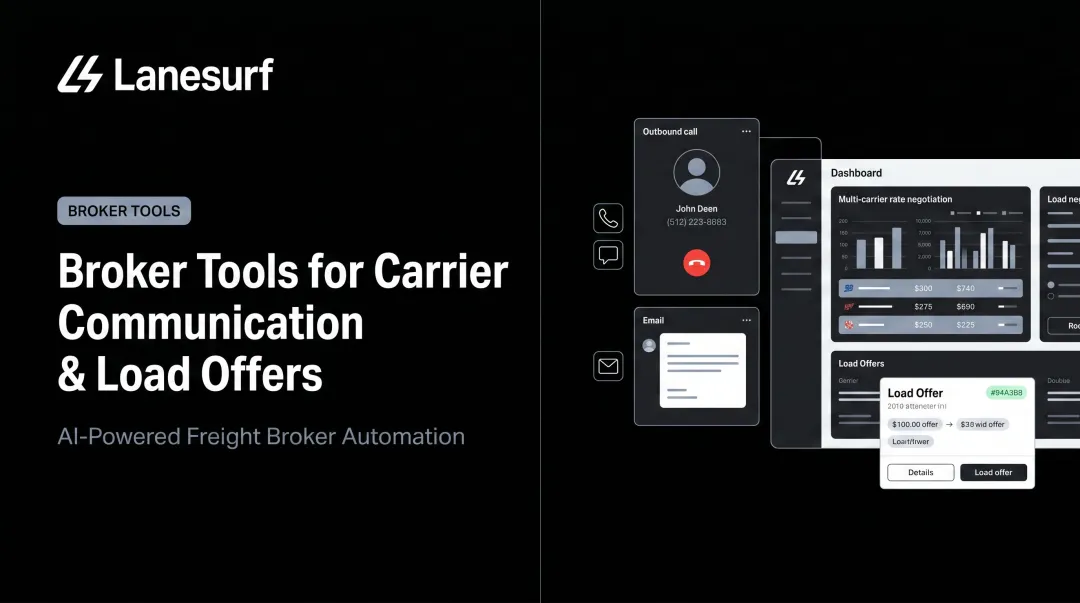
Platforms like LaneSurf extend this further by automating the entire carrier communication cycle that surrounds the assignment logic. The AI Carrier Sales Agent handles the full source-quote-negotiate-vet-book cycle in under 10 minutes per load:
- Contacts 10–50+ carriers simultaneously via voice, email, and text
- Runs compliance vetting and rate negotiation against lane-specific thresholds
- Returns the booked load to the TMS as a single connected workflow
Key Advantages of Load Assignment Automation
These advantages reflect the operational outcomes freight brokerages and carriers actually track — not abstract efficiency gains, but changes you can see in your KPIs.
Smarter Driver-Load Matching Based on Real Constraints
Manual dispatcher matching has a fundamental scaling problem: the more drivers and loads in play, the more variables a dispatcher has to hold in their head simultaneously. Equipment type, current location, hours of service, lane familiarity, carrier compliance status — checking all of these manually for every load, every time, is impractical at volume.
Automation solves this by evaluating all constraints simultaneously and instantly, surfacing the best-fit match in seconds rather than minutes.
The compliance angle deserves particular attention. According to CVSA's 2025 International Roadcheck results, Hours of Service violations were the single largest category of driver out-of-service violations — accounting for 31.6% of U.S. driver out-of-service violations, with 992 drivers placed out of service for HOS issues in a single three-day inspection period.
FMCSA penalties for recordkeeping violations can reach $15,846 per incident.
Automated systems prevent these outcomes by enforcing HOS compliance checks at the assignment stage — before a driver is dispatched, not after a violation surfaces during an inspection.
KPIs impacted:
- On-time delivery rate
- Compliance violation rate
- Driver utilization rate
- Load rejection rate
The higher the load volume and the larger the carrier pool, the more manual matching breaks down — which is precisely where automated constraint evaluation holds.
Reduced Driver Idle Time and Fewer Deadhead Miles
Every hour a driver sits between loads is lost revenue. Every empty mile driven is a direct cost with no corresponding income. ATRI's 2025 trucking cost analysis puts the average cost of operating a truck at $2.26 per mile, with empty miles averaging 16.7% of total miles in 2024. For a truckload sector already running a -2.3% operating margin, deadhead isn't an inconvenience — it's a solvency issue.

The connection between manual dispatch and idle time is direct. When a dispatcher manually monitors driver status and assigns the next load, there's always a gap: the time between when a driver completes a delivery and when the dispatcher notices, makes a call, and gets the next assignment confirmed. That gap is idle time by definition.
Automated systems close that gap by continuously monitoring driver and carrier availability and triggering assignment the moment capacity opens up — whether that's at 2 PM on a Tuesday or 11 PM on a Friday. Platforms like LaneSurf run 24/7, meaning loads that previously went unmatched after hours are covered overnight, with full audit logs delivered to the team the next morning.
Convoy's earlier work on automated matching showed what's possible: they achieved 100% automated load-to-truck matching in top markets without human intervention, specifically targeting empty mile reduction through pre-planned load combinations.
KPIs impacted:
- Deadhead miles per load
- Driver idle time
- Revenue per truck per week
- Asset utilization rate
For brokerages managing carriers across multiple regions or time zones, real-time manual monitoring of driver status isn't feasible — and that's exactly where always-on automation replaces a structural gap.
Faster Dispatch Decisions and Lower Communication Overhead
The manual dispatch communication cycle has a predictable structure: find an available driver or carrier, make a call, wait for a response, confirm details, log the result, repeat. Each step takes time. Multiplied across dozens of loads per day, it becomes the ceiling on how many loads a brokerage can actually close.
Automation breaks that ceiling by removing the sequential call loop. Assignment rules trigger dispatch notifications automatically. The carrier gets contacted — across voice, email, and text simultaneously — without a dispatcher manually dialing.
LaneSurf's AI Voice Agent takes this further by handling both outbound outreach and inbound carrier calls within the same automated pipeline. The platform contacts 10–50+ carriers in parallel for each load, collects and normalizes quotes, negotiates against lane-specific pricing thresholds, and completes compliance vetting before a booking is confirmed.
LaneSurf customer data attributes 4+ hours of manual effort saved per rep per day specifically to eliminating the outbound carrier call burden, with a separate 1–2 hours per day recovered from automating driver check-calls and in-transit status follow-ups.
At that scale of time recovery, dispatcher capacity effectively doubles — without adding headcount.
KPIs impacted:
- Time-to-dispatch per load
- Loads handled per dispatcher per day
- Call volume per load
- Deal closure rate
Under manual dispatch, communication overhead grows in direct proportion to load volume. Automation inverts that relationship: higher volume means more leverage per dispatcher, not more strain.
What Happens When Load Assignment Automation Is Missing
Without automation, these aren't edge cases. They're the daily operating reality for brokerages still running manual dispatch processes.
- Dispatchers rely on familiarity and memory rather than real-time data, leading to assignments that miss compliance requirements or equipment fit
- Problems surface as emergencies instead of being caught upstream by automated rules, pulling dispatchers away from work that actually requires their judgment
- Idle time and deadhead miles accumulate: Without continuous automated matching, gaps between loads grow — often invisibly, until the weekly P&L makes the pattern impossible to ignore
- A hard ceiling on growth: Every additional load in a manual system requires proportionally more dispatcher time. Adding headcount raises costs without fixing the underlying inefficiency
Those inefficiencies compound in a market that's already compressing margins. TIA's Q4 2024 data shows shipment volumes rose 5% year-over-year while average invoice value dropped over 10% and gross margins compressed to 15.2%. At that spread, operational inefficiency stops being a back-office concern and starts showing up directly in your P&L.

How to Get the Most Value from Load Assignment Automation
Automation delivers compounding value when it's treated as an ongoing operational system, not a one-time setup. Three conditions determine whether it reaches its potential:
1. Keep assignment rules current. Driver constraints, carrier compliance thresholds, equipment requirements, and lane-specific pricing rules must reflect current operational reality. Outdated data produces mismatched loads. This matters most for HOS limits and carrier compliance data, where regulations shift and carrier statuses can change overnight.
2. Review outcomes and refine the logic. Track KPIs like deadhead miles, idle time, on-time delivery, and dispatcher throughput weekly. When the data shows the automation producing suboptimal matches — a carrier type that keeps getting flagged, a lane where the pricing threshold is consistently too tight — adjust the rules. The system improves with feedback.
3. Connect assignment and communication as one workflow. Load assignment automation loses most of its value if the notification step still requires manual dispatcher intervention. Platforms like LaneSurf connect assignment logic and carrier communication as a single pipeline: the load gets matched, the carrier gets contacted, the compliance check runs, and the confirmed booking flows back to the TMS — no manual handoffs between steps.
The result is measurable. Brokerages running this end-to-end workflow typically recover 4+ hours of rep time per day while maintaining full dispatcher control over pricing and carrier selection.
Conclusion
Load assignment automation improves driver efficiency by ensuring that every carrier gets matched to the right load with the right constraints checked — consistently, at speed, at any hour. In practice, smarter matching reduces violations and rejections, continuous availability monitoring closes the gap between loads, and automated communication removes the bottleneck that limits how many loads a brokerage can close in a day.
Those gains compound as volume grows. Brokerages that actively monitor and refine their automation rules — tightening matching logic, adjusting thresholds, expanding integrations — are the ones that turn efficiency gains into sustained margin improvement as their load volume scales.
Frequently Asked Questions
What is the auto assignment rule?
An auto assignment rule is pre-configured logic within a dispatch or TMS platform that automatically assigns a driver or carrier to a load when specific criteria are met — such as availability, location, equipment type, or compliance status — without dispatcher input. Rules reflect your SOPs and are updated as operational requirements change.
How does load assignment automation reduce driver idle time?
Automation continuously monitors carrier and driver availability and triggers the next assignment as soon as capacity opens up — rather than waiting for a dispatcher to notice and intervene manually. That closes the idle gap between load completion and next dispatch, keeping drivers moving rather than waiting.
Can load assignment automation work with existing TMS platforms?
Load assignment automation tools typically integrate with existing TMS platforms via APIs or native connectors. LaneSurf, for example, integrates with McLeod, MercuryGate, Tai, Turvo, Revenova, Aljex, and Tailwind — with full integration completing in under 10 days and a fast-start option available while integration finalizes.
How does automated load assignment affect driver satisfaction and retention?
Drivers assigned to well-matched loads — ones that respect HOS limits, equipment requirements, and route fit — experience fewer compliance issues and less unnecessary deadhead time. Given that annual turnover at large truckload carriers frequently exceeds 90–100%, reducing friction in the assignment process is one practical lever for improving retention.
What are the four types of automation in freight dispatch?
The four types are fixed (rule-based), programmable (configurable by scenario and lane), flexible (AI-adaptive), and integrated (end-to-end, connecting TMS, communication, and compliance). Freight load assignment typically uses programmable or flexible automation depending on the platform.
What tools are commonly used for load assignment automation?
Leading options include TMS platforms with built-in dispatch automation, AI-powered carrier matching engines, carrier communication platforms like LaneSurf, and load board integration software. The right fit depends on load volume, your current TMS, and whether you need to automate matching only or the full source-to-book cycle.