
Key Takeaways
- Automated carrier selection replaces manual outreach with rule-based, AI-driven matching across cost, compliance, lane history, and capacity
- Manual processes don't scale—each additional load compounds the bottleneck
- Selection rules should cover rate benchmarks, on-time performance, compliance status, and freight-type qualifications
- Clean carrier data and well-defined routing rules are what separate a working system from one that stalls at launch
- TMS integration connects carrier selection to the full load lifecycle — booking, tracking, and performance rolled into one workflow
What Is Automated Carrier Selection?
Automated carrier selection is the use of software and rule-based logic—now increasingly AI-powered—to evaluate available carriers and assign the best-fit option for each load, without requiring a broker to manually compare options or make calls.
It's distinct from general shipping automation tools built for ecommerce merchants. Brokerage-specific carrier selection involves vetting capacity across real carrier relationships, negotiating rates, and managing compliance at scale.
The Three Carrier Tiers Automated Systems Evaluate
Freight brokers typically draw from three carrier pools:
- For-hire carriers — FMCSA reported 519,420 for-hire carriers active in 2023, ranging from large fleets to micro-operations
- Owner-operators — FMCSA data shows 418,526 carriers with a single power unit; the majority of the market is small operators
- Spot market capacity — third-party fleets sourced through load boards like DAT and Truckstop when primary options are unavailable
Automated systems evaluate across all three using criteria like lane history, rate benchmarks, and compliance records—selecting the best match without the broker manually sorting through each tier.
Why Volume Makes This a Daily Operational Problem
Carrier selection isn't a one-time configuration. It happens hundreds of times per day at growing brokerages. According to ATA, 91.5% of US motor carriers operate 10 or fewer trucks—meaning brokers are navigating a deeply fragmented, highly variable market on every single load. At that volume, manual processes create a compounding bottleneck that limits how fast a brokerage can actually grow.
Why Manual Carrier Selection Holds Freight Brokers Back
The core problem is throughput. A broker manually calling or emailing carriers to cover a single load might spend 30–90 minutes on that one transaction—time that multiplies across dozens of daily loads. At scale, manual carrier outreach becomes a hard ceiling on how much business a brokerage can handle.
The Consistency Problem
Manual selection introduces variance that costs money. Decisions depend on:
- Which broker is on shift and their personal carrier relationships
- Memory of who hauled a lane last month rather than data
- Willingness to shop the market versus accepting the first rate that comes back
This leads to margin erosion. FreightWaves' 2026 brokerage cost model puts average gross margin at 9.91% against an 11.3% break-even threshold—a margin that disappears quickly when brokers default to familiar-but-expensive carriers instead of best-rate options. The same analysis notes that automation can reduce carrier-operational costs per load by 40–50% by shifting staff to exceptions rather than routine outreach.

The Competitive Disadvantage
That margin pressure compounds when the competitive clock is running. Truckload tender lead times averaged 3.63 days in 2025—up 7.3% from the prior year, according to FreightWaves data. That compresses the window brokers have to secure capacity and respond competitively. Brokers relying on manual outreach during that window are slower to confirm, more likely to miss coverage, and less able to present a competitive rate.
DAT's RFP benchmarking data shows that winning 8% of priced lanes qualifies as a strong result. That's a tight margin for operational slippage—and manual processes consistently fail to hit those windows at volume.
How Automated Carrier Selection Works
Automated carrier selection runs through five stages, each feeding directly into the next:
1. Data Ingestion
The system pulls shipment details—origin, destination, equipment type, weight, freight class, special requirements—directly from your TMS or load board. That load context is matched against a carrier database containing rate history, lane performance, capacity signals, and compliance records.
2. Rule Configuration
Brokers or operations managers define the business logic that guides every selection decision. Rules might include:
- Prioritize carriers with proven history on a specific lane
- Filter out carriers with active safety violations or lapsed insurance
- Apply different rate thresholds depending on load type or shipper
- Escalate to a human when compliance checks fail or edge cases arise
These rules standardize decisions that individual brokers would otherwise make inconsistently across dozens of daily loads.
3. Automated Evaluation and Matching
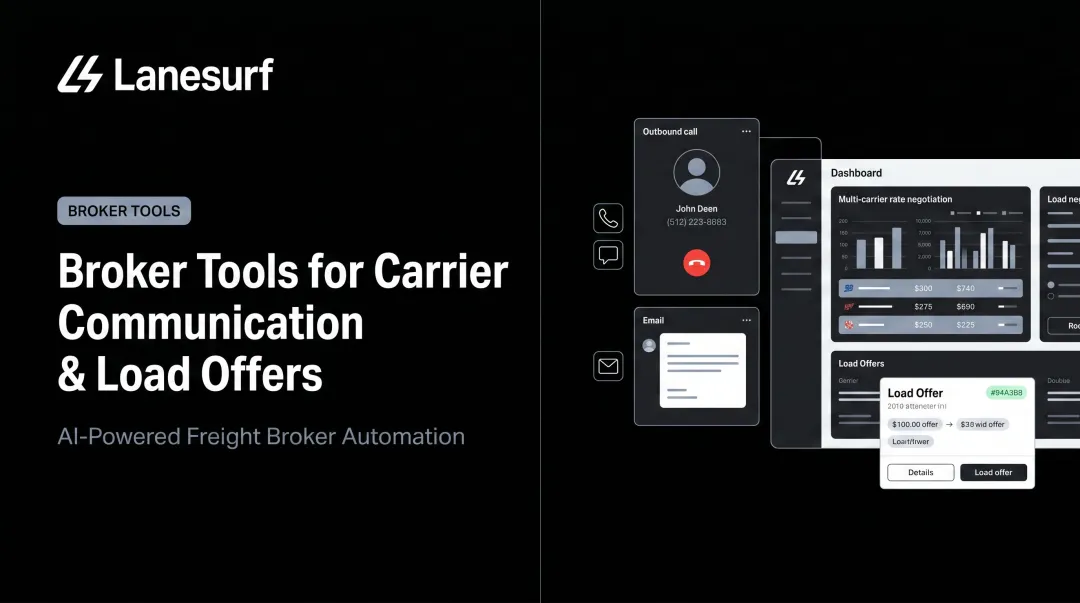
The system scores eligible carriers against configured rules and surfaces the top options, or auto-assigns the best match and initiates outreach via automated call, text, or digital tender. Platforms like LaneSurf take this further. The AI Carrier Sales Agent contacts 10–50+ carriers simultaneously across voice, email, and text, then:
- Collects and normalizes all quotes in parallel
- Negotiates within lane-specific pricing thresholds
- Executes the booking without human intervention
The result: a full source-to-book cycle completed in under 10 minutes per load, compared to the 30–90 minutes typical of manual workflows.

4. Downstream Workflow Integration
Confirming a carrier triggers the rest of the load lifecycle automatically. The system:
- Updates the load record in your TMS automatically
- Initiates rate confirmations, BOLs, and POD documentation
- Activates in-transit tracking and ETA monitoring
- Feeds EDI message flows (204, 990, 214) without manual handling
5. Human Oversight and Exception Handling
Automation handles speed and consistency. Brokers retain control through exception routing: flagged loads, compliance failures, and edge cases route to a human with full audit context. Brokers also review system performance data over time to refine rules as lanes and conditions change.
Key Criteria Automated Systems Use to Select Carriers
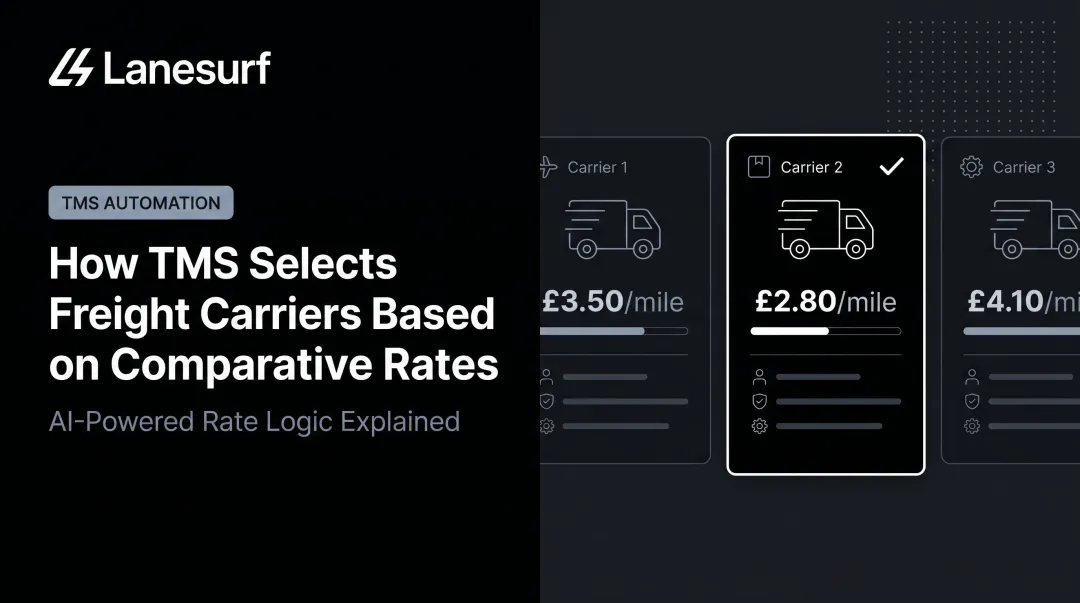
Cost and Rate Benchmarking
Automated systems compare carrier quotes against lane-level benchmarks in real time. This prevents two failure modes: overpaying on spot loads and locking in above-market contract rates. That comparison should account for accessorials—fuel surcharges, detention, layover—not just the base rate.
LaneSurf's parallel negotiation approach runs simultaneous rate collection across all channels, normalizing every quote across origin, destination, equipment type, and accessorials before ranking. Per LaneSurf customer data, this delivers 8–10% better buy rates per load compared to single-carrier sequential negotiations.
Reliability and Lane Performance
Past behavior on a specific lane predicts future performance more accurately than general carrier reputation. Automated systems track:
- On-time pickup and delivery rates by lane
- Claim frequency by carrier
- Hauling history with the specific shipper
- Tender acceptance patterns by lane and season
Carriers with strong lane-specific track records surface first—not just familiar names from a broker's contact list.
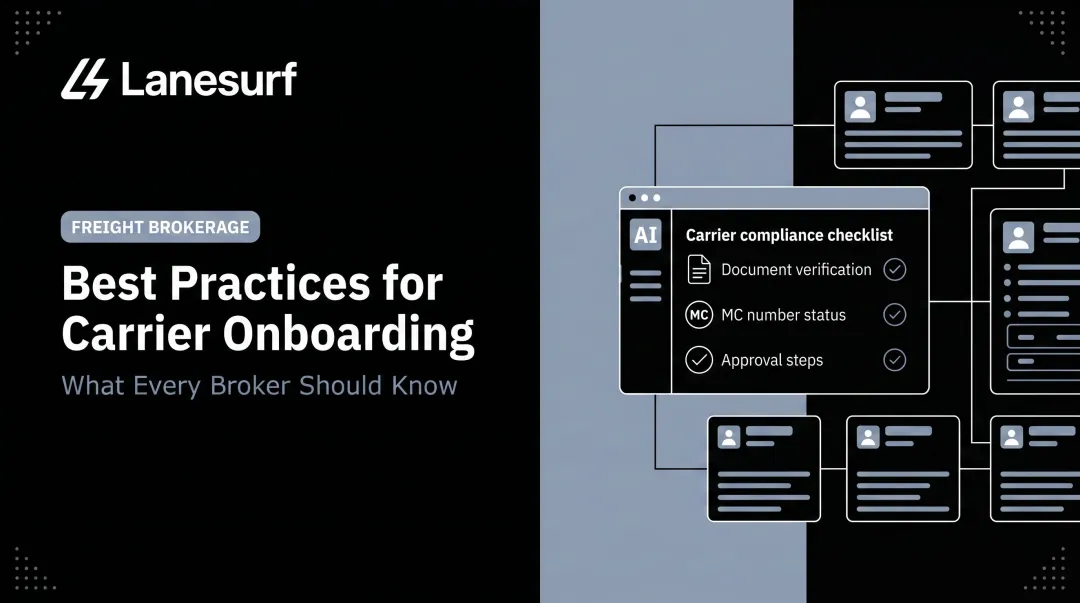
Compliance and Safety Records
FMCSA recorded 3,011,902 inspections in 2023, with vehicle out-of-service rates at 22.6% and driver OOS rates at 6.4%. Automated systems integrate with FMCSA data and third-party compliance portals—RMIS, MyCarrierPortal, Highway, Carrier Assure—to filter out carriers with safety violations, lapsed insurance, or authority issues before they're ever presented as an option.
LaneSurf handles this automatically: MC vetting, COI verification, authority status checks, and CSA/SMS evaluation run on every carrier before any booking executes.
Service-Level and Freight-Type Matching
Not every carrier can haul every load. Automated selection applies logic for:
- Temperature-controlled equipment (reefer units)
- Oversized or flatbed requirements
- Hazmat certifications and placard authority
- Cargo insurance minimums for high-value freight
Lane and commodity-specific compliance rules ensure only qualified carriers surface for loads with specialized requirements.
Best Practices for Implementing Automated Carrier Selection
Start With Clean Carrier Data
Automation is only as good as the data feeding it. Before implementation, audit your carrier database:
- Update insurance certificates and confirm active authority
- Remove inactive or non-compliant carriers
- Tag carriers by lane history, equipment type, and performance data
Poor source data produces poor automation decisions—there's no shortcut around this step.
Build and Refine Rules Iteratively
Don't try to configure every possible scenario upfront. Instead:
- Start with your highest-volume lanes — where the ROI is immediate and data is richest
- Monitor exception rates during the first 30–60 days to identify gaps in your rules
- Refine logic based on outcomes, not assumptions—let performance data drive adjustments
Integrate Carrier Selection With the Full Load Lifecycle
Siloed automation creates new handoff problems. Carrier selection delivers its full value when connected from load entry through delivery confirmation—with booking output feeding directly into your TMS, documentation triggering automatically, and tracking activating without a separate manual step.
LaneSurf's TMS integrations—covering McLeod, MercuryGate, Tai, Turvo, Revenova, Aljex, and Tailwind—complete in under 10 days. A pre-integration fast-start using an Excel export of current loads means the AI begins working immediately while integration finalizes, with no operational gap.
Maintain a Tiered Carrier Strategy
Build carrier tiering into your system's rules:
- Primary tier — carriers with strong lane history and performance records
- Secondary tier — backup options for lanes where primary carriers are unavailable
- Spot market fallback — broader outreach when both primary and secondary options are exhausted

Automation should follow a predictable escalation path, not randomly source capacity from the broadest pool on every load.
Track and Review Automation Performance Monthly
Set KPIs for the automated system itself:
- Match rate without manual intervention (coverage rate)
- Buy rate vs. lane benchmark — is automation beating manual performance?
- Carrier acceptance rate — are contacted carriers actually converting?
Review these monthly. Underperforming lanes signal a need to refine rules—not revert to manual processes.
Frequently Asked Questions
What is the carrier selection process?
Carrier selection is the process of evaluating and choosing the right carrier for a specific shipment based on criteria like cost, availability, lane performance, reliability, and compliance. In freight brokerage, this decision repeats dozens of times daily — making it one of the highest-leverage operational processes a brokerage runs.
Which shipping carrier should I use?
The right carrier depends on lane-specific factors including the origin-destination pair, freight type, required service level, and cost benchmarks. Automated carrier selection systems evaluate all of these variables simultaneously, surfacing the best-fit option for each individual load rather than defaulting to preferred carriers regardless of fit.
What is automated carrier selection in freight brokerage?
Automated carrier selection uses software and rule-based logic — sometimes AI-powered — to match loads with qualified carriers automatically. It replaces manual phone outreach and rate comparison with instant decisions based on live performance data, applied consistently across every load regardless of which broker is on shift.
What are the main benefits of automating carrier selection?
Core benefits include faster load coverage, reduced time spent on manual outreach, more consistent carrier performance through performance-based matching, and the ability to scale load volume without proportionally growing headcount. LaneSurf customers report 60–80% of loads booked via AI-sourced capacity and 4+ hours of manual effort saved per rep per day.
What criteria should automated carrier selection systems evaluate?
The core evaluation factors are: carrier rate versus lane benchmark, on-time performance history by lane, capacity availability on the specific origin-destination pair, compliance and safety standing (MC authority, COI, CSA scores), and any specialized equipment or certification requirements the load demands.
How does automated carrier selection help freight brokers close more deals?
Faster carrier matching enables quicker tender responses, which directly increases win rates on competitive freight. Automation also frees broker time from routine carrier calls, redirecting it toward customer relationships, new business development, and margin optimization — the activities that grow a brokerage.