
The core problem isn't effort. It's process. Many brokerages still rely on single-carrier relationships or manual quote-gathering, which means they're systematically missing better options. According to C.H. Robinson, accessorial fees now appear on nearly 40% of LTL shipments — up from just 10% before the pandemic — yet most brokers don't account for these until after booking.
This guide covers the mechanics of LTL rate pricing, how to shop rates systematically, what to evaluate when selecting carriers, how to negotiate better terms, and where automation fits into an optimized LTL workflow.
Key Takeaways
- LTL freight rates depend on freight class, shipment density, lane, and accessorial charges — misclassifying any of these inflates every invoice.
- Effective rate shopping evaluates total landed cost: base rate plus transit time, claims history, and service reliability.
- Mixing national and regional carriers reduces embargo risk and gives you real negotiating leverage.
- Multi-carrier quote automation gives brokers full market visibility without the manual legwork.
What Factors Determine LTL Freight Rates?
Unlike truckload pricing, LTL rates don't follow a simple mileage formula. Multiple shipments share one trailer, so carriers price each one based on how much space it occupies, how risky it is to handle, and where it's going. Several variables interact to produce the final number.
Freight Class and NMFC Codes
The National Motor Freight Traffic Association (NMFTA) assigns every commodity an NMFC freight class, ranging from Class 50 to Class 500, based on four criteria: density, stowability, handling difficulty, and liability. Higher classes mean higher rates.
Misclassification is one of the most expensive and common errors in LTL brokerage. When a broker quotes on the wrong class, post-delivery invoice adjustments eliminate the margin on that load entirely.
The stakes got higher in 2025. As FreightWaves reported, NMFTA's 2025 updates — which took effect July 19, 2025 — converted approximately 2,000 commodity items to a density-based classification scale. This means accurate dimensional and weight data must be confirmed before quoting. Estimated dimensions mean a guessed class — and that guess shows up as a post-delivery invoice adjustment.
Shipment Weight and Density
Carriers care about density, not just weight. A bulky pallet that weighs 200 lbs but occupies the space of a 500 lb shipment will be priced accordingly — because it takes up trailer space that could hold revenue-generating freight.
Most carriers also apply a minimum charge, meaning very light shipments get priced at a floor rate regardless of actual weight. This catches brokers off guard when small shipments end up costing nearly as much as mid-weight ones.
Lane, Distance, and Carrier Network Coverage
The origin-destination pair has an outsized effect on LTL pricing. Long lanes, rural delivery zip codes, and regions with low inbound freight density all carry premium rates. Carrier network structure matters too: hub-and-spoke systems mean some lanes require interline transfers between carriers — adding both cost and transit time to the equation.
Accessorial Charges and Fuel Surcharges
Accessorials are where LTL invoices diverge most sharply from initial quotes. Common charges that significantly inflate final invoices include:
- Liftgate pickup or delivery
- Residential delivery fees
- Inside delivery
- Appointment scheduling
- Limited access location surcharges
- Fuel surcharges (updated weekly based on the DOE/EIA diesel index)
Both XPO and Old Dominion publish fuel surcharge tables tied directly to the EIA's weekly on-highway diesel price data — meaning fuel costs can shift your effective rate from one week to the next.
Those weekly fuel swings compound with carrier general rate increases. FreightWaves reported that LTL rates reached an all-time high in Q3 2025, with the rate-per-pound index sitting 65.1% above January 2018 levels. Old Dominion announced a 4.9% GRI for late 2025, while ABF, Saia, and FedEx Freight each pushed through 5.9% increases. Quotes locked in under a prior GRI structure will be underpriced the moment a new increase takes effect.

How to Rate Shop for LTL Freight Effectively
LTL rate shopping is the practice of gathering and comparing quotes from multiple carriers for a given shipment — evaluating not just price but the full value of service, including transit time, reliability, and total landed cost. Without a structured approach, it becomes an exercise in picking the cheapest number without knowing what it actually costs.
Compare More Than Just the Base Rate
The most common rate shopping mistake is selecting the lowest base rate without accounting for accessorials, transit days, or carrier claim history.
Consider a quick example: Carrier A quotes $450 base rate on a lane. Carrier B quotes $520. On the surface, Carrier A wins. But if Carrier A has a high damage rate for that commodity type, adds a residential delivery surcharge that Carrier B doesn't, and runs a two-day longer transit time — the real cost comparison looks very different. Carrier B was the better option.
Rate shopping has to account for total landed cost, not the headline number.
Use Multi-Carrier Rate Aggregation
Checking carrier portals one at a time creates blind spots. A broker working through three portals manually will miss the fourth carrier that would have won on both price and service. A TMS or rate aggregation platform that pulls multi-carrier quotes into a single view closes that gap, cutting manual effort and ensuring no option gets skipped under time pressure.
Account for Hidden Costs Before Booking
Before confirming a quote, run through this checklist:
- Identify likely accessorials — Is the delivery address residential? Does it require a liftgate? Is it a limited-access location?
- Check for embargoes — Some carriers restrict service to specific zip codes or regions during capacity crunches.
- Verify transit time terms — Does the quoted transit time include or exclude weekends? Is it a standard estimate or a guaranteed service level?
- Confirm fuel surcharge timing — Rates are updated weekly; a quote from Monday may reflect different fuel costs than an invoice billed Friday.
Match Carrier to Shipment, Track Performance Over Time
The "best" carrier changes by shipment. Regional carriers often outperform national carriers on short-haul lanes — they typically offer lower prices and faster transit within their footprint, with more direct handling. For long-haul or coastal lanes, national carriers provide the coverage breadth that regionals simply can't match.
Beyond individual shipment decisions, tracking quoted versus actual invoiced rates over time gives brokers a data advantage. Carriers that consistently undercharge or overcharge relative to their initial quotes become visible in the data, which means future rate decisions can be grounded in actual performance history rather than gut feel.
How to Choose the Right LTL Freight Carrier
Carrier selection for a freight broker isn't a one-time decision. It's an ongoing process of building and managing a portfolio of carrier relationships matched to your typical lanes, freight types, and service level commitments.
Service Coverage: National vs. Regional
| Factor | National Carriers | Regional Carriers |
|---|---|---|
| Geographic coverage | Broad, coast-to-coast | Limited to defined footprint |
| Short-haul pricing | Often premium | Typically lower |
| Transit time (short-haul) | Longer (more hub transfers) | Often faster |
| Process consistency | High | Varies by carrier |
| Relationship accessibility | Limited | More direct |

Map your top lanes. On short-haul corridors within a regional carrier's footprint, that carrier will frequently outperform on both price and speed. Reserve national carriers for long-haul and cross-country lanes where breadth of coverage matters most.
On-Time Performance and Claims Ratio
These two metrics tell you more about a carrier than their rate card. Old Dominion, for example, reports 99% on-time service and a claims ratio below 0.1% — numbers they've maintained consistently and which set a reasonable bar for what top-tier LTL carrier performance looks like. That said, these are carrier-published metrics, not industry averages; other carriers vary considerably.
Claims ratio matters especially for fragile or high-value freight. A single damage claim on a $10,000 shipment can wipe out months of rate savings from a cheaper carrier. Before adding a new carrier to your mix, request:
- On-time performance data for the specific lanes you're considering
- Claims history broken down by freight type or commodity
- Their resolution process for damaged or delayed shipments
Transit Time and Financial Stability
Confirm whether a carrier's published transit time is a standard estimate or a guaranteed service level, and clarify what resolution looks like if a guaranteed window is missed. Customer SLAs don't flex because a carrier ran behind.
Transit reliability and financial health are linked — a carrier under financial stress will show cracks in service before the balance sheet does. Yellow Corporation's Chapter 11 filing in August 2023 pulled the third-largest U.S. LTL carrier from the market almost overnight, disrupting lanes and tightening capacity across the industry. Brokers with diversified carrier relationships absorbed the shock; those relying heavily on Yellow scrambled.
Monitor carrier financial news and keep backup options active on critical lanes. It's straightforward risk management.
How to Negotiate Better LTL Freight Rates
Rate negotiation is underused by smaller brokerages, but even modest, consistent volume on specific lanes can unlock meaningful discounts.
Leverage Volume and Lane Density
Carriers price based on risk and predictability. A broker who demonstrates consistent volume on a specific lane — even if total shipment count is modest — is a more attractive partner than one who shops unpredictably across dozens of lanes. Before entering rate negotiations, prepare a lane-level shipment summary covering:
- Origin-destination pairs
- Average weekly shipment count
- Typical weight and dimensions
- Freight class distribution
This makes the business case concrete.
Bring Competing Quotes to the Table
Bringing competing quotes to rate negotiations creates actionable pressure. When you can show a carrier that another provider offered a lower rate on the same lane, it gives the carrier a concrete reason to match or beat that number. This tactic only works if rate shopping is already a systematic practice — you need the data to use it.
Negotiate Beyond the Base Rate
Linehaul rate is the starting point, not the finish line. Push for:
- Accessorial rate caps on high-frequency charges (liftgate, residential)
- Fuel surcharge indexing agreements that lock in the calculation methodology
- Priority handling commitments on lanes you route consistently

Small wins on accessorials compound significantly across hundreds of shipments over a year. A capped residential delivery surcharge on a lane you run weekly adds up faster than a 2% improvement on the base rate.
Streamlining LTL Rate Shopping with Automation
Automating LTL Rate Shopping: How AI Replaces the Manual Cycle
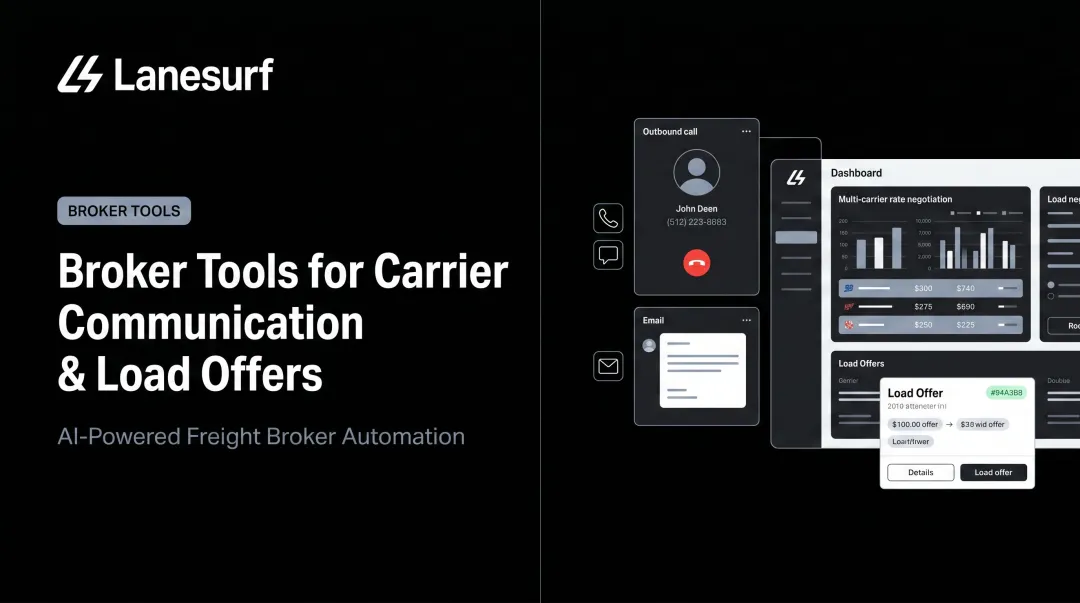
For brokerages handling significant shipment volumes, manually rate shopping every load — contacting carriers, entering data across portals, tracking quotes — consumes hours each day and introduces errors at every handoff. Platforms like LaneSurf address this directly by replacing that manual cycle with an AI carrier operations layer.
Rather than a rep spending hours on outbound carrier calls, LaneSurf's AI simultaneously contacts 10–50+ carriers per load via voice, email, and text — running parallel negotiations in real time and holding lane-specific pricing thresholds firm. The result: 8–10% better buy rates per load (per LaneSurf customer data), driven by eliminating the one-and-done rate acceptance that typically costs brokers margin.
When evaluating any freight automation platform, look for these capabilities in a single workflow:
- Multi-carrier integration — simultaneous outreach across your carrier database and load boards
- Real-time quote aggregation — normalized rate comparison across all channels (voice, email, text, load board)
- Automated carrier communication — 24/7 inbound and outbound coverage without rep intervention
- Load tracking and exception management — proactive delay detection and escalation
LaneSurf integrates with major TMS platforms — McLeod, MercuryGate, Tai, Turvo, Aljex, and Tailwind — with full integration completing in under 10 days. A fast-start option lets brokers submit an Excel file of current loads so the AI agent begins working immediately while integration completes. Book a demo at lanesurf.com.
Frequently Asked Questions
What factors determine LTL freight rates?
LTL rates are shaped by freight class (NMFC classification from 50–500), shipment weight and density, origin-destination lane, accessorial charges, and the current fuel surcharge based on the DOE/EIA weekly diesel index. These variables interact: a lightweight but bulky shipment on a rural lane with a liftgate requirement can cost significantly more than the base rate suggests.
How do you negotiate LTL freight rates?
Effective negotiation requires lane-level volume data, competitive rate comparisons on the same lanes, and a willingness to push beyond the linehaul rate — targeting accessorial caps and fuel surcharge indexing agreements. Carriers respond to predictability and specificity, not vague volume promises.
How do you choose an LTL freight carrier?
Match the carrier to the shipment: regional carriers typically outperform on short-haul lanes; nationals cover long-haul and coastal lanes more effectively. Before adding any carrier to your mix, evaluate on-time performance, claims ratio, transit time accuracy, and financial stability.
What is LTL rate shopping?
LTL rate shopping is the practice of comparing quotes from multiple carriers for a given shipment, evaluating price alongside transit time, service quality, and total landed cost including accessorials. Rate shopping based on base rate alone routinely produces the wrong carrier selection.
How many LTL carriers should a freight broker work with?
Most brokerages need a mix of national and regional carriers to ensure coverage across key lanes and a viable backup when embargoes or capacity crunches hit. The right number depends on your lane profile, but concentrating significant volume with one or two carriers is a real operational risk.