
Introduction
Freight brokers spend a disproportionate amount of their workday doing one thing: trying to reach carriers. Reps run 50–150 outbound calls per day — manually searching DAT or Truckstop, dialing one carrier at a time, waiting on callbacks, and still missing loads. At the brokerage level, phones ring 200–800 times daily, and after-hours calls go unanswered entirely.
That's not a workflow problem. That's a structural ceiling on how many loads a brokerage can cover.
That ceiling has a dollar value attached to it. The US freight brokerage market hit USD 16.58 billion in 2023 and is projected to reach USD 24.75 billion by 2028. The brokerages growing into that opportunity aren't hiring more reps — they're building smarter communication stacks.
This post breaks down the core tool categories brokers use to contact carriers and move load offers — from load boards and TMS platforms to AI voice agents — and what each one actually changes at the operational level.
Key Takeaways
- Load boards, TMS platforms, and digital freight matching each serve distinct functions — and combining all three outperforms relying on any single tool
- Strong load offers front-load all decision-relevant details to minimize back-and-forth
- Automated multi-channel outreach reaches more carriers per hour than sequential calling ever could
- AI handles first contact, check-calls, and routine follow-ups, freeing brokers to focus on relationships and escalations
- Integration capability is the most important factor when evaluating any new communication tool
Why Carrier Communication Remains a Bottleneck
The Manual Workflow Has a Hard Ceiling
Traditional carrier outreach follows a predictable, slow pattern: search a load board, build a call list by hand, dial carriers sequentially, hit voicemail, wait for callbacks, and repeat — often across 30–90 minutes per load. A rep running that cycle can only cover so many loads before the day runs out.
The broker who reaches a carrier with a credible offer first typically wins the booking. A sequential, manual workflow makes that nearly impossible — you're structurally slower than any brokerage running parallel outreach.
FreightWaves reported that only 2% of US brokerages have fully automated accounts payable, and 2% have fully automated accounts receivable — a signal that most are still running heavily manual back-office and outreach workflows. Brokerages that have introduced automation cite 46% fewer errors and 44% faster order-to-cash cycles.

Disconnected Tools Multiply the Problem
Most brokerage operations run across 5–8 disconnected tools — TMS, load board, email client, phone system, spreadsheet, and compliance portal — with 3–6 manual handoffs per load. Each handoff creates an opening for a missed follow-up, a data entry error, or duplicated work.
The fragmentation doesn't just slow brokers down — it obscures what's happening on any given load, making it harder to spot compliance gaps or flag a rate that's crept above threshold. That lack of visibility compounds on every load handled the same way.
Carrier Relationships Suffer Under Transactional Volume
Nearly 90% of carriers operate five trucks or fewer, and 66% are one-truck owner-operators. These carriers have choices about which brokers they work with. Brokers who communicate consistently — not just when they need capacity — earn preferred routing and better availability. High-volume, purely transactional outreach erodes that goodwill fast.
Core Tool Categories for Broker-Carrier Communication
Broker-carrier communication relies on an interconnected stack, and each tool serves a distinct function. Using them together — rather than in isolation — is what separates high-performing brokerages.
Load Boards
Load boards like DAT and Truckstop are typically the starting point for broker-carrier communication. DAT alone processes more than 291 million load and truck posts annually, with brokers posting more than 722,500 loads every business day. Truckstop has served 250,000+ active users across its 30-year history.
The core limitation: load boards require carriers to come to you. They're reactive by design, not proactive outreach tools.
That said, modern load boards have evolved. Today's platforms include:
- Lane history and pricing data
- Carrier ratings and company reviews
- Direct messaging features for first contact
- Real-time load availability and instant booking options
LaneSurf integrates directly with DAT One and Truckstop, using load board data to power automated carrier discovery. Instead of a rep manually building a call list from search results, the AI agent does it and immediately initiates parallel outreach.
Transportation Management Systems (TMS)
A TMS is the operational hub where brokers manage load details, carrier assignments, documentation, and billing. Armstrong & Associates characterized TMS as a baseline requirement for domestic transportation management — expected infrastructure, not a competitive edge on its own.
What separates modern TMS platforms from older ones is integration depth. The best systems now offer:
- Built-in carrier messaging and status update automation
- Load board and visibility tool integrations
- Settlement-ready handoff at load completion
- Full audit logs per booking
LaneSurf connects natively to McLeod LoadMaster/PowerBroker, MercuryGate, Tai Software, Turvo, Revenova, Aljex, and Tailwind TMS. The integration pulls load context directly from the TMS, then pushes booked-load handoffs, status updates, and settlement-ready records back in — with full integration completing in under 10 days.
Digital Freight Matching Platforms
Digital freight matching (DFM) uses algorithms to automatically pair available loads with carriers based on lane, equipment type, location, and carrier history. DAT defines it as software that helps brokers connect with carriers using capacity specifics, location, and truck type as matching criteria.
DFM reduces the number of manual calls required per load by surfacing pre-qualified carriers before a broker even picks up the phone. Predictive matching takes it further: it identifies carriers likely to be available in a future time window, giving brokers a head start on coverage before competitors begin searching.
The global digital freight matching market was valued at $47.2 billion in 2024 and is projected to reach $247.6 billion by 2030. For brokers, that growth signals a shift in competitive baseline — DFM is moving from advantage to expectation.
How to Send Load Offers That Get Responses
What a Strong Load Offer Actually Looks Like
Most carriers dismiss a load offer quickly — not because the rate is wrong, but because the information is incomplete. A well-structured offer eliminates friction at the carrier's decision point.
A load offer that gets responses includes:
- Clear rate — no ambiguity about all-in versus linehaul
- Origin and destination — with city, state, and ZIP
- Pickup window — specific time range, not just a date
- Equipment requirements — including any specialty (flatbed, reefer, temp range)
- Special instructions — hazmat, team-driver requirements, dock restrictions

Front-loading this information cuts back-and-forth and makes it easy for a carrier to say yes — or quickly pass without a phone tag loop.
Automated Load Offer Distribution Changes the Math
Calling carriers one at a time is a volume problem as much as a time problem. When your outreach is sequential, you're competing against brokerages using parallel distribution.
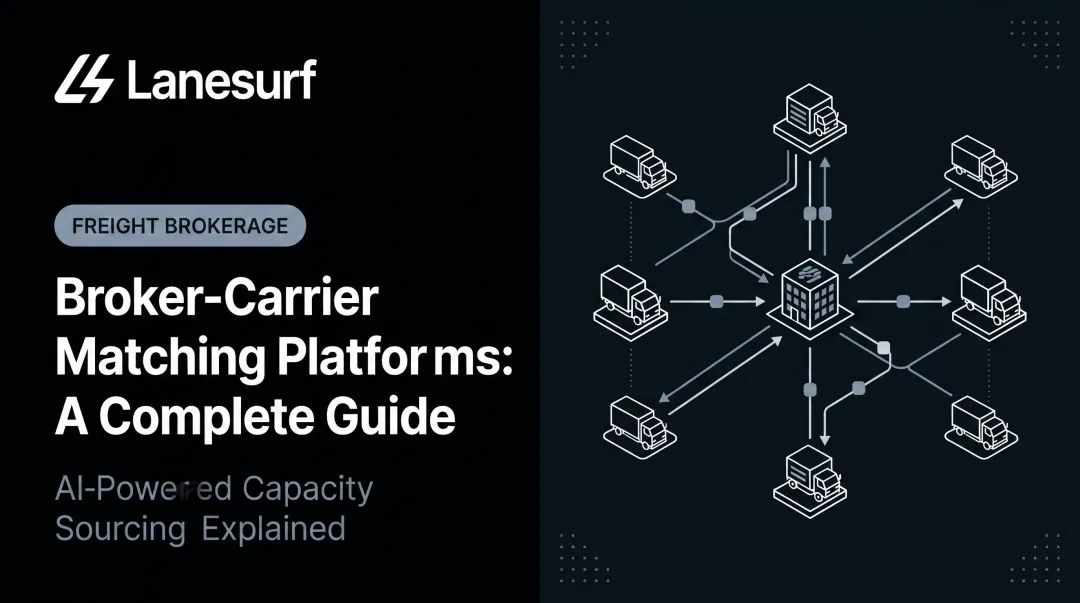
LaneSurf's AI Carrier Sales Agent simultaneously contacts 10–50+ carriers per load across voice, email, and text — at the same time, not in sequence. That parallel approach means:
- More carriers receive the offer before it goes cold
- Quote collection happens across all channels simultaneously
- Best-rate selection is based on real competitive data, not the first callback
Per LaneSurf customer data, this approach delivers 60–80% of loads booked with AI-sourced capacity and 8–10% better buy rates per load. Those buy-rate gains come from parallel negotiation holding lane-specific pricing thresholds firm — not from accepting the first quote that comes back.
Compliance Pre-Qualification Before the Offer Goes Out
Distributing to more carriers simultaneously only works if those carriers are pre-vetted. Sending load offers to non-compliant carriers wastes time and creates booking risk.
LaneSurf runs automated MC vetting, COI verification, authority status checks, and safety score evaluation before any carrier is engaged. It integrates with RMIS, MyCarrierPortal, Highway, Carrier Assure, and Saferwatch, and every booking generates a full audit log.
That compliance layer is part of what enables LaneSurf's 10-minute end-to-end booking cycle. By collapsing sourcing, quoting, negotiation, vetting, and booking execution into one automated pipeline, the process that typically takes a rep 30–90 minutes runs in a fraction of the time.
AI-Powered Tools That Automate Carrier Outreach
How AI Carrier Call Automation Works in Practice
Transport Topics reported in 2026 that TMS vendors are deploying AI voice agents that automate outbound carrier calls for backhaul outreach, handle track-and-trace check-calls around the clock, and sync conversation summaries directly into the TMS in real time — eliminating the manual logging step entirely.
The broader logistics impact is measurable. McKinsey found that one transportation company automated 60% of check calls, 73% of order acceptances, and processed 2 million quotes via AI agents — saving tens of thousands of labor hours. A separate company achieved a 40%+ productivity boost since deploying an AI-enabled supply chain platform.
LaneSurf's Approach: Full Carrier Communication Lifecycle
Those outcomes point to a specific gap: the carrier communication layer itself. LaneSurf is built to close that gap for freight brokerages and 3PLs. Its AI Carrier Sales Agent covers the full outreach cycle:
- Dials carriers across your database and live load board results simultaneously on first contact
- Answers every inbound carrier call instantly — including after hours and weekends, with no voicemail
- Holds firm on lane-specific pricing parameters, actively negotiating rather than just collecting quotes
- Runs compliance checks at point of contact before any booking is confirmed
- Contacts drivers for ETA updates and delay detection via automated check-calls
- Logs every interaction and pushes booked loads back into your TMS automatically

AI handles first contact, routine follow-ups, check-calls, and within-threshold negotiations. When edge cases appear — team-driver requirements, a missing COI, rates outside defined parameters — the system auto-escalates to a human broker with full context already populated.
That escalation boundary is where the time savings compound. Per LaneSurf customer data: 4+ hours saved per rep per day, with reps redirected away from repetitive call volume toward negotiation escalations and exception handling.
What to Look for When Evaluating Broker Communication Tools
Plenty of tools promise to improve carrier communication. Few of them actually reduce manual work. These three criteria help you tell the difference before you commit.
Integration Capability First
The 2025 NTT DATA/CSCMP Third-Party Logistics Study identified integration with existing systems as the top barrier to AI adoption, cited by 28% of respondents — ahead of skills gaps and cost concerns. A tool that doesn't connect to your TMS, load boards, and compliance portals doesn't reduce manual work. It adds a separate workflow your team still has to manage manually.
Evaluate any platform against your existing stack:
- Does it integrate with your specific TMS (not just "a TMS")?
- Does it pull data from your load boards and push results back automatically?
- Does it connect to your compliance providers so vetting happens automatically at booking?
LaneSurf's integration stack covers:
- TMS platforms: McLeod, MercuryGate, Tai, Turvo, Revenova, Aljex, Tailwind
- Load boards: DAT, Truckstop
- Compliance portals: RMIS, MyCarrierPortal, Highway, Carrier Assure
- ERP systems: NetSuite, SAP, Microsoft Dynamics 365, Oracle
- EDI message flows: 204, 990, 214, 210, 997

Carrier Adoption and Friction
The best carrier-facing tools are the ones carriers actually use. A Truckstop survey of 500+ carriers found 70% of drivers — and 79% of drivers under 35 — are comfortable with new technology. That's a good sign for platform adoption, but friction still kills it in practice.
Look for platforms with:
- High network adoption among carriers in your lanes
- Mobile-friendly interfaces for drivers and dispatchers
- Low-friction engagement (no lengthy registration, no app required on the carrier side)
Once you've confirmed carriers will actually use the tool, the next question is how fast your operation can put it to work.
Scalability and Deployment Speed
The right tool should handle your current load volume and grow with your brokerage — without a six-month implementation that delays ROI.
LaneSurf offers onboarding in under 48 hours via an Excel-of-loads fast-start: send your current load file and the AI agent begins working real loads immediately while TMS integration completes in the background (under 10 days). The platform operates on a subscription SaaS model, with per-seat and per-rep pricing configurations available directly from LaneSurf.
For brokerages handling sensitive shipper and carrier data, security matters as much as speed. LaneSurf includes AES-256 encryption at rest, TLS 1.2+ in transit, MFA, role-based permissions, and SOC-2 Type II certification currently in review.
Frequently Asked Questions
What software do freight brokers use?
The core stack includes a TMS for operational management, load boards (DAT, Truckstop) for freight posting and carrier discovery, digital freight matching platforms for capacity sourcing, and increasingly AI-powered communication tools for automating carrier outreach. LaneSurf operates as a complementary automation layer on top of existing TMS and load board tools — not a replacement for them.
How do brokers get their loads?
Brokers source loads primarily through shipper relationships, contracts, and RFP processes. Once a load is in hand, digital freight matching and automated outreach tools help them find and book carriers quickly — which is where the competitive pressure on coverage speed is highest.
How do carriers negotiate with brokers?
Carriers can negotiate more effectively by presenting lane history, on-time performance data, and competitive rates. Brokers use market rate benchmarks and compliance data within their TMS and matching tools to evaluate and counter offers. Whichever side walks in with better data typically controls the outcome.
What is digital freight matching?
Digital freight matching uses algorithms to pair a broker's available loads with suitable carriers based on location, equipment type, lane preference, and performance history. It reduces manual calling by presenting pre-qualified carrier options automatically — no sequential searching or cold dialing required.
How does AI help freight brokers communicate with carriers?
AI tools like LaneSurf automate outbound carrier calls, send load offer notifications across voice, email, and text simultaneously, handle routine check-ins, and log all communication back to the broker's TMS. That frees brokers to focus on relationship-building, escalations, and the complex negotiations where human judgment actually counts.