
The stakes are real. According to TIA's 2024 framework on freight fraud, freight fraud and double brokering cost victims an estimated $500 million to $700 million in freight payments annually. A structured onboarding process is the first and most practical line of defense.
This guide covers everything brokers need: what carrier onboarding actually involves, which documents to collect, common friction points, and the practices that separate high-performing brokerages from reactive ones.
Key Takeaways
- Every carrier must be verified, approved, and fully integrated before they move a single load — skipping steps creates liability
- Document collection, compliance verification, and payment setup form the three pillars of a defensible onboarding process
- A structured process directly guards against fraud, double brokering, and compliance drift
- Automation reduces onboarding from hours to minutes—without adding headcount
- Continuous monitoring post-onboarding is just as important as the initial vetting
What Is Carrier Onboarding?
Carrier onboarding is the formal process of verifying, approving, and integrating a new carrier into a broker's network. It covers everything from confirming operating authority and insurance to collecting signed agreements, setting up payment terms, and creating the carrier profile in your TMS. Finding a carrier on DAT or Truckstop is discovery. Onboarding is the compliance and operational bridge between that discovery and actually tendering a load.
It's also distinct from ongoing carrier monitoring. Onboarding is the entry checkpoint — a one-time gate a carrier must pass before you tender them freight. Monitoring picks up from there, tracking whether that carrier stays compliant, maintains safety ratings, and keeps valid insurance over time. Confusing the two is how compliance gaps develop.
For freight brokers, the accountability is direct. Shippers don't distinguish between "the carrier failed" and "the broker's carrier failed" — the broker owns the outcome either way. Any gap in vetting creates both reputational risk and real legal exposure. That's why onboarding carries higher stakes for brokers than for shippers or 3PLs managing their own assets.
Why Carrier Onboarding Matters
Fraud Is Getting More Sophisticated
FreightWaves reported CargoNet data showing strategic cargo theft—which includes carrier identity theft, double brokering, and fictitious pickups—grew 430% year-over-year in Q3 2023. These are organized schemes where fraudulent parties impersonate legitimate carriers using stolen MC numbers or spoofed domains—not random, opportunistic events.
TIA also identifies specific red flags brokers should watch for during onboarding:
- Recently activated operating authority
- Multiple address changes in a short period
- P.O. boxes or virtual office addresses
- Gmail accounts used for business communications
- Spoofed domains mimicking legitimate carriers
- Fraudulent factoring notices of assignment

A manual review process rarely catches sophisticated versions of these schemes. Systematic verification—at both the company and dispatcher level—is the only reliable defense.
Shippers Are Watching
Shippers hire brokers precisely to manage carrier risk. A broker who demonstrates a rigorous, consistent onboarding standard builds credibility and earns repeat business. Poor onboarding exposes the broker to cargo claims, chargebacks, and lost accounts—and shippers notice. How you vet carriers signals how seriously you take the responsibility they've handed you.
Scale Demands Process
As load volume grows, so does the carrier roster. Without a documented, repeatable onboarding workflow, growth creates operational chaos—reps chasing documents, inconsistent vetting standards, duplicated effort, and no audit trail if something goes wrong. A well-structured process turns onboarding into a repeatable workflow rather than a recurring bottleneck.
Essential Documents and Compliance Requirements
Every carrier onboarding packet should include the following:
Operating Authority (FMCSA/SAFER Verification)
Brokers must confirm the carrier holds active Motor Carrier (MC) authority issued by the FMCSA. Cross-reference this on the FMCSA's SAFER system. Expired or revoked authority is an immediate disqualifier—and a common fraud vector where bad actors present credentials from a legitimate carrier they've impersonated.
Certificate of Insurance
Collect a Certificate of Insurance showing active auto liability and cargo coverage. Per federal regulation (49 CFR 387.9), the minimum financial responsibility for nonhazardous property carriers with a GVWR over 10,001 lbs is $750,000. However, TIA's model broker-carrier agreement sets higher thresholds that many brokers adopt as their standard:
- $1,000,000 auto/motor vehicle liability
- $100,000 cargo coverage
- $1,000,000 general liability
Brokers should be listed as certificate holders on the COI so they receive direct notification of cancellations or changes.
CSA Scores and Safety Record
Use the FMCSA's Safety Measurement System (SMS) to review a carrier's CSA scores across BASICs. Higher percentiles indicate worse safety performance. The five BASIC categories to check:
- Unsafe Driving
- Hours-of-Service Compliance
- Vehicle Maintenance
- Crash Indicator
- Controlled Substances/Alcohol
FMCSA's published intervention thresholds—65% for Unsafe Driving and HOS Compliance for general property carriers—are a useful starting reference. Most brokerages set their own internal thresholds below these levels.

Signed Broker-Carrier Agreement
The carrier agreement establishes terms of service, payment timelines, liability allocation, and load acceptance procedures. Electronic signatures keep this step fully paperless and should not add any delay to the onboarding timeline.
W-9 and Secure Payment Setup
A completed W-9 is required for tax purposes. Handle banking and payment details through secure, encrypted systems only. ACH fraud is a documented and increasing threat: bad actors intercept payment redirect requests to divert remittances to accounts they control. Never store or transmit carrier banking information through unsecured email.
TIA Watchdog and Industry Blacklists
TIA Watchdog is a member-based reporting system where brokers can flag carriers with known fraud history or double-brokering incidents. Cross-referencing new carriers against this database provides a useful check, particularly for carriers with recently activated authority or any of the red flags listed above.
Common Pain Points in Carrier Onboarding
Manual, Paper-Based Processes
Traditional onboarding—faxed forms, emailed PDFs, manual TMS data entry—creates predictable bottlenecks. Documents get lost. Data gets entered incorrectly. Reps spend hours per carrier on administrative follow-up rather than building relationships or covering loads. According to Truckstop, their RMIS Carrier Onboarding allows brokers to vet and hire carriers 80% faster than manual processes (vendor-stated benchmark; public methodology not disclosed).
Fraud and Identity Verification Gaps
Without systematic identity verification, brokers are exposed to impersonation schemes. A fraudulent party can present a stolen MC number, use a spoofed domain, and pass a surface-level manual review. The manual process was never designed to catch sophisticated fraud, and the organized groups running double-brokering schemes exploit that gap deliberately.
Compliance Drift After Onboarding
This is the most underappreciated risk in carrier management. A carrier passes onboarding with flying colors: valid authority, clean insurance, solid CSA scores.
Six months later, things change. Common post-onboarding compliance failures include:
- Insurance lapses without broker notification
- Operating authority revoked or suspended
- Safety ratings dropping below acceptable thresholds
- Carrier name or MC number transferred through a sale
Without continuous monitoring, brokers have no visibility into any of these changes until something goes wrong on an active load.

FMCSA's insurance cancellation process provides a 33-day window after the agency receives cancellation notification before it acts. That window offers no protection to a broker who never knew the coverage changed in the first place.
Best Practices to Streamline Your Carrier Onboarding Process
Best Practices to Tighten Your Carrier Onboarding Process
Standardize Your Onboarding Packet
Build a defined carrier packet—a required document list, forms, and agreements every carrier completes before receiving a load. A checklist removes ambiguity for both your team and the carrier, and creates an auditable record for dispute resolution. No exceptions, no workarounds.
Integrate Onboarding with Your TMS
When carrier onboarding flows directly into your TMS, you eliminate redundant data entry and ensure carrier records are current across all active loads from day one. LaneSurf completes the full onboarding cycle—document collection, MC vetting, COI verification, and TMS profile setup—automatically, reducing onboarding time from hours to minutes per carrier.
Integrating onboarding with a secure payment platform means your team never stores sensitive banking information internally, which directly reduces ACH fraud exposure.
Implement Continuous Carrier Monitoring
Treat monitoring as the second half of onboarding, not an optional add-on. Automated tools can track insurance expiration dates, authority status, and CSA score changes—alerting your team when a carrier's credentials change so you're not discovering problems at the point of dispatch.
LaneSurf's compliance vetting runs before every booking, not just at initial onboarding. Because every carrier is re-vetted each time they're assigned a load, insurance lapses and authority changes surface automatically before a load is confirmed rather than after.
Set Clear Expectations from Day One
Document performance expectations in the carrier agreement at onboarding:
- On-time delivery targets
- Check-call requirements and frequency
- Claims procedures and notification timelines
- Communication protocols and escalation paths
Written benchmarks reduce disputes and give brokers measurable criteria for evaluating carrier relationships over time.
Use AI and Automation to Remove Manual Work
Modern onboarding platforms automate document collection, flag credential inconsistencies, and push completed carrier profiles into a TMS without manual intervention. LaneSurf takes this further: its AI handles routine carrier communications across voice, email, and text simultaneously—covering outbound sourcing calls, capacity confirmation, and document follow-up.
For growing brokerages, this means the carrier network can expand without proportionally growing headcount.
How AI Is Transforming Carrier Onboarding
The shift from manual to automated onboarding is no longer a future trend—it's happening now. AI-powered platforms can pull compliance data from integrated carrier portals, verify carrier identity in real time, trigger document requests, and push completed carrier profiles into a TMS without a rep touching the process.
LaneSurf integrates with leading compliance portals so vetting runs against the same data sources brokerages already trust:
- RMIS
- MyCarrierPortal
- Highway
- Carrier Assure
- Saferwatch
When a carrier fails any check, the system auto-flags the exception and routes it to a human team member with full context. Every action is logged in an audit trail per carrier.
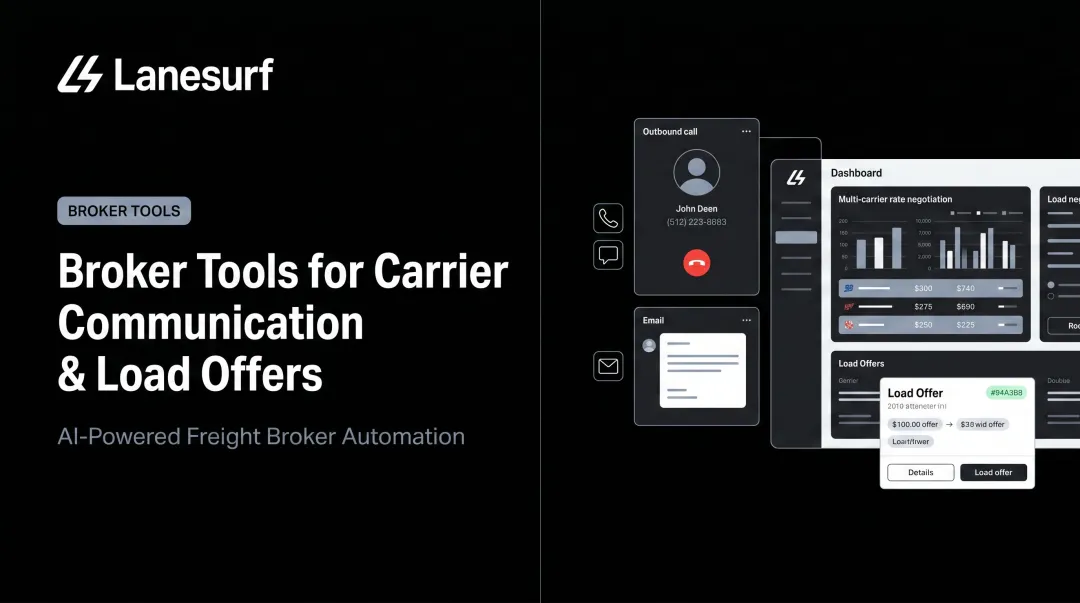
Beyond onboarding paperwork, AI is extending into carrier communication and relationship management. LaneSurf's AI Carrier Sales Agent contacts carriers via parallel voice, email, and text—running multi-carrier rate negotiations simultaneously, handling inbound carrier calls 24/7, and managing check calls post-booking. The result: the source-quote-negotiate-vet-book cycle completes in under 10 minutes per load, compared to 30–90 minutes manually.

For mid-market and enterprise brokerages, this translates directly to faster carrier activation, shorter gaps in capacity coverage, and compliance maintained without additional oversight headcount. Brokerages running these workflows close capacity faster than competitors still working the phones — and shippers notice.
Frequently Asked Questions
What is carrier onboarding?
Carrier onboarding is the process freight brokers use to verify, approve, and integrate new carriers into their logistics network. It ensures every carrier meets legal, safety, and operational standards before being tendered any freight.
What are the 5 C's of carrier onboarding?
The five core pillars brokers commonly apply are:
- Credentials — operating authority and licenses
- Compliance — safety ratings and regulatory requirements
- Coverage — insurance verification
- Contract — signed broker-carrier agreement
- Communication — payment setup and operational protocols
The five core pillars brokers commonly apply are:
- Credentials — operating authority and licenses
- Compliance — safety ratings and regulatory requirements
- Coverage — insurance verification
- Contract — signed broker-carrier agreement
- Communication — payment setup and operational protocols
What is TMS software for carriers?
A Transportation Management System (TMS) is software that manages freight operations—including carrier onboarding, load assignment, tracking, and invoicing. For brokers, a TMS that integrates with onboarding automation eliminates duplicate data entry and keeps carrier records current across all active loads without re-entering data manually.
What documents should brokers collect during carrier onboarding?
Core documents include: FMCSA operating authority confirmation, Certificate of Insurance (auto liability and cargo), signed broker-carrier agreement, W-9 form, and secure banking/payment details. CSA score reviews and TIA Watchdog cross-referencing complete the vetting picture.
How can brokers prevent carrier fraud during onboarding?
Verify carrier identity directly through FMCSA's SAFER system, cross-reference against the TIA Watchdog database, and confirm dispatcher identity at both the company and individual level. Automated onboarding platforms that flag credential inconsistencies in real time catch gaps that manual review routinely misses.
How does automation improve carrier onboarding?
Automation eliminates manual document collection, accelerates compliance verification, reduces data entry errors, and enables continuous monitoring post-onboarding. Brokers can onboard new carriers significantly faster and at greater scale—without adding administrative staff or creating compliance gaps.