
Manual reconciliation doesn't scale. As carrier rate complexity grows and invoice volumes climb, freight brokerages and logistics companies need software that automates both audit and payment workflows — and connects directly with their existing TMS.
This post breaks down the best freight audit and payment software with TMS integration, what to look for when evaluating platforms, and how to find the right fit for your operation.
Key Takeaways
- Freight invoice error rates run 15–25% — automated auditing catches what manual spot-checks miss
- TMS integration enables real-time invoice matching against shipment data, contracted rates, and delivery records
- Top FAP platforms include Loop, Pando.ai, nVision Global, FreightPOP, and Cass Information Systems
- The best tools combine native or API-based TMS connectors with AI-powered matching — look for platforms where exception workflows are automated, not manual
- Choosing the right platform means prioritizing integration depth and automation rate above all else
What Is Freight Audit & Payment Software with TMS Integration?
Freight audit and payment (FAP) software is a digital platform that automatically verifies carrier invoices against contracted rates, shipment records, and delivery confirmations before releasing payment. It replaces the manual reconciliation workflow — where AP teams cross-reference documents by hand, often catching only a fraction of billing errors.
Gartner describes FAP services as covering invoice collection, pre-audit, processing, payment, and analytics of transportation invoices. In practice, that means the software ingests an invoice, checks it against your rate tables and shipment records, flags discrepancies, routes exceptions for review, and approves clean invoices for payment — without anyone manually touching the document.
Where TMS Integration Changes the Equation
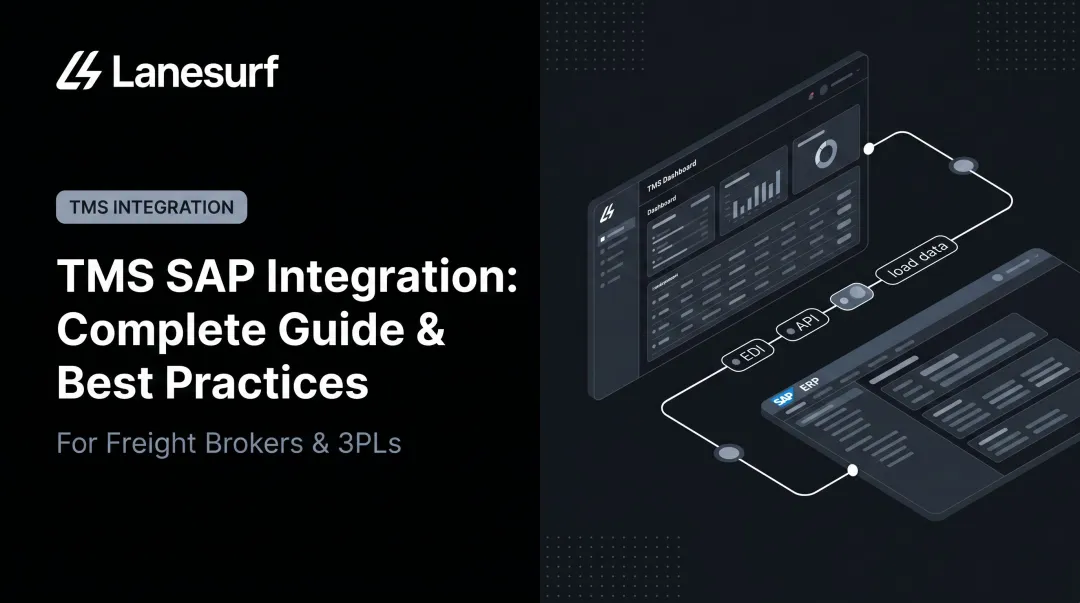
When FAP software connects to a Transportation Management System, it pulls real-time shipment data directly: rates, routes, delivery status, and accessorial charges. That connection enables automated three-way or four-way invoice matching — comparing the invoice against the PO, the contracted rate, and the proof of delivery at the same time.
For freight brokerages managing dozens of carriers across multiple lanes, the difference is significant. FAP platforms without TMS connectivity depend on manually uploaded files or batch transfers, which introduces lag and data gaps. A live TMS connection closes that gap:
- Invoice validation runs in real time against current shipment records
- Exception rates drop because data is always current, not periodically synced
- Accessorial charges get verified automatically rather than flagged for manual review

The platforms below represent the top FAP platforms currently available in the U.S. market, evaluated specifically on TMS integration depth, audit automation capability, and brokerage-relevant features.
Best Freight Audit & Payment Software with TMS Integration
Each platform below was evaluated on TMS integration quality, audit automation depth, payment processing flexibility, and fit for freight brokerages and logistics companies in the U.S. Selection criteria included:
- Ability to connect with major TMS and ERP platforms via API or EDI
- Automation rate for invoice auditing and exception handling
- Payment processing flexibility (direct, bank-backed, or AP-integrated)
- Suitability for mid-size to enterprise freight operations
Loop
Loop is a SaaS-based logistics AI platform founded in 2021 and headquartered in Chicago, IL. It automates freight and parcel invoice auditing, enriches data from TMS and ERP systems, and is purpose-built for shippers and 3PLs managing high invoice volumes.
Its core differentiator is logistics-specific AI that extracts data from virtually any document format — PDF, CSV, EDI, API, or email — and auto-validates rates against SMC3 tariffs. Loop claims it can automate up to 99% of freight and parcel audits (a vendor-published figure), with root-cause explainability for every discrepancy flagged rather than just flagging an error code.
| Category | Details |
|---|---|
| Key Features | AI-powered invoice matching, GL cost allocation, accessorial auditing, ERP/TMS data enrichment, self-serve analytics |
| TMS Integration | API and EDI integrations with leading TMS and ERP platforms; enriches TMS shipment data to enable audit-grade rate validation |
| Best Suited For | Mid-to-large shippers and 3PLs in North America managing high volumes of parcel, LTL, and TL invoices |
Pando.ai
Pando.ai is an AI-first fulfillment platform positioned for global manufacturers, retailers, and distributors. Its FAP module automates four-way matching across purchase orders, shipment records, delivery confirmations, and carrier invoices — with configurable tolerance levels that allow clean invoices to process without human review.
Beyond audit accuracy, Pando's differentiators are in financial intelligence: predictive analytics for freight spend, AI agents that flag discrepancies before payment cycles close, and strategic cost insights that feed into carrier negotiations and budgeting. Its 2025 "Pi" platform extends these capabilities to autonomous invoice execution across modes, services, and currencies.
| Category | Details |
|---|---|
| Key Features | Four-way invoice matching, predictive spend analytics, automated accruals, global payment processing, AI anomaly and duplicate detection |
| TMS Integration | API-based connections with TMS and ERP systems to pull shipment and rate data for real-time invoice validation |
| Best Suited For | Enterprise shippers and global logistics operators requiring multi-carrier, multi-lane spend visibility with AI-driven insights |
nVision Global
nVision Global, founded in 1992 and headquartered in McDonough, GA, is an AI-powered freight audit platform with operations across 190+ countries. It automates invoice auditing, rate validation, and exception handling across all transportation modes, with TMS and ERP integration built into its Impact TMS platform.
nVision's differentiator is operational depth at global scale: multilingual support, multicurrency billing audit capabilities, and over 200 audit points per invoice. For logistics operations with cross-border freight flows and complex rate structures, few FAP platforms match its native infrastructure for handling that complexity.
| Category | Details |
|---|---|
| Key Features | AI-powered rate validation, multi-modal audit, 200+ audit points, exception management, multilingual support, real-time analytics |
| TMS Integration | EDI and API-based data exchange with TMS and ERP environments; freight audit built into Impact TMS natively |
| Best Suited For | Large enterprises and 3PLs with international freight requiring multi-currency, multi-mode audit at scale |

FreightPOP
FreightPOP is a cloud-based TMS that bundles freight audit and payment functionality directly within its transportation management platform, eliminating the need for a separate integration layer. It automates invoice-to-quote comparisons, flags discrepancies, and connects with ERP systems (including NetSuite and SAP) for payment processing across LTL, TL, parcel, air, ocean, and drayage.
The combined TMS-plus-FAP model is its clearest differentiator. For mid-size brokerages and shippers that don't want to manage two separate vendor relationships, FreightPOP delivers both functions in one system with a faster onboarding path than most enterprise-grade platforms.
| Category | Details |
|---|---|
| Key Features | Native quote-to-invoice auditing, EDI and API connectivity, ERP integration for payment processing, multi-modal support, discrepancy flagging |
| TMS Integration | FAP is native to the FreightPOP TMS platform; ERP integrations handle AP payment processing without leaving the system |
| Best Suited For | Mid-size freight brokerages and shippers seeking a combined TMS and audit platform without the overhead of separate systems |
Cass Information Systems (CassPort®)
Cass Information Systems, founded in 1906 and headquartered in St. Louis, MO, is unique in FAP for one reason: it operates its own bank. Cass Commercial Bank, a wholly owned subsidiary, executes carrier payments directly. That banking infrastructure gives Cass capabilities no pure-software vendor can match: working capital solutions, early payment discount programs, and local-currency payments from a single master currency account.
CassPort®, introduced in 2004, provides detailed invoice auditing, parcel spend management, GL coding, cost allocation, and business intelligence dashboards. Cass normalizes invoice data from multiple TMS platforms and disparate systems, making it particularly effective for large enterprises managing complex multi-TMS environments.
| Category | Details |
|---|---|
| Key Features | Multi-modal invoice audit, GL coding and cost allocation, parcel spend management, BI dashboards, bank-backed payment execution |
| TMS Integration | Connects with multiple TMS and ERP platforms to normalize shipment data across disparate systems; supports EDI and API data ingestion |
| Best Suited For | Large enterprise shippers and complex supply chains with multi-TMS environments needing a managed service combining software, payment infrastructure, and expert oversight |
How We Chose the Best Freight Audit & Payment Software
The most common mistake buyers make is prioritizing cost or name recognition over integration depth — then discovering months later that their FAP platform requires manual data uploads or doesn't connect cleanly with their TMS. At that point, teams are doing manually exactly what the software was supposed to handle.
These are the criteria that actually determine whether a FAP platform delivers on its promise:
- TMS integration depth — Can the platform match invoices against live shipment and rate data, or does it just store invoices? Native or API-based connectors matter more than checkbox compatibility claims.
- Audit automation rate — What percentage of invoices process without human intervention? A high touchless rate reduces labor cost and speeds payment cycles.
- Exception management — How does the platform handle discrepancies? Structured exception workflows — routing, escalation, resolution tracking — prevent disputed invoices from stalling payment.
- Payment flexibility — Does the platform support ACH, EDI, and multi-currency? Bank-backed options add working capital and early payment capabilities.
- Spend analytics and GL cost allocation — Invoice data is only valuable if it's organized by lane, carrier, mode, and cost center. Strong BI output feeds smarter contract negotiations.
- Scalability — A platform handling 500 invoices per month may struggle at 5,000. Evaluate the platform against your projected volume, not just current volume.

The platforms reviewed below were evaluated against each of these criteria — not just feature checklists.
Conclusion
The right freight audit and payment platform does more than process invoices. It protects margins by catching overcharges before they're paid, strengthens carrier relationships through accurate settlements, and gives logistics leaders the spend visibility needed to negotiate smarter contracts.
When evaluating options, don't just assess current feature fit. Consider TMS integration depth, audit automation rate, and whether the platform can handle exception volume as your freight operation scales. The tool that works at 500 invoices a month may buckle at 5,000.
For freight brokerages looking to automate beyond billing, LaneSurf addresses the operational layer that FAP software doesn't touch. While your FAP platform audits invoices and processes carrier payments, LaneSurf handles what happens upstream: sourcing capacity, negotiating rates, vetting carriers, booking loads, and tracking shipments — around the clock, without adding headcount.
Customers report measurable results from day one:
- 60–80% of loads booked with AI-sourced capacity
- 8–10% better buy rates per load
- 4+ hours of manual effort saved per rep per day
LaneSurf integrates natively with McLeod, MercuryGate, Tai, Turvo, Revenova, Aljex, and Tailwind TMS — the same environments most FAP evaluations are built around. Onboarding takes under 48 hours, with full TMS integration in under 10 days. See a live demo at lanesurf.com or get started at app.lanesurf.com/auth/signup.
Frequently Asked Questions
What is the freight audit and payment process?
The freight audit and payment process involves verifying carrier invoices against contracted rates, shipment records, and delivery confirmations before approving payment. Steps include invoice receipt, rate validation, discrepancy identification, exception resolution, and payment execution. This replaces manual document review with an automated, rules-driven workflow.
How does a TMS improve freight audit processes?
A TMS provides real-time shipment data — rates, routes, delivery status, accessorial charges — that FAP software uses to automatically cross-reference carrier invoices. This enables automated audits without manual data entry and supports three-way or four-way matching that catches errors that would otherwise require manual follow-up across systems.
What is the difference between freight audit software and a TMS freight audit module?
Standalone FAP software is purpose-built for audit-grade rate validation, GL coding, and payment execution. TMS audit modules are typically designed around shipment planning and often lack the rate table depth, exception management workflows, and payment processing capabilities needed for financially accurate auditing at scale.
What types of billing errors can freight audit and payment software detect?
Common errors include duplicate invoices, incorrect linehaul or accessorial rates, missing negotiated discounts, unauthorized charges, and mismatches between invoiced and contracted amounts. AI-powered platforms flag these in real time before payment is released, rather than catching them in post-payment audits.
Can freight audit and payment software work without a TMS?
Most FAP platforms can operate independently by ingesting invoice and shipment data via EDI, API, or CSV file uploads. However, TMS integration significantly improves accuracy and automation rates by enabling real-time data cross-referencing rather than relying on manually uploaded or batch-transferred files.
How long does it take to implement freight audit and payment software?
Implementation timelines vary by platform and complexity. All-in-one cloud platforms like FreightPOP can onboard within weeks. Enterprise platforms with deep TMS and ERP integrations typically require more configuration time depending on data sources, carrier volume, and custom rule setup.